Retrospective: Command & Conquer - The Tiberian Saga
The land of Nod.
"I remember the day I picked up the newspaper after the War on Terror got underway, and saw the Global Defence Initiative labelled in the news," says Louis Castle, co-founder of Westwood Studios, the developer that created Command & Conquer. He laughs, leaning back on his chair in the EA LA meeting room where a handful of series vets have converged to look back over the landmark RTS series. "That was in 2003. So, it only took the real world eight years to get there."
As for Castle's team, they'd founded their own GDI back in 1995, but, despite the rousing name and the militaristic fetishes of the series - the colourful explosions, heroic tank rushes, and glinting piles of heavy armour - the story at the heart of Command & Conquer has always been uniquely ambiguous, rejecting easier answers about right and wrong, and using its opposing factions - the GDI and the Brotherhood of Nod - to explore conflicting perspectives on a single issue.
In the words of the current 'lore master' and campaign and story lead, Sam Bass: "It's about philosophical differences acted out through military action." So, with the Tiberian story arc coming to an end in the upcoming fourth instalment, previewed on Eurogamer tomorrow, it's time to take a trip back through the world of C&C: time for a refresher course on the story itself, and time to steal a quick glance at the ways the game has shaped RTS development in general.
Command & Conquer: Tiberian Dawn (1995)
"With Tiberian Dawn, one of the greatest innovations wasn't just that it was real time, but that we were going to dedicate a lot of time and energy to story," suggests Castle. "That's what separates the best RTSs: the complexity and the depth. Without the context of what you're doing, games can lack that connectivity. They can lack that epic nature."
By 1995, Westwood had already experimented with narrative elements in its last game, Dune II, the title that helped establish the RTS genre in the first place, and which broke up its action with tiny story vignettes. Tiberian Dawn may have used a modified version of Dune II's interface, but it would prove far more ambitious when it came to the plot. "With Tiberian Dawn, we had CD-ROMs, and we suddenly had all this data," laughs Castle. "What were we going to do with it? We decided we were going to do full-screen movies."
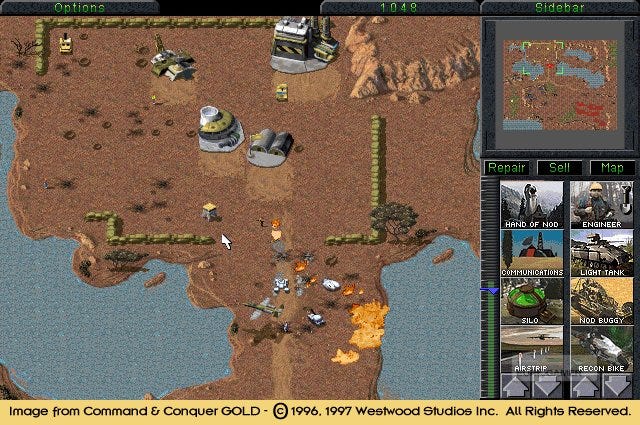
Less colourful than its little sister Red Alert, Tiberian Dawn still retains flashes of stoical beauty.
Enter full-motion video, the campy, charmingly primitive live-action film clips that broke up campaign missions and would quickly help define the series. The unintentional effect may have been humorous, but the story the FMVs helped relate was entirely serious, revolving around the geopolitical aftershocks of a meteor impact in the Tiber river in 1995, which introduces the Earth to an extra-terrestrial crystal, named Tiberium. "The hinge of the C&C universe is the sudden appearance of this strange mineral," says Castle. "It's a crystal that leeches all the great minerals and metals from the area around it, and brings it up into this crystal where it can be easily harvested. Once this starts appearing around the world, scientists realise they can break it down: it becomes an instant source of wealth and energy. Some scientists say it's a wonderful thing, and others are very concerned."
And how. With governments seeking to control the use of Tiberium, a charismatic underground leader named Kane soon emerges from the fringes, creating the cultish Brotherhood of Nod. They may sound like a consortium of those city trader types who like to dress up in romper suits and sleep in cots, but they're actually a kind of militarised pressure group. "Kane urges people everywhere to cultivate Tiberium themselves," continues Castle. "He wants to make the world an even playing field - he wants equality, and takes the side of the individual. Of course, he's labelled a terrorist leader by the western world for leading people against their governments."
In response to Kane, the authorities create the Global Defence Initiative. "Being in the west, we see these as the heroic force that's going to defend us against Kane's terrorists. But it's really important to remember that, since the beginning, Kane doesn't see himself as a terrorist, but as a liberator," says Castle. "And the GDI don't see themselves as a heavy-handed militaristic government, but as defender. That sets up a really great stage for epic conflict. Kane: heavily funded through shadow groups, but with unique tactics, very separate and broken down into groups. GDI: very organised, a very top-down structure, but slower."
"What's really interesting about this is that this story was written between '93 and '95," muses Castle. "Many years before where we are today. But it has striking similarities, because the really bright people who wrote these stories were looking at world events and saying, 'You know, the real enemy of the future isn't a rogue nation. It's not the cold war. The real enemy is a non-government body, a loose connection of terrorist cells, and if there was one charismatic leader who could come along and get them to take action, that could really change the world.'"
Spooky foresight and wobbly FMV weren't C&C's only innovations. The campaigns may have explained the basics and got the storyline moving, but Tiberian Dawn's multiplayer set new standards, allowing for four-player games over a network or modem, and supported with two expansion packs that only added to the options. When it wasn't redefining group time-wasting, Westwood also introduced the world to the talents of one Joe Kucan, the studio's recently hired director of dramatic assets, who boldly leapt into the role of Kane, and made it his own. With an acting style that can best be described as sub-WWE, he's been an endearing presence in the game ever since, utilising little-known high-level thesp skills such as speaking rather slowly, and staring. You know, really staring.
Even without his goateed charms, Tiberian Dawn would still have been a landmark, however: this was the game that solidified the conventions of the genre that Dune II had helped establish, and it put some promising narrative elements in play: two factions, both tinged with moral ambiguity, in a heavily-armed fight over a dangerous resource. The stage was set for a prolonged war of attrition - and a lot of right-clicking.
Command & Conquer: Tiberian Sun (1999)
Kane is defeated at the end of Tiberian Dawn, splattered by the GDI's orbital Ion Cannon while gurning messianically, if such a thing is possible, in the Nod Temple in Sarajevo. Following a troubled development, Tiberian Sun emerged four years later to pick up the story.
"Time has passed, and the Nod and GDI have been battling it out for decades now. This is where we start to add a lot of the depth to the game," says Castle. "By now, Tiberium has been proven to be a very toxic substance, the world is starting to get carved up into areas, some clear of the mineral, and some with Tiberium infestation, where the population has mutated. It's pretty clear that GDI thinks they've been right: Tiberium is dangerous, they need to wipe it out, and they don't care about the people who get in the way. Nod, on other hand, has lost its leader, lost purpose and become fragmented. For most of Tiberian Sun, they're behind various different leaders that have popped up - generals who have made themselves self-important."

Kane is thinking: thinking about where to stick his latest pulpit?
Then, in the middle of the game, Kane makes his return. "He hasn't been destroyed, and he looks like he did 40 years ago," says Castle. "Whether it's because of experiments he's done before, or whether he's not quite human, we don't really know." He's got luggage, too, having found an alien artefact called the Tacitus - an ancient database, containing a wealth of knowledge regarding the harnessing of Tiberium, which allows Nod to make a dramatic leap in technology.
It's not enough, however, and the GDI finally defeat Kane once more, this time in Cairo (where I would always recommend the Pensione Roma to budget travellers - nice breakfasts and the guy behind the counter looks like George Kostanza), capturing the Tacitus in the process.
But that just leads to further questions. "In the process, the GDI learn about the Scrin," says Castle, "the alien race that has given us the Tacitus. Nobody's really quite sure if the Tacitus was put there for us to find and exploit, or if it was a warning. And that really evolves the mystery of Tiberium: what is it about? Is it a terraforming agent, or is it something else?"
While Tiberium's role in the plot was becoming more elaborate, its role within the game was growing increasingly complex, too, with Tiberian Sun splitting the harvestable - and toxic - crystal into two different strains of varying potency, while introducing veins of the stuff which couldn't be turned into credits at all. Alongside more involved resource-management, the sequel also built upon Hero units, an idea sketched out in Tiberian Dawn and then expanded upon in the first Red Alert title. Powerful toys that gave the player a huge advantage in combat, Hero units also lend a touch of personalised swagger to the faceless armies scurrying around the screen: Tiberian Sun allowed the GDI to mess around with a couple of real meanies drawn from the Forgotten, a motley of human unfortunates mutated by exposure to Tiberium, while Nod had their own powerful Cyborg Commando to blow things up with.
Other tweaks included basic terrain deformation, advanced lighting, and mechs, while Firestorm, an expansion pack, picked up the plot strands just after the end of Tiberian Sun, and featured the struggle against CABAL, an AI built by Kane using knowledge gained from the Tacitus.
Command & Conquer 3: Tiberium Wars (2007)
Once again, by the end of Tiberian Sun, the GDI believes it's killed Kane off. Once again, it's wrong, but players would have to wait the best part of a decade to find out why. "With Tiberium Wars, we were bringing the series back nine years after the last one, but we wanted to pick up the story where it left off," says Bass. "The main thing we wanted to do was introduce the Scrin properly. There was fan fiction and internet theories - some of which were awesome - and we wanted to make them real."
It all kicks off with the return of Kane. "15 years after Firestorm, Kane leads a Nod invasion of the Eastern Seaboard," says Bass. "What he returns to is very different. We'd taken the stratified society of Tiberian Dawn and Tiberian Sun further, and the world is literally divided into zones - blue zones, which are utopian futuristic GDI areas where the rich and happy live, and yellow zones, post-apocalyptic areas where the downtrodden live. That's where Nod exists. They've effectively made a terrorist nation state: they bring food and medicine but they also use the yellow zones for recruiting. And the yellow zones are being encroached upon by red zones: uninhabitable Tiberium areas, which are effectively an alien environment."
Kane's attack destroys the Philadelphia, the space station that played a crucial part in Tiberian Sun. "They're not trying to conquer GDI but to lure them into attacking," says Bass. "The GDI launch an ion cannon attack on Nod Temple Prime in Sarajevo, not realising Kane's constructed a liquid Tiberium device inside, which creates an enormous explosion. That in turn alerts the Scrin, in dormant form in a mining fleet outside of Pluto, waiting for Earth to turn into a green harvestable ball.
Their assumption is they would either find cavemen or that everyone would be dead, but they instead find two heavily armoured militaristic factions who, with the Tacitus and Tiberium, have become a fairly advanced race. The Scrin think, 'Oh crap,' essentially, but their job is to get the Tiberium, so they're sent in. They invade the Earth and build portal towers. The GDI repels the Scrin and destroys all but one of the towers - only one has been completed - but it's dormant and it doesn't appear to be doing anything."

The controls had to go through some real rethinking for the third game. The results, building on the success of Battle for Middle-Earth II, were a success.
Guess what? In the aftermath of the Temple Prime explosion, everyone assumes Kane's dead. Again. "But Kane doesn't die a lot," laughs Bass. "In the expansion, Kane's Wrath, we see that he's gone underground and wants to get the Tacitus back. He's built a new AI called LEGION, a kind of CABAL 2.0, and with that, he finally reclaims the alien archive."
The first C&C title designed with consoles in mind from the word go, Tiberium Wars featured surprisingly effective controller mapping, and was also the first Tiberian game to boast a fully 3D engine. Along with a third playable faction in the form of the Scrin, the FMV took another leap forward, at least in C-list star power, with Billy Dee Williams propping up the wonky sets, while, on the gameplay side, the arms race continued when Kane's Wrath introduced Epic units, such as the GDI's Mammoth Armed Reclamation Vehicle, and the Nod's Redeemer. As the names suggest, these were not dainty additions to the battlefield. You tended to notice when they were around.
And in amongst all the chaos, the C&C team has quietly put the pieces in place for the concluding chapter: the Earth is riddled with Tiberium, a Scrin tower stands dormant in amidst the wreckage, and, somewhere, presumably in an underground lair complete with pulpit and mood lighting, Kane has the Tacitus back in his mono-gloved hands. The question now, then, is simple: What comes next?
Command & Conquer 4 is due out on PC next year, and we'll have a huge preview for you to devour tomorrow.
You may also like...
-
Retrospective: Grim Fandango
-
Retrospective: Star Wars Episode I Racer
-
Game of the Week: Catherine
-
Digital Foundry: PS3 Skyrim Lag Fixed?
-
Who Killed Rare?
-
Mobile Controller Group Test
-
The Story Behind XBLA's Biggest Game
-
Why Devs Owe You Nothing
-
Face-Off: Final Fantasy 13-2
-
Face-Off: The Darkness 2
-
Gotham City Impostors Review
-
Kingdoms of Amalur: Reckoning Review
-
EA evaluating FIFA Street features for FIFA 13
-
Catherine Review
-
The Darkness 2 Review
-
Grand Slam Tennis 2 Review
-
Catherine launch trailer is looking saucy
-
Sony admits "dropping the ball" with Demon's Souls
-
Metal Gear Solid: The "Lost" HD Remasters
-
CD Projekt: Witcher 2 intro cinematic "the most expensive asset we ever created"
-
King Arthur 2 Review
-
Epic's Sweeney on graphics tech: "the limit really is in sight"
-
Skyrim patch 1.4 now live for Xbox 360
-
Skyrim patch 1.4 performance tip: make a new manual save
-
Skyrim gets high-res PC texture pack


Comments (20) Latest comment 3 years ago
Comments threads automatically close after 30 days, but please feel free to continue chatting on the forum!
Comment below viewing threshold Show
Personally only one i played thourghly was tiberian sun.
Comment below viewing threshold Show
Yes! I love the simple left-click-for-everything interface too! In fact, the first thing I do whenever I install C&C3 is switching the control method to "classic". As it should be.
Comment below viewing threshold Show
that vid that you posted is a music video. the singer is just meant to look like Kane. The original actor is will reprise his role as Kane in C&C4, don't worry.
Comment below viewing threshold Show
I thought they would never finish it.
Comment below viewing threshold Show
@Pro_Gamer
you are an idiot.
@insane_Cobra
you are right (I reckon you must be a mature player, unlike Pro_gamer)
Comment below viewing threshold Show
Otherwise, really looking forward to more of the story, and the fun gaming experience. So long as they haven't changed so much that it loses what made it good in the first place.
Comment below viewing threshold Show
I only played a few missions of Tiberian Sun before deciding that I couldn't be bothered to play 15 missions, gaining one new unit per mission, constantly starting from nothing, just to see the story.
No doubt this will make me very unpopular. I loved the original and Red Alert, though, anyone else here go on Westwood Chat to play online back in the day?
Comment below viewing threshold Show
Meh ill just dust off tiberium sun
Comment below viewing threshold Show