Killzone 2

Guerrilla warfare.

It's hard making the sequel to a classic, but it's probably harder making the sequel to a game that everybody expected to be a classic. Guerrilla's Killzone had distinctive World War I-inspired art, authentically creepy enemies, and pre-release claims of revolutionary squad AI, yet the game never delivered on its obvious promise. Its grey trenches brought heavy-handed railroading along with their stylish claustrophobia, and the designer baddies combined a conspicuous lack of street smarts with annoyingly long health bars, which saw them absorb a wearying number of bullets to the chest before eventually collapsing.

As a basis for a sequel, the best you can say is that it leaves the developer with plenty of areas to work on. Add to that the high-profile "target render" trailer shown at E3 2005, Guerrilla's relatively new first-party status, and some heavily-entrenched competition, and you can see why the Amsterdam-based developer is currently rushed off its feet, working around the clock to make Killzone 2 perfect.

But right now, no-one's rushing around. Frozen in time on a developer's monitor, one of the game's grim cityscapes is a picture of calm. A lone figure hangs in mid-air, ducking incoming bullets that are paused in the act of chipping away concrete, while behind him, oppressive high-rises stand out against a darkened sky. Like most sci-fi, Killzone 2's future is heavily in debt to Blade Runner's sodium-lit Los Angeles, but there's a hint of the sheerness of Robocop's Detroit too, simultaneously sleek and filthy.

A closer look reveals a wealth of finer details: the concrete's cracked and scarred, and the buildings are wedged haphazardly against one another, covered with tin bandages and broken windows. There's time to notice a few more niceties - how good the textures look close-up, or the sad puddle of water in the middle of the street - and then the developer presses the pause button again, and the quiet city turns into a brutal hell, filled with shouting, gunfire, and distant lightning.

1

Hit response meshes animation and physics so tightly that Guerrilla has had to cheat to ensure enemies don't drop their guns if you hit them too hard.

Textures, effects, lighting: Guerrilla is eager to start our tour of its Amsterdam HQ with an exhaustive look at the company's technology. This, after all, is where this team feels most comfortable, and as a result the studio almost hums with electrical energy. All day long, people have been telling us that just to give ten journalists hands-on time without fusing the entire neighbourhood, a dozen members of staff have been sent home early. It sounds like a witty piece of PR nonsense, until the Killzone 2 presentation kicks off with slides showing massive petrol-powered generators being craned into Guerrilla's back garden during pre-production. After that, nobody's so sure they're being joked around anymore.

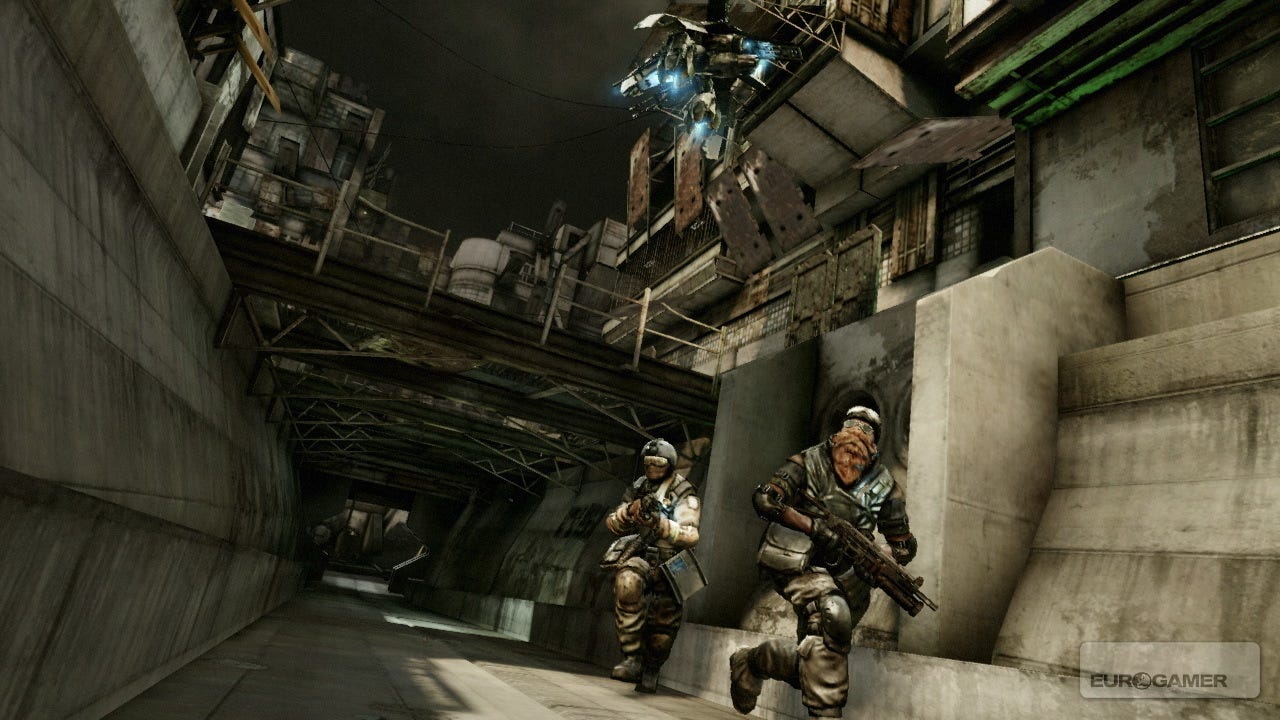
One thing you can be sure of is that Killzone 2 is a very pretty game. Guerrilla's in-house engine uses deferred rendering, separating its various filters such as motion blur, film grain and bloom onto six of the PS3's SPUs, to create a cinematic blend of visual effects without damaging the frame-rate, while the art department is focusing in on the design details that will help tell the story. Weapons and vehicles both play their parts in differentiating the two warring factions, from the nasty, wooden-stocked, rusting guns and predatory aircraft of the Helghast, hinting at a society that's both brutal and stagnant, to the slicker, cleaner rifles of the ISA, whose tanks and planes resemble existing military technology that's just been nudged forward a few years.

By and large though, the real polish is being applied to the environments. Guerrilla's first game played out in a muddy warren of swamps and corridors, but the sequel takes the fight back to the Helghast's home planet. Killzone 2 tells an unusual war story, then: you're not the underdog anymore. In fact, the ISA are now all but victorious, zeroing in on the last enclave of a weakened enemy.
2

Squad-mate AI has been noticeably improved: your buddies do the same damage as you, but have less accuracy to balance it out.

"We knew the Helghast are fascist and wanted that to be reflected in their world, but we didn't want it to be too big and rich, so we made it cramped and dirty: China or Moscow rather than Berlin," says art director Jan-Bart Van Beek. The results are a cobbled-together futuristic slum, a decaying urban sprawl that threatens to spill apart. Rather than streets, the levels flow through empty concrete riverbeds, and there are signs of oppression and neglect everywhere.

But the game's in no danger of becoming samey - the city we've seen already isn't the only environment, and the rest display a surprising range of styles. A later visit to a forgotten Helghast outpost features carcasses of industrial buildings constructed from the bones of the spaceships that first landed there. The inspiration lies with Pakistani ship-breaking wharfs where boats are stripped for parts, and while it means yet more factories to plod through in a first-person shooter, these have a haunting, mysterious quality that makes them different: a mixture of the sad, the brutal, and the gently exotic. And in every location, the toxic variety of Helghan is always present. In the game's fiction, the planet's polluted atmosphere is itself a Class III toxin, and the ravaged weather system's lightning flashes and dust storms seem likely to have an influence on the level construction.

Guerrilla's proud of the world it's created, but it isn't about to let visual excess lead the game over a cliff. In amongst presentations on lighting, dynamic music and weapon design, the word we hear most often is "balance". Take visuals: too much detail and your eyes don't know where to look. The outcome? You're run over by a tank while you're staring at the wallpaper. Killzone 2's environments are full of intricacies, but the developer is careful to use lighting and blur to guide you towards the important details. It's the same with physics: "We still want to have a game that's progressable," says development director Arjan Brussee. "Sometimes you can do things which are too much: blow up a tank in the middle of the road and it's hard to get around it. As with everything else, it's finding that balance between the destructible and the non-destructible."

Looks and physics will only get you so far, however, and when it comes to the core experience, the developers have a simple goal. They want to make Killzone 2 one of the most intense console shooters around, and that means zeroing on the simple business of killing people. The team has identified weak hit-response as one of the key elements that damaged the first game, and they've spent a lot of time working on a blend of physics and animation to improve it. Where previously enemies would scarcely react as you fired endless clips into their stomachs, they now jolt, twist and writhe under the impact of bullets, before slumping to the ground after a more realistically brief onslaught. It may seem like a strange detail to fixate on, but it's astonishing how much drama the right reactions can bring to the game's shootouts. When you fire guns in Killzone 2, it's immediately obvious that you're making things happen, and the result is a more involving experience, even on a short playthrough.

AI was an arguably a bigger problem with the original game, and it's another aspect the team have taken pains to address. "With AI the frustrating thing is if you get 90 per cent right, that last ten per cent with someone who gets stuck on a wall can let you down," says game designer Rob Heald. "Killzone 2's AI is still an evolution of the AI in the original, we haven't started from scratch. But we have taken advantage of the technology. The AI can make more decisions, decide between greater threats and different inputs. They're capable of dealing with a much more dynamic world. You'll see a lot more rolling out of the way of grenades, flanking, avoiding destructible objects. It's a clich, but you won't see the same encounter play out twice. And there's more variety in the enemies: there's long-range guys, and short-range guys who will move in and flush you out."

3

A battle in the slums turns nasty: the horizons disappear and the shotgun comes into its own.

Playing through a few sections of the campaign reveals that the Helghast have become fearsome opponents, far removed from the pop-up targets of the first game. They soften you up from afar, move in to flank, and will come looking for you if you start to hang back, and the game's varied levels give you plenty of time to try out different strategies as the fighting switches between open environments and grotty close-up battling. Set-pieces are everywhere, from a tank suddenly barrelling over a wall before disgorging troops into the heart of your squad, to a prolonged scramble through a collapsing military installation, and the opening dropship invasion.

The controls will take some getting used to. An emphasis on realistic recoil means that Killzone 2's weapons can initially feel unwieldy rather than simply weighty, and the slightly slippery aim, which seems too slow in the centre of the screen and too quick at the edges, is going to require acclimatisation for any hardcore COD players. But even though the game allows you generous options for tweaking sensitivities, assigning different button layouts, and effectively recreating any other game's mapping, the more we played, the less we wanted to substitute Guerrilla's control scheme for something more familiar. After an hour or so, Killzone's layout starts to make sense, its weak running and gunning options forcing you to find a space and make use of the iron sights, while the slightly slow turning and lengthy reload animations draw you into a game that plays out at a tenser, more measured pace than COD or Halo.

4

For multiplayer impressions, check out the gamepage for our recent hands-on.

Throw in a cover system - in single-player only - that doesn't take the player out of the first-person perspective, but instead relies on a surprisingly cinematic lean-and-peak mechanic, and you have a seriously tactical, if traditional shooter starting to find its feet. The overall feeling of what we've played so far is a carefully constructed solidity: Killzone 2's world may not constantly surprise you, but it's remarkably tangible, from the heavy guns, to the thick, alien wind roaring in your face, and the drunken staggers of dying enemies. Despite its conservative aims - rather than introduce new ideas, Guerrilla wants to perfect a few old ones - no other shooter plays quite like Killzone 2, and no other shooter looks quite like it, either. That's a risk in a market as saturated as this, but the one thing Guerrilla has never struggled with is drawing attention to itself. Now at last there are promising indications that it's got the game to go along with the hype.

Killzone 2 is due out exclusively for PlayStation 3 in February.

Comments (192)

Comments for this article are now closed, but please feel free to continue chatting on the forum!

  • Loading...hold tight!