Valkyria Chronicles • Page 3

Brushed with greatness.

If you have even a passing interest in the RPG genre, it can't have escaped your notice that Microsoft has been going crazy nuts loopy trying to woo as many Japanese developers as possible into bringing their skills - and fanbases - to the 360. Some argue this has left the PS3 bereft of the games that helped make its predecessor such an enduring hit in the East.

To this I say pish, tosh and piffle. The traditional JRPG may have spread its buttery pleasures more evenly across multiple formats but there's one sub-genre, beloved by the Japanese, where the PS3 is still dominant - and that's the tactical RPG. September brought Disgaea 3 (in America, at least) and now SEGA has upped the ante with Valkyria Chronicles, a lovingly rendered turn-based strategy role-playing game that oozes style and nimbly somersaults over the more common pitfalls of the genre.

Our setting is 1935, and a world similar to our own yet obviously different. Gallia is a peaceful and neutral country, the Switzerland equivalent, trapped in between the Atlantic Federation and the East Europan Imperial Alliance. These two superpowers are warring over ragnite, a miracle mineral that can be used for everything from medicine to powering vehicles. Gallia happens to be sitting on top of a major ragnite deposit, and the fiendish Imperials waste no time in crossing its borders with ruthless domination in mind.

Our hero is Welkin, and he's a cut above the usual Japanese RPG leads. For one thing, he's not some long lost amnesiac warrior following a cosmic destiny. He's an ordinary 22-year-old, returning to his home in a time of crisis. He's not a fighter - he loves nature and wants to be a teacher - but he has no qualms about taking up arms to defend his country. And he doesn't do this as part of some ragtag gang of rebels - he's drafted into the militia, along with every other youngster capable of holding a rifle.

1

The battlefield map is easy to follow and makes forward planning an absolute breeze.

What follows is a surprisingly low-key introduction to a fairly realistic world. It's a war story, rather than an epic personal quest, and the game is at its strongest - narratively speaking - as it follows Welkin and his squad through the sorts of battles you'd expect to see in Saving Private Ryan rather than Final Fantasy. The tone is perhaps a little too whimsical at times, but the characters are likeable and well-rounded. That the game inevitably introduces an ancient race with special powers - the Valkyria of the title - therefore comes as something of a disappointment.

It's the combat where Valkyria Chronicles really distinguishes itself, however. It's a turn-based strategy game, but fighting is also played out as a real-time third-person action game. It sounds confusing, but the system used to pull off this juggling act is wonderfully simply and intuitive that what sounds daunting in theory becomes second nature almost immediately.

2

The third-person view, and comic book style, makes combat encounters much more enjoyable than the usual isometric grids.

From relatively small beginnings, the game soon finds you in charge of a large squad, which you can chop and change as you see fit, and there are five character classes to draw from. Scouts have longer range, but weak armour and weaponry. Shocktroopers can deliver - and take - more punishment, but their machine-guns are useless over long distance. Lancers are your heavy-weapons troops, armed with bazooka lances capable of damaging tanks. Snipers are fairly self-explanatory, while Engineers can disarm mines, fix defences and restock ammo.

Battles start with an overhead map view. From here you position and deploy your troops, drawn from a constantly topped up pool of new recruits. Select a soldier and the view swoops down to ground level, giving you full control of the character in question. You're free to move them around in real-time, though each step uses up some of their finite Action Points.

You can fire once per turn, an allowance you can use at any time while you have control. So you could use all your action points to advance the character as far as they can go, and then open fire on an enemy. Or you could move, fire, then move again to find cover. Should you stray into the sights of an enemy while moving, they'll fire at you, but this stops the moment you go into aiming mode. You can then take your time to line up your shot, and let fly with a volley of shots. Your target then gets a chance to respond in kind, so finding cover before attacking is always wise. Just by allowing you to try for headshots and other trappings of action games, it's far more visceral than the usual stat-based grid systems usually associated with the genre. If you want a handy soundbite comparison, imagine Full Spectrum Warrior going to a JRPG cosplay convention.

The fresh ideas don't end there though. Whereas most strategy games only allow you to move each unit once per turn, Valkyria is much more flexible. At the start of your turn you're allotted a number of Command Points. Each time you select a character, you use up one of these points, but how you spend them is up to you. You can select the same character twice in a row, either to push their advance further, or to pull them back out of harm's way if they run out of Action Points in the open. If you don't want to spend all your Command Points, any left over are carried into the next turn, allowing you to stockpile your options.

Characters downed in battle will lie on the battlefield. If you can reach them within three turns, a medic will come and transport them to safety, allowing you to recall them from a friendly base later. If you don't reach them in time, or if an enemy soldier reaches them first, then they're dead. Forever. Lost. Gone.

3

Using a scout to rush a tank? Probably not the best military strategy ever devised.

This isn't quite the setback you'd expect, since all characters in the same class level up at the same time as you spend your EXP points, and receive the same weaponry, as you spend your loot on upgraded arms. The only reason to try and keep a specific soldier alive - apart from Welkin, whose survival is essential - is because, well, you like them. This is entirely possible as they're all fairly distinct, with unique faces and voices, and their own personalities which manifest on the battlefield as "potentials".

A male soldier who likes the ladies will receive a status boost when near to female squad-mates, for example. A soldier with hay fever will suffer a status drop if deployed in a rural location. Country-born soldiers are less effective when fighting in urban situations. There are even gay characters, racist characters...it's a real tangle of different social elements, and thankfully the game doesn't punish you too harshly if you don't pay attention to every last foible of every character. For those who like to go that little bit deeper, it's definitely a clever and charming way of squeezing a little extra efficiency out of your squad.

4

Optional sight lines will show you which enemies are within range of your character. Or you can just follow the bullets...

Sadly, as innovative as the combat is, it's not without its annoyances. The AI is far from stellar, both for the enemy and your own units when they're taking advantage of opportunity shots or returning fire. The enemy, for example, will often waste Command Points on repetitive manoeuvres. In the fifth chapter there's a special enemy tank which rolls forwards each turn, then rolls back again, using up four precious Command Points each time. A sniper in the sixth chapter does the same, popping out of cover, running around and then diving back into cover for no apparent reason. It often feels like you're facing an opponent stuck following a fixed script rather than dynamically reacting to your actions. With absolutely no multiplayer options, experienced strategists will be less than satisfied.

Your soldiers will open fire if they spot a bad guy during the enemy turn, but not actually check that their line of sight is clear. Having an enemy break through your lines because your line of defence was too busy shooting a wall as they ran past is frustratingly common. And then there's the strangely inconsistent damage model, with splash damage from explosions proving particularly flaky. Sometimes this works in your favour - magically shielding one of your soldiers from harm - but it's incredibly annoying to waste both Action and Command Points on a grenade attack that seems to have no effect.

The game often seems too rigidly tied to its rock-paper-scissors attack formula, since a tank shell needs to hit a soldier dead centre to cause any damage purely because it's meant for other tanks, yet a mortar shell landing in the exact same place can kill several soldiers at once. Grenades can bring down a wall, or explode impotently, depending on a difference of just a few pixels. Rushing an enemy with a machine-gun will see your character cut down with cruel efficiency, yet the same tactic works all too well against Lancers or Snipers. Armed with long range weapons, they simply don't react at all to close range incursions and stand there impassively, mindlessly taking round after round in the face until they drop dead. Again, this can be hugely beneficial or massively annoying depending on whether you're the one doing the shooting.

The cover system needs work as well, allowing you to crouch behind piles of sandbags or in trenches, but not offering the same protection when standing next to what would seem to be equally effective sources of protection. Why can't you duck behind a stone bench, for example? Or that pile of crates? Or that low wall? Or all the other environmental details littering the otherwise well designed levels? You simply can't, and must instead leave your character standing and exposed, or use up another Command Point to move them somewhere safer. When only the scout class has any real movement range, this inexplicably fussy distinction between useful cover and non-interactive scenery can prove very irritating.
5

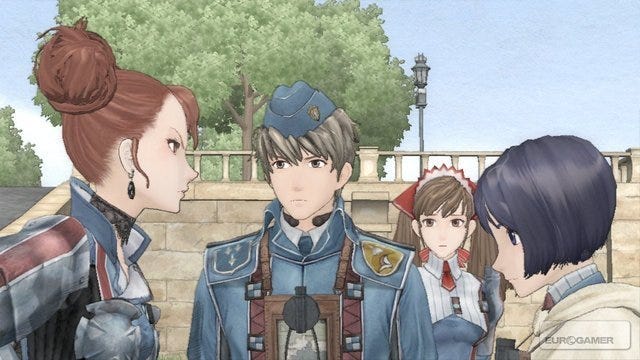
The beautiful graphics really help to sell the story, and make the game stand out from its hyperactive manga-styled peers.

This shortlist of fairly fundamental flaws is sadly just enough to prevent the game from reaching the upper echelons of greatness. It's absolutely stunning, visually speaking, with a lovely sketchy watercolour Miyazaki style that looks breathtaking in HD. The music, by Final Fantasy Tactics composer Hitoshi Sakimoto, is of a similarly high standard, alternating between martial urgency and plaintive themes with confident grace. The story is witty and well told, while the characters are memorable and blessed with surprisingly good voice acting. There's so much to praise that it feels churlish to dwell on the negatives, yet there they are - and they're so inextricably linked to the core of the gameplay that they can't help but tarnish an otherwise wonderful game.

Make no mistake, Valkyria Chronicles is a really, really, really good tactical RPG, and fans of the genre should pick it up without delay, but beneath the inviting exterior and thoughtfully designed battle system lies a game with a few too many clunky inconsistencies which directly impact the strategic heart of the experience.

8 / 10

Read the Eurogamer.net scoring policy

Comments (111)

Comments for this article are now closed, but please feel free to continue chatting on the forum!

  • Loading...hold tight!