Too Human Review

Norway Jose.

Version tested: Xbox 360

I think it's only fair to warn you. These are first words I'm typing, but I can already tell from my notes that this is going to be a laundry list of complaints, gripes and grumbles. And that's a shame, because Too Human isn't a terrible game. It's just one of those "could've been" games where potential is squandered in so many areas that it's hard to know where to begin. Suffice to say, most of the game's good points can be summed in one simple sentence: it's a pretty good action game. Not a very good one, and certainly not a great one, but a slightly-above-average entry in the hack'n'slash genre that provides amusement amidst annoyances.

The core concept won't be new to anyone who watched Ulysses 31 in the 1980s. It's ancient mythology rewritten as science fiction, with Norse legends retold as an advanced civilisation where cybernetically-enhanced humans are considered protective gods by the general population. Our hero is Baldur, favoured creation of the AI program ODIN and popular people's champion of Asgard. You can rename him (although everyone still calls him Baldur) and choose one of five classes for him, and each will be familiar to regular RPG players. Berserker is your meaty melee combat specialist while Commando is your choice for firearms and ranged weapons. Champion is the piggy in the middle, averagely proficient at both forms of fighting. Defender is the heavily armoured tank option, with Bio Engineer the surrogate Mage, able to heal himself and others.

Your choice made, you're dropped into the game at the head of Baldur's "wolf pack", a squad of space marine types, and you're set on the trail of the monstrous robot GRNDL-1 (Cyber-Beowulf was too busy). As you stroll through the ruined Hall of Heroes, robot goblins attack and you're introduced to Too Human's curious combat system. Rather than use the face buttons, you direct your melee attacks with the right stick. Move the stick in the direction of an enemy, and Baldur lunges at them. This basic template can be modified by using the left stick in the same direction, making Baldur launch energy projectiles or fly towards enemies depending on how far away they are, while a double directional twitch juggles foes into the air. Successful attacks fill a combo meter, which can be used to deploy Ruiners - radial smart-bomb attacks that vary from weapon to weapon. Ballistic attacks, meanwhile, are carried out by holding down the right trigger, which starts you shooting with your equipped firearm, and then the right stick is once more used to direct your fire.

1

Those evil metal monsters are the Geth. Sorry, GOBLINS. What was I thinking of?

It takes some getting used to, but when it works the results can be impressive, as Baldur effortlessly flies from enemy to enemy racking up the kills. When it doesn't work, it's a mess. Shooting is especially problematic, with a skittish automatic lock-on that often does the opposite of what you want. Targeting a specific enemy in the middle of a battle is often impossible, and that's a problem when the game introduces exploding enemies that need to be killed from afar in order to avoid splash damage. The game spams you with different enemy types, some requiring firearms attacks to remove their shields, but as they swarm around you there's little room for any tactical play. Depth comes simply from choosing the best attack to clear some space - and trying to target the pounding arms of a giant robot troll even as the game insists that, no, you want to be shooting at the less dangerous goblins at its feet, is never fun.

The melee attacks are easier to master, but it's not a system with much flexibility or depth. The difficulty in lining up two sticks in the same direction means that the "advanced moves" can be unreliable, and the game sometimes has weird ideas as to when enemies are far away or nearby. You have three weapon options to choose from - sword, staff or hammer - but apart from variations in speed, the results are almost always the same. Mindless stick-twizzling (it's the new button-mashing!) won't get you to the end of the game very quickly, but nor will you find yourself being stunned by the tactical scope of this new control system. It pales alongside the precision offered by the likes of Ninja Gaiden, or even Samurai Warriors.
2

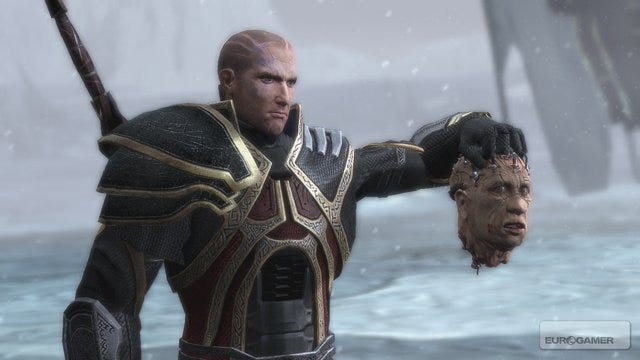
Baldur explains how to get ahead in Asgard...

The control issues, which persist long after you've mastered the basics, are compounded by a wilfully unhelpful camera. With the right stick pulling duty in combat, keeping everything in view falls to a roving AI viewpoint that, like the aiming, makes the wrong assumptions about what you want to be looking at. A tap on the left shoulder bumper centres the camera between Baldur, at least for a while, but you find yourself having to do this more and more because the camera ties itself in knots whenever you do something besides ploughing forwards. It's most problematic in the boss battles, where the need to keep the monstrous enemy in view apparently overrides the need to see where you're going, leading to some horribly confusing - and often fatal - moments.

Then there's cyberspace, an underused alternate dimension that Baldur is able to access through special magical wells. In this bucolic virtual realm, where ones and zeroes conjure up pastoral tranquillity, Baldur must use a trio of gradually-revealed powers to push, lift or burn items in order to open new areas back in the real world. Push a tree over a gorge, for instance, and a bridge is activated in reality. It's not unlike the reality-shifting elements of Soul Reaver, the Legacy of Kain sequel that found Silicon Knights suing former collaborators Crystal Dynamics, and it's a touch trite, perhaps, but there's potential here for some clever puzzling and a nice change of pace. Sadly though, often you just have to stroll for a bit, push something over, and stroll back. While there's an attempt to use this area to add a subplot to the game, it's a boring and long-winded way of achieving a simple aim, and you're always aware that you could just as easily have pressed a button in the real world instead.

But what of the much-vaunted RPG depth we were promised? Well, there's certainly a role-playing mechanism behind the scenes but, compared to any other entry in that genre, it's nothing to get excited about. Weapons and armour can be modified by attaching runes, while Charms enable additional benefits if you can complete their relevant "quests". It's a misleading use of the term, since the requirements are things like "Kill 200 enemies" or "Find 2 secret areas". Things you'd already be doing, in other words, not genuine quests that take you off the beaten path.

Rounding out these auxiliary powers are three special moves and abilities, unlocked by cashing in your skill points every time Baldur levels up. Spiders are robotic allies who can be dropped in battle to deliver damage in various ways, or even to provide a roving healing station. They're time-limited and Spiders must recharge before you can use them again. Battle Cries are status buffs by any other name, boosting your stats or weakening the enemy when activated. They use up your combo meter, and the higher the meter the stronger and more long-lasting the effect. Finally there are Sentient Weapons, an extremely useful ability and by default the last item on your skill tree. Set off by depressing both thumb-sticks, it sends a spooky copy of your current weapon floating into battle alongside you. Sentient Weapons take a long time to recharge, but can rack up your combo meter in seconds. They also look funny.

3

Enormous laser cannons are just one of the ballistic weapon options.

All three elements are unavoidable choices on the rather simple six-tier skill tree, which restricts you to a trio of fixed development paths per class. As half of your options are already taken up by the different forms of the aforementioned support abilities, that doesn't leave a whole lot of room to experiment and as you can reassign all your points on the fly, you'll easily be able to try all the abilities before you reach level 20. Roughly halfway through the game, another layer is added as you get to choose between becoming cybernetically enhanced or following the organic human route. Both open up an additional, smaller skill tree, with Cybernetics maximising damage and Humans favouring improved combo efficiency.

It seems like a lot of options in theory, but in gameplay terms it's all rather narrow in its focus. Unlike the different skill-sets and character classes in Mass Effect, another apparent influence, there's not enough to drastically alter the way you play. Because the game is built around melee brawling, there's just no incentive to try a different approach - because you'll only end up tackling each battle in the same way, albeit with slightly different stats and auxiliary abilities. Out of the five initial classes, only the Bio Engineer feels noticeably different, with the others more like variations on a tired theme - one that's already been covered by Warhammer 40,000 among others.

4

We weren't able to test the online co-op, but feel free to add another point to the score if that sort of thing is really important to you.

Even basic elements like an item inventory are absent. The game will happily slurp up runes and trousers called Proficient Web-Brace Greaves of Toughness by the dozen, but there's no way of stockpiling a simple health orb. Nor are there any items to counteract the various status effects that enemies inflict on you. This means that when your health is low, all you can do is plough onwards and hope that you get some health in a loot drop. If you find yourself poisoned with low health, you might as well just wait to die - there's nothing you can do. Oh, and when you die? I hope you enjoy the unskippable 30-second animation of a cyborg valkyrie descending from the sky and lifting you to Valhalla. You'll see it a lot.

Except you don't go to Valhalla. You're immortal, and so you respawn at the last save-point while all the enemies remain as they were. Provided you keep swapping your weapons and armour for better versions, progress is never all that taxing. This means the game is both frustrating and easy as long you've got the patience to keep plugging away. You'll rarely have to resort to such methods, but just knowing that death has no lasting consequence automatically lowers the stakes. And, yes, BioShock did much the same thing, but Too Human is no Bioshock.

So you're left with a rather awkward action game built on top of a rudimentary loot-hording RPG framework. There's no obvious AI to either enemies or allies, so any attempts to craft something deeper from the one-note gameplay are doomed to partial success at best. Sadly, where Too Human continues to flounder is in the lack of polish, a generally impenetrable approach that will turn off less experienced players and a very unsatisfying story.

Graphically it's passable but nothing spectacular. The draw distance is impressive but character models are less endearing. Despite occasional flourishes that turn the Norse inspiration into something unique, the whole game is draped in generic videogame cloth. It's all metal corridors and hangars, cast in the same shades of green, grey and blue that we've seen a hundred times before. The final section lowers the bar yet further. As Baldur storms Helheim, the Norse hell, you'd be forgiven for thinking that the rusty, dusty brown and red industrial landscape filled with shambling cyborg zombies came from Quake. Or Gears of War. Or take your pick.

The whole Norse mythology angle is consistently half-baked. There's no context for this mash-up of Vikings and technology, and the way the mythology is woven into the new tale is of limited success. Certain stories, such as Tyr's fateful encounter with Garm, are cleverly worked into the boss battle narrative framework, but mostly it seems rather ad-hoc, with the fantasy elements sitting clumsily alongside clichd SF imagery. Asgard, for instance, comes across as a shopping mall built inside a cathedral. The majestic home of the Gods is nothing but a large soulless hub, populated by anonymous humans in modern-day clothes, all milling around aimlessly. In a real RPG this would be a place to engage in some NPC conversations to unearth new info, or discover some side-quests, but here it's just a pointless space where you stock up on items before triggering the next level, tediously trekking from one end to the other to do so.

5

We weren't able to test the online co-op, but feel free to add another point to the score if that sort of thing is really important to you.

This brings me to the final and perhaps biggest problem with the game: it's too short. Now, I don't subscribe to the notion that games must justify themselves by length - I believe that a game should be as long as it needs to be. But with just four worlds - essentially four long, linear levels of constant combat - my first playthrough clocked in at around twelve hours, and I thought I was taking my time, exploring every last dead-end corridor for more bounty. Of course, if you want to play with every class, and unlock every last Achievement, then you'll have to play it through several times. But you can play any game over and over. That doesn't mean it offers 80 hours of entertainment. While Too Human can be replayed, it's not the sort of game where you'll uncover new stories or quests that you missed first time around.

And it's not just a question of truncated gameplay, it's the narrative as well. Based on the story, I was convinced there was at least one more section of gameplay to come after a hardly conclusive cut-scene, but instead I was unceremoniously dumped into the credits. If that's supposed to leave players hungry for the next instalment, it does a piss-poor job. Planning an entire trilogy of games is a bold undertaking, but you need to make each part work as a game and story in its own right. Too Human doesn't build to a cliff-hanger or thrilling crescendo, it simply stops in one of the worst-paced conclusions to a game since Halo 2.

6

You'd need a few. Maybe six pints.

And even with my word count threatening to burst like a fat melon, there are still more scribbled notes that I've not even touched on. Like how at least half of the character classes are of limited value in a single-player game, and are presumably throwbacks to when it was going to offer four-player online co-op (now it's only two-player). Like how useless the NPC characters are in battle, cluttering the speakers with constant clichd action movie prattle yet adding nothing of value to the actual combat, and often inexplicably vanishing completely. Like how weapons offer effects such as "Annulment +8%" with no explanation as to what that means in tangible gameplay terms. Like how so many of the mythological characters are poorly established, their motivations often incomprehensible unless you know your Norse. Like how many of these criticisms, and more besides, were being voiced in previews as far back as 2006 and yet still remain relevant today.

I really wish there were more positive things I could say to outweigh the avalanche of grump. It's not that bad, but then "not that bad" is the highest praise it deserves. A more cohesive game, with an engaging story, might be able to overcome some of its many flaws. But this game, with this story, and this many problems, is always going to be on shaky ground. It's rather fitting that this is still being touted as the first part of a trilogy, since it definitely feels like one third of a potentially interesting game.

6 / 10

Read the Eurogamer.net scoring policy

Comments (177)

Comments for this article are now closed, but please feel free to continue chatting on the forum!

  • Loading...hold tight!