Psychonauts
"So this is it. The strapline." "It looks like a half-arsed reference." "A *mental* half-arsed reference."

People keep saying to us: "Ooh, I like the sound of Psychonauts, but I wish it wasn't a platform game." But more on that later.
There's a bit in Psychonauts that, for us, captures the spirit of the game in a single exchange. It takes place after a few hours and a pivotal plot event, and - modified a bit to save spoiling it - starts something like this: "Are you ready to join me?" With an option of two responses. "Yes" or "No, not yet"
Playing through this, our gamer senses kicked in. Gosh, we thought, what if this is a significant breaking point, and we'll lose access to all that's come before? Maybe it's asking us because it knows we might need more time? Maybe we should save first, and then agree. Mmm. "No, not yet."
SLAP! "How about now?"
It's a laugh-out-loud, Tim Schafer moment. The man who made games like Day of the Tentacle and Grim Fandango so fantabulous has returned in a different genre with similar design principles. The thing that's great about the above joke is that most people won't see it. It made us spit Diet Coke all over the wall, but anybody who clicks "Yes" will be robbed of the laugh. It illustrates not only how far Double Fine has gone to make sure that everything you can poke has a feather waiting to tickle you back with, but also how well the developer understands gamer behaviour - and preys upon it.
Psychonauts undoubtedly comes close to reaching the levels of saturation-humour achieved by other games on Schafer's best-of list - and more or less everything sees you coming. Learn Telekinesis, accidentally pick up your mentor, and he'll say something like, "Yes, very good, now let's try picking something up that won't kill you if you make it angry."
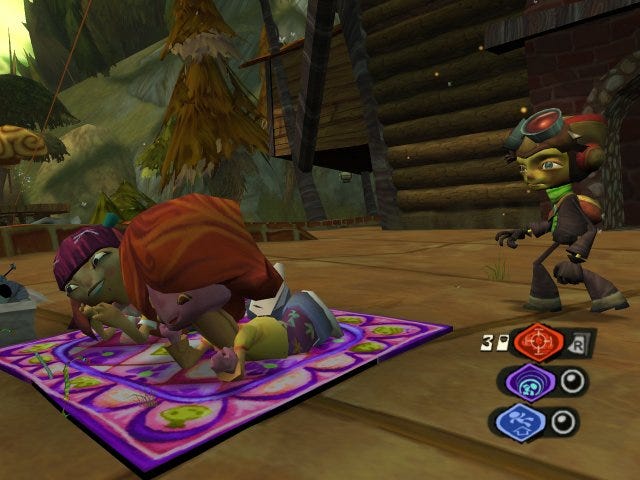
The humour isn't an excuse for a weak or entry-level platform game, either. The platform game underneath would have been fine without it. The controls are spread logically over the Xbox pad (or the PC gamepad you must employ to fully enjoy it), it has an enormous campsite hub area full of things to climb, things you can't climb yet and hidden depths home to pick-ups, a nice progressive system of accumulating tools, health and unnecessary trinkets, a very well-masked structure that marks out the plot without settling into a predictable rhythm, and more lovely level ideas than Andy Warhol's aborted attempt to design elevator doors. It's also a lot funnier than that last line.
The latter (clever levels, that is; not malformed witticism) are often borne of the fact that you're wandering through people's minds. A Psychonaut, see, is a psychic soldier, who jumps into people's heads and fights their personal demons. Literally. And each person's mind is different. A lot of games would give you this premise and expect you to swallow it without question - quite possibly occupying the jackboots of a grizzled veteran of several psychic wars. Or summat. But Psychonauts takes quite the opposite approach, putting you in the shoes of a ten year-old boy, Razputin, who's found his way to psychic summer camp - where he aims to become a full-fledged Psychonaut.
Hence the training level is an obstacle course set in your army veteran coach's head, starting off in a recruitment office, snaking through minefields, past circling bombers, up walls that are being shelled, and so on - all carved out of a convincingly astral plane, complete with slightly quirky marching tunes, which patter off-key like the arch of someone's eyebrow. All the while you're being hounded by your coach, Oleander. "Is your name Joey!?" "No." "Because I'm going to call you Slowy Joey!" "That's not my name." "What's that, Slowy? I can't hear you! You're talkin' too slow!"
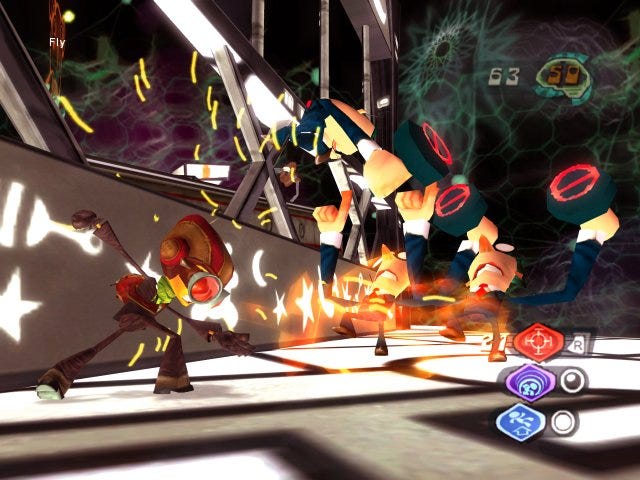
Before too long, you're exploring minds out of necessity rather than academia, as the routine of psychic summer camp takes a backseat to the machinations of a psychic evildoer in its midst. It's a bit like Harry Potter, except, you know, funny. And with a likable lead. And likable everything else. Including a camp bully whose hair resembles a giant Nik Nak.
Except, there's a problem with all of that. We said, "The platform game underneath." Go back, look - see? Silly of us. The platform game isn't underneath the funny; it is the funny. It's impossible to talk about the way Psychonauts looks, plays and feels without wandering back to the way it makes you laugh, as the two are inextricably linked. You don't play to get to a joke, like you do in Jak & Daxter. You play and laugh. And it's a reviewer's dream, because most of the jokes you feel like spoiling won't be seen by most, and there are 100 other funnier ones.
Your collectables, which contribute toward markers that increase your "rank" (unlocking better abilities, over time, increased health and firing capacity for your psi-blasts and the like) are translucent 2D images called figments. Of your imagination. Gosh. There are others too - there are loads to collect, in fact. It may sound a bit cute and cynical - blue blobs contributing to your "mental health", for example - but let us leave you in no doubt that this is a platform game. There are multiple-multiple collectables for each stage - things like psi cards, challenge markers, figments, and the like. You have to cover every inch to get them all. You have to think back to past areas where new skills might apply. You have to clamber over things, swing from branches and trapezes, climb pillars and flagpoles, sidle along edges, and add it all up to progression. The game understands your gaming conventions and desires - and spends as much time sating them as it does hiding jokes in amongst them.
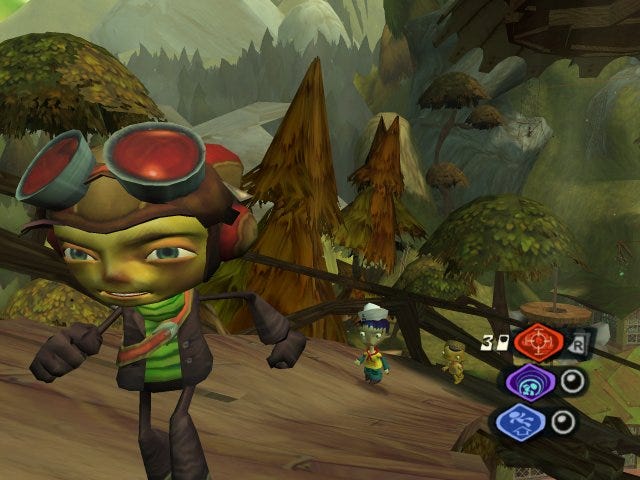
Stroll along a walkway on the inside of a rotating cylinder, which expects you to wait cautiously for the ground to line up beneath your feet, and the coach yells, "Ah, the old rolling tunnel of crazy logs bit." It second-guesses your cynicism. It's a bit like us in that, except, you know, funny. We wish we were Psychonauts.
Fortunately we can pretend we are for aaaages. We read some forum threads full of anecdotes drawing on bits we loved - and half the time we were left thinking, "Hang on, that's brilliant, where the hell was that?" Replay value is assured - even as you revisit the same levels on your first run-through, you're greeted with different jokes.
Animation and voice acting are up to a standard barely witnessed in any other series - and the latter is ubiquitous, with no secession to text-based filler in-between cut-scenes [you see what you're missing LucasArts? YOU SEE? - Ed]. Half the time the audio is incidental - walk up to a pair of arguing kids in the campsite area and press Y to engage them and the game flicks to a prescribed exchange between all three of you, but just stand there and the conversation that excludes you is actually funnier. You'll want to listen to everyone before you actually talk to them. And when you do, you'll find more life in their little Tim Burton-esque faces than every NPC in Jak & Daxter put together. In fact, are there any NPCs in Psychonauts who don't have something for you to remember them by? We can't remember.