Darksiders

Additional revelations.

Lest we forget, THQ stands for Toy Headquarters. Sounds wholesome, doesn't it? Goodness knows what's happened, then, because over the last few months I've popped elbows and head-locked people to asphyxiation, dropped hundreds of tons of masonry on the men and women of Mars, witnessed the launch of a pair of new franchises that consist primarily of dropping fools using massive assault rifles, and chainsawing and nuking my enemies in the name of a soul-harvesting god-emperor respectively, and all in the name of THQ. Oh well, at least the kids still have Darksiders.

I joke. I like to joke in previews. Darksiders is the most gristle-gnashing, fire-breathing, man-the-f***-up violent pantomime I've run around in for years. It's a gothic slasher with Bruckheimer scale and polish, inviting a multitude of comparisons - to Prototype's obsession with combat upgrades and buffs, to Zelda/Metroid/Vania's geographical knottiness, or to Resident Evil and Devil May Cry's fondness for cut-scene pageantry. And, appropriately for a story about the end of the world in a medium where half of the 40 most popular releases any given week are primarily based on extreme violence, you play a bloke called War.

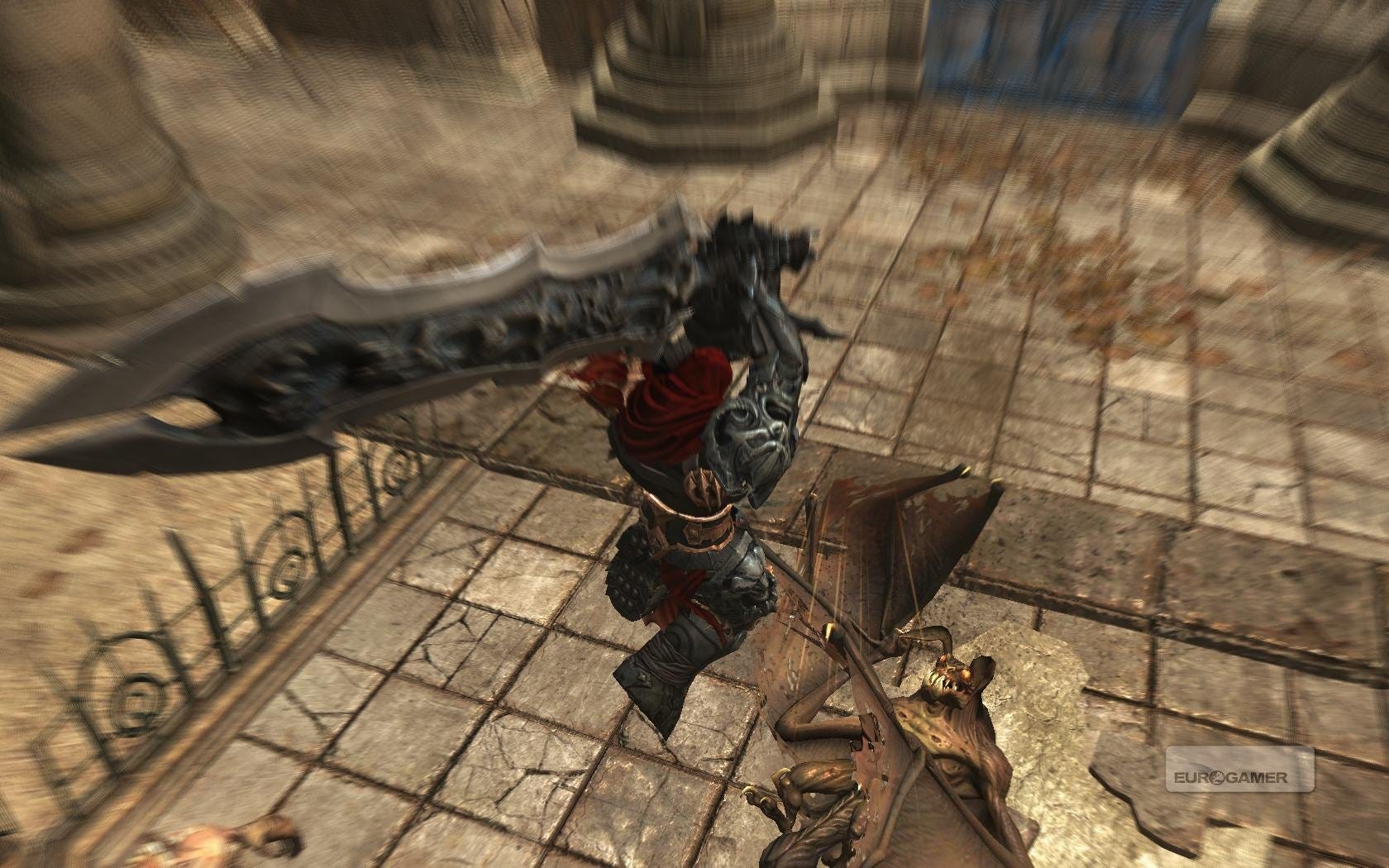
And how. In some of the deeper sections of the game, which I'm being shown today, War has a range of abilities that may condemn the instruction booklet to hardcover. Even the basic stuff could fill the internet several times over (and it has to be said the Wikipedia scribes simply aren't trying): War can lock onto enemies with left trigger and execute basic multi-tap sword attacks, and he can pop off with his handcannon, but he can also trigger optional contextual executions when prompted, rolling an otherwise-standard final blow aside in favour of canned ultradeath.
1

For instance, by leaping into the air and compressing his broad sword through his enemy's head and deep into the neck cavity, or by stamping on an incoming sword blow and cutting his enemy in half at the waist, or by taking a massive golem's arms off at the bicep one by one, before ripping his head out of its socket, or, in a section towards the end of the demo, by disemboweling a giant sandworm by scoring a deep gash the length of its body. (They did say I'd get a vertical slice.) Given all the geysering entrails, blood fountains, fire-breathing and putrid, fleshy apocalypse interior-decoration elsewhere, the only letdown was the lack of guts exploding outward from their cylindrical deathwrap.

But wait, that's just the initial melee combat layer. Thanks to Vulgrim, the 'shop demon' as he's hereby to be known, you can unlock innumerable new attacks with awesome names like Harpoon Tackle, Tremor Punch and Air Grinder; special, chargeable 'wrath powers' that allow you to summon demons, or spikes from the floor, or wreathe yourself in flame; not to mention various passive buffs - 10 per cent of all damage fed back as health, that sort of thing - and of course potions to go along with the health chests you open by punching them . Plus you can buy more weapons. The currency for all this stuff, gathered from enemies as they fall, is souls. Obviously.
2

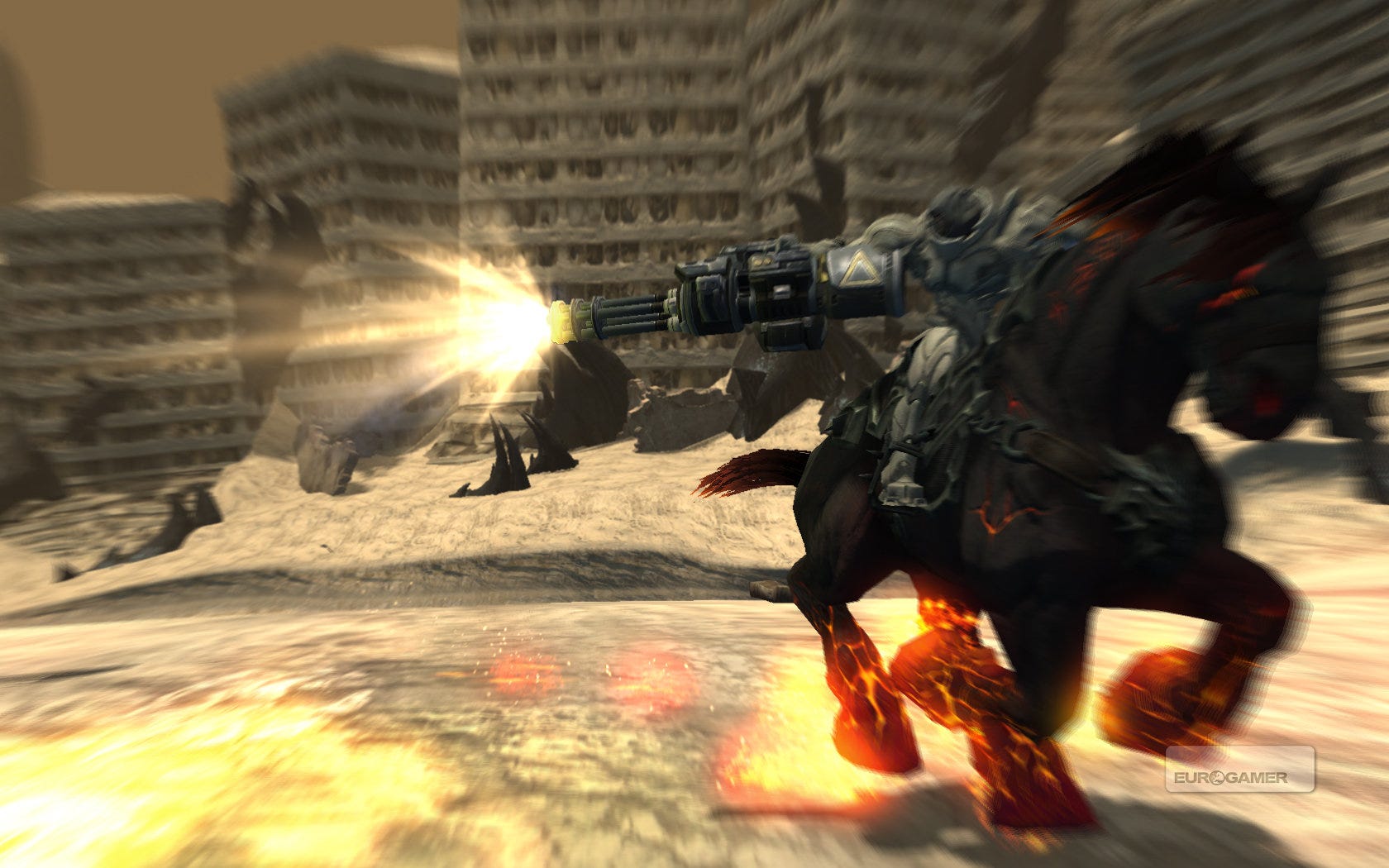
In-game, of course, there's your chargeable chaos form, which transforms you into a massive megademon, rather than a mere seven-foot Horseman of the Apocalypse. Oh yes, you've got a horse, too, recovered in a battle early on against a black-and-red-suited mini-boss, who makes the mistake of saying you're short, which he probably regrets later when you chop him down just above the knees and then... actually, I can't remember, but it was either crushing his head with your bare hands or driving your sword into chest. One of those. Your recaptured horse, Ruin, can be deployed or mothballed on a moment's notice at the touch of a pair of buttons, any time anywhere, even mid-combo, and allows you to gallop around windmilling people with your sword from the sanctuary of height and comfort.

Ruin has a chargeable dash move. You can just dash repeatedly on-foot, which is handy for evasion, and for getting closer to larger enemies who have thicker armour and attack patterns that only expose them to damage at specific points. It's similar to Link's roll move, and it's safe to say that it's not just this and the horsey that are tugging on the green tunic in the wake of the master, because the more of Darksiders you play, more obvious are the similarities to Zelda. The Twilight Cathedral, home to the bat-queen Tiamat mentioned in our last hands-on, is best thought of as a Zelda dungeon, for instance.

You begin by switching puzzle swords between statues to unlock certain doorways, and stabbing your way through them (yes, in the world of Darksiders, even the keys are swords), and figuring out ways to drop heavy objects onto loose flooring to pop open access to the catacombs. Once down there, you gather the Crossblade, a sort of Klingon equivalent of Link's boomerang, used to slice enemies, but also to solve puzzles - destroying rubble blocking a statue you need to raise from fatal lava, for instance, and transporting sparks from a burning torch bowl to combustible bomb rocks you've thrown onto the sticky exterior of the mentalist bat-queen.

Pick your way into a dungeon, earn a new toy, pick the rest of the way to the boss with its help, zigzagging through common areas with new tools to traverse them. The only difference is that Link doesn't usually rip the wings off the boss's back and flap them about mockingly before reaching into its chest cavity with a massive iron glove and ripping its heart out. Darksiders even has its own four-note "you've just unlocked something" jingle, and collectable heart shards to expand your health capacity.

3

Besides the Crossblade, other abilities include demonic wings, which allow you to hover by holding onto the button after a double-jump, and can be combined with abyssal geyser thingies, or bounce pads in the common tongue, to reach new heights; and the Mask of Shadows, which reveals elements of the level you might otherwise not spot; and Chronomancing, which allows you to manipulate time. But really, we are going to run out of internet sooner or later, and I still need to mention aerial combos, and of course projectile weapons, like the temporary-use rocket launcher thing picked up pre-horsey, which allows you to fire four big, glowing death-rods into various enemies and then pull the other trigger to remote-detonate them.

There's a danger with all this, of course, that developer Vigil's Nintendo-flattery proves feebly derivative, rather than effective, and it's fair to say that while it packs a lot of action and options, and echoes the framework of a Zelda game, most of the things listed above are just hyperviolent extensions of standard action-adventure tools and weapons. But there is a lot of imagination in Darksiders; it already feels like a coherent world, rather than some walls around the blood-letting, and it already has a cast of bonkers enemies, and it even has Mark Hamill playing a faceless demon who lives in your glove and pops out occasionally for a peptalk.

4

It's wonderfully realised in characterful designs, animations and architecture, skipping along at a fair frame-rate even this far in advance of launch, and it feels extremely solid, with intuitive controls that allow you to flick between different areas of the combat and ability spectrum quickly and efficiently. Enemies are skeletons in armour, flapping monster bats and charging biped rhino death-monsters, all of whom are quickly identified in combat by their appearance, next to which you'll file their patterns and weaknesses with similar speed, just as you might in a Devil May Cry or a God of War or a Zelda, again (sorry). It might not be the sort of THQ game of yesteryear, but in an already strong year for the venerable publisher, it could well be among the strongest.

Darksiders: Wrath of War is due out at the start of 2010 on PS3 and Xbox 360.

Comments (20)

Comments for this article are now closed, but please feel free to continue chatting on the forum!

  • Loading...hold tight!