Version tested: DS
Is the chance to play with time gaming's greatest gift to players? It's something no other entertainment medium offers and yet, when we rewind the last ten seconds of Prince of Persia, un-jumping a mistimed leap, it's the most natural thing in the world. In Race Driver GRID, a 150mph collision can be undone in an instant, fenders uncrumpling, engine rebuilding, broken faces rearranged with the squeeze of a trigger. In Braid, time can be inched forward and back, millisecond adjustments that solve four-dimensional puzzles impossible to experience outside of a videogame. And yet, with all this power - the power of a time lord, the power that inventors have hungered for throughout history - all we seem to use it for is fixing our petty mistakes.
Chrono Trigger's time-manipulation has a higher purpose. Here you hold in your hands a seismic force, one whose mastery can bring about wars or avert them, can wipe out entire lineages or birth them, can right the wrongs (or wrong the rights) of generations. It's a power that gives rise to new futures. In this world, a trivial act of kindness 600 years in the past changes the landscape of the present immeasurably, and you can be there to see it happen. And yet time travel is just the first of a hundred different ideas that make Chrono Trigger the greatest Japanese RPG ever made.
Released toward the end of the genre's golden age on the Super Nintendo, Chrono Trigger brought together Square's "Dream Team" of Hironobu Sakaguchi, creator of Final Fantasy, and Yuji Horii, creator of Dragon Quest, flanked by stars such as renowned anime artist Akira Toriyama and composer Nobuo Uematsu. Together they set to work on a JRPG that, in many ways, is nothing like a JRPG.
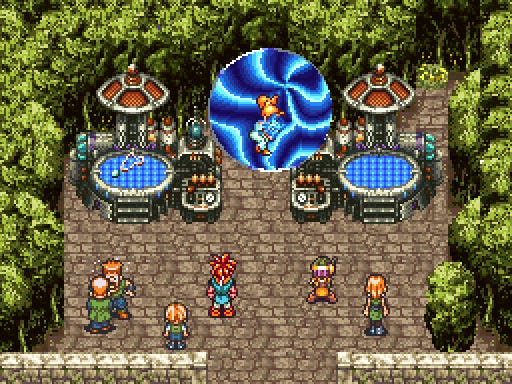
One of the most controversial changes in the new translation of the game is the removal of Frog's olde world accent. Traditionalists argue that, as the mediaeval knight's accent was never present in the Japanese original, this latest version is the purest, but we still miss it a little bit.
To begin with, the team kicked away the genre crutches that so rile its haters. Gone are the random battles, the tedious level grinding and the drawn-out battle animations. In their place, a breezy kind of combat, closer to Link than Cloud. Now you're free to visit the final boss at almost any point, ending the game whenever you're ready to be rewarded with one of fourteen different endings. Gone is the tedious, overblown storytelling, replaced by a tale told in the straightforward vocabulary of a classic children's book. The game's dialogue is universally accessible, its themes universally understood, its fantasy grounded in that truth that makes a good story a classic one.
The game opens in 1000 AD, introducing players to Crono (so named because removing the 'h' freed up much-needed cartridge space in the SNES original, although you can now rename him). Crono's best friend, science nerd girl Lucca, has invented a teleporter that, when tested for the first time, turns out to be a time machine. The duo travel back and forth between seven periods, building a ragtag team of friends drawn from as far back as 65 Million BC all the way forward to a post-apocalyptic 2300 AD. Together they fix the mistakes of the past, watching as their butterfly wing actions turn history-making tornadoes across the millennia.
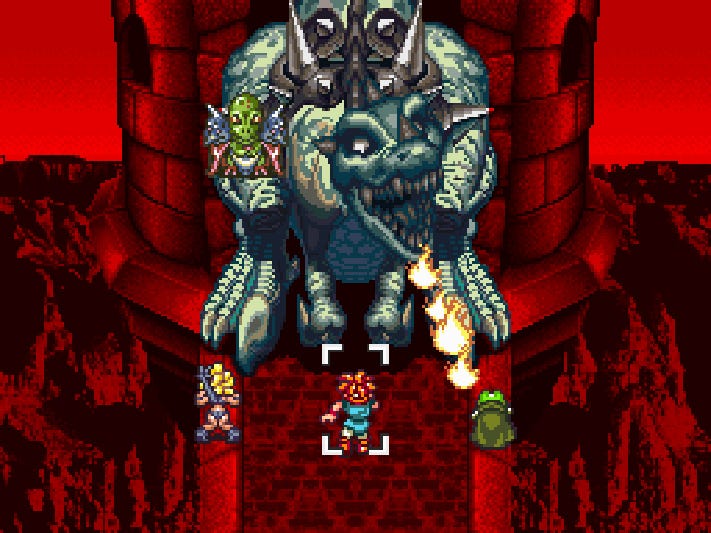
While all of the bonus content from the PlayStation port is included in this version of the game, the crippling slowdown has been removed, making this DS version the definitive Chrono Trigger release.
The game world is small in terms of geography, so exploration is carried out in time rather than in space, a fascinating shift for a genre normally obsessed with travel. The themes of cause and effect characterise not only the main quest but also the side missions. For example, in Crono's time period, a greedy and foolish mayor runs the bustling port of Porre. Travel back in time and you can speak to one of his ancestral mothers. During this encounter you're given the option to give her an item for free. Do so and she vows to always bring up her children to believe in kindness and generosity. When you next return to Porre you'll find the mayor is now a charitable man, and his port is far more valuable than it was before. This wide-angle examination of cause and effect, always videogaming's primary theme, is mesmerising, even if it is sometimes over-simplistic and, necessarily, idealistic.
But that's not to say the game's too worthy. In one memorable scene early on, Crono stands trial for crimes you're sure you never committed. During the trial, the prosecution shows footage of your actions earlier in the game, running from stall to stall at a bustling fair, 'stealing' goods from trestle tables. It's the game poking fun at your habit of clicking on everything; an excellent and surprising joke that not only ridicules the JRPG conventions its makers helped establish, but foreshadows the game's wider themes in a lighthearted way.
The removal of the JRPG's traditional fussiness is best exemplified by the battle system. Whenever Crono encounters an enemy on-screen his party springs into formation and the battle is underway. There's no protracted transition screen or stentorian fanfare. The active battle system ensures that combat is fast-paced and interesting, and the 'techs', special moves that work in a range of different ways for different characters, provide just enough depth and strategy to make the system interesting over the long haul.
The game's narrative strength, and the impact of its more poetic moments, is heightened by one of gaming's best-loved soundtracks. Yasunori Mitsuda, a young composer at Square hired three years previous to Chrono Trigger's development, was so desperate for a project to call his own that he gave Sakaguchi an ultimatum: give me a game to score or fire me. Under the watchful eye of Final Fantasy composer Nobuo Uematsu (who penned a few of the game's melodies himself), Mitsuda worked so hard on the soundtrack that he made himself physically sick, a dedication of effort that's comes through in the texture and nuance of the work.
A useful 'Endings' tab in the enhanced menu screen lets you collect and watch all of the game's different endings. After each completion you can opt to start again with a New Game +, keeping hold of all of your hard-won stats.
So to the technical aspects of Chrono Trigger's port to DS. There are two modes: DS and Classic. The former places all of the menu options and a map on the touch-screen, clearing the game visuals of clutter, while the latter presents the original layout on a single screen. Many of the PlayStation port's additional features have been bundled in, including a bestiary, all-new anime-style cut-scenes, a music player and a treasure guide. There are a few new items and some new quest areas. These vary in quality but, without exception, fall short of the inventiveness of the original's missions. Finally, there's a new ending that attempts to tie the story of Chrono Trigger and its inferior PlayStation sequel, Chrono Cross, closer together. The additions are almost all welcome, but almost all unnecessary, save perhaps for the reworked translation that irons out some of the foibles of Ted Woolsey's original work.
The problem with remakes and ports for the critic, especially those of old beloved games, is emotional baggage. It's difficult to give a cold, measured critique of something you've loved since childhood. How can you give an objective appraisal when every time you hear the game's start-up melody your mind soaks happy in memories of warm endless school holidays, and that delicious, pure, all-encompassing escapism unique to children who play videogames? This game's story is also a part of my story, so it's impossible to get much distance between the two.
But for fans of the original game, there is no risk in coming to reassess those long-held opinions. Chrono Trigger is a masterclass in RPG design, its execution so far beyond the quality and poise of contemporary JRPGs it's embarrassing. It represents the work of a company at the very top of its field, a team of designers so confident with the rules that they helped establish that they felt free to subvert and invert them to glorious effect. While this is a game presented in simple 2D sprites and count-the-frames animations, its underlying maturity and creativity is somehow all the more potent for it. And in this DS update, everyone has the chance to turn back the clock to see how, in many ways, the Japanese RPG's brightest future still lies in its past.
10 / 10
