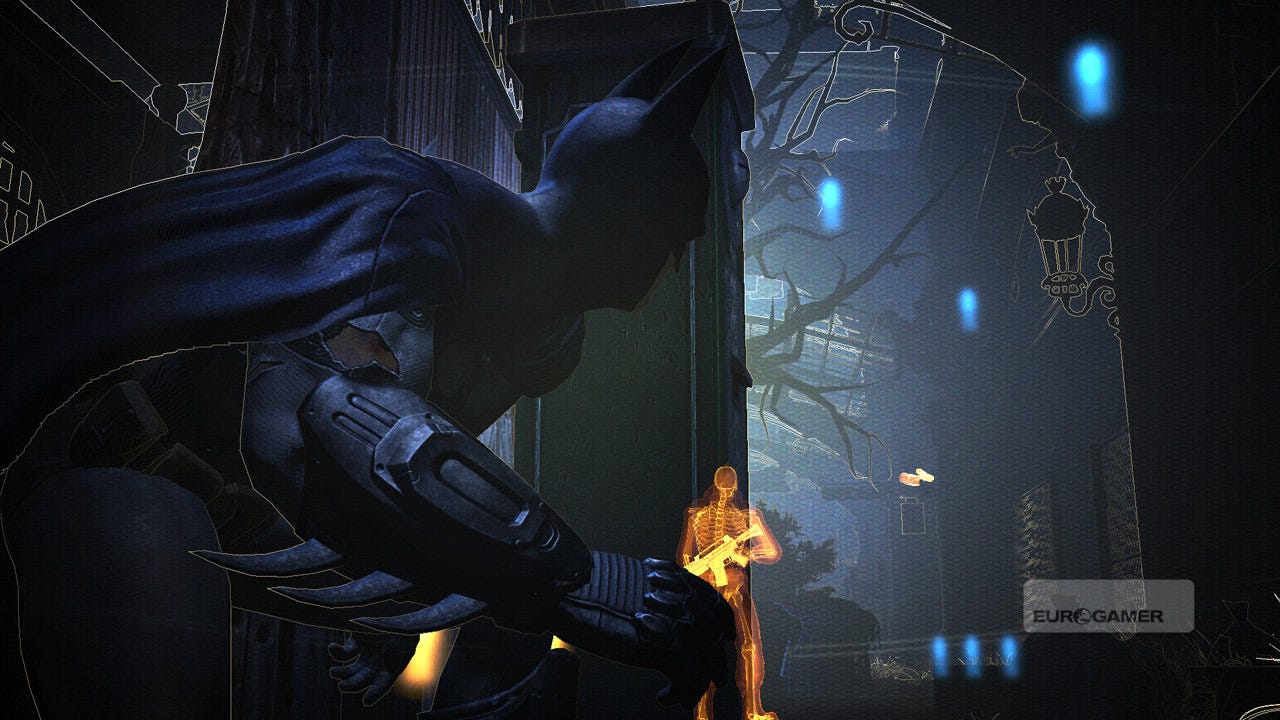
Batman: Arkham City Review

Where does he get those wonderful toys?
Version tested: Xbox 360

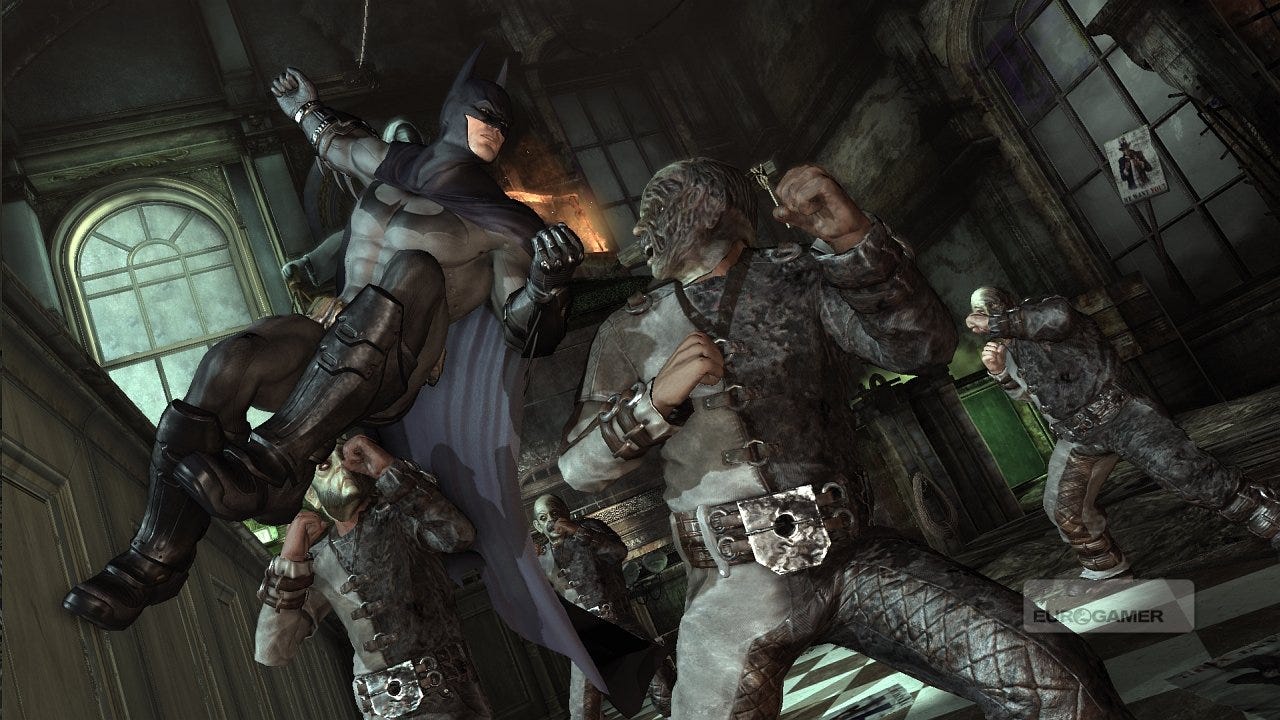
It's a role-playing game, when you get down to it. Not just because you gain XP, engage in a little light levelling and are free to sharpen your combat skills one upgrade at a time. It's a role-playing game in the most literal sense of the phrase, a game in which you're encouraged to give in to the fantasy, and to see what life is like when it's composed of rooftop brawls and zip-line getaways. Animations, traversal mechanics, takedowns: they're all building towards the same thing. In Arkham City, you become Batman.

And it's an easy role to play, partly because Arkham Asylum already laid out such an excellent framework, delivering not just the power of the Dark Knight but also his cunning and his tightly controlled rage. And partly because, if you're like me, you've secretly been Batman since primary school anyway.

Pretending a series of bedrooms and attics were subterranean strongholds. Daydreaming of dangling cyclists over the ledges of skyscrapers when they rode their freakin' bikes on the sidewalk. Promising to avenge your parents' deaths, even though they were still alive and well and sat in the next room, arguing about why the Morris Minor wouldn't start that morning.

I must be a creature of the night! You said it, Bruce. We've been Batman for years, if only somebody would notice. Arkham City just makes it all a little less awkward. It's a Batman simulator as much as a Batman game. It's wish fulfilment on a grand scale.

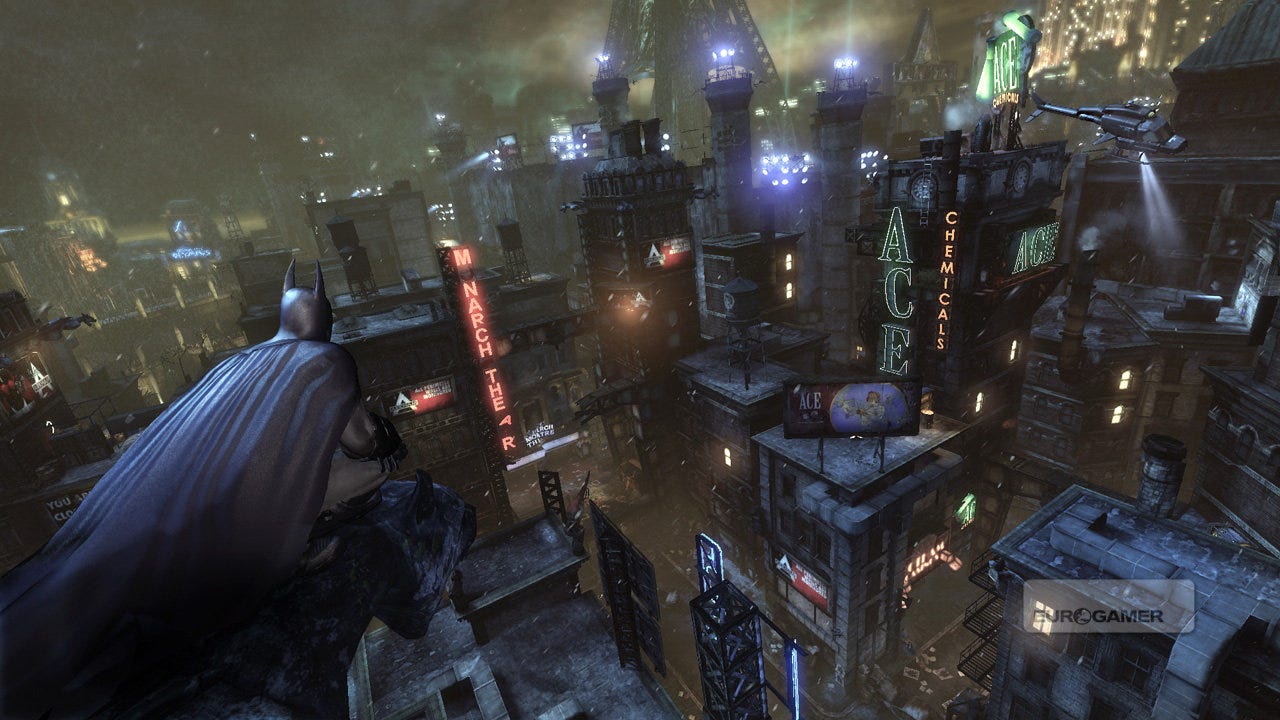
The kind of scale, in fact, that only video games can deliver, creating courtyards, avenues and entire neighbourhoods mired in crime and gothic mystery. The set-up is simple: the former warden of Arkham Asylum has become Gotham's mayor, and he's turned the city's slums into an expanded loony bin. Surrounded by guard towers, spotlights and barbed wire, psychopaths have taken back everything from the Bowery to Crime Alley - where you-know-what happened - and the old GCPD building. Now, under the all-seeing eyes of Dr Hugo Strange, these inmates have started to form gangs and carve up the territory.

Into this landscape of uneasy truces and shifting alliances comes Batman, and the story that unfolds is a race-tuned comic-book narrative in the style of Hush or The Long Halloween: a story built of short, punchy escapades, where any plot-twist is excusable as long as it lands you with a neat gadget or sends you pinwheeling from one supervillain cameo to the next.
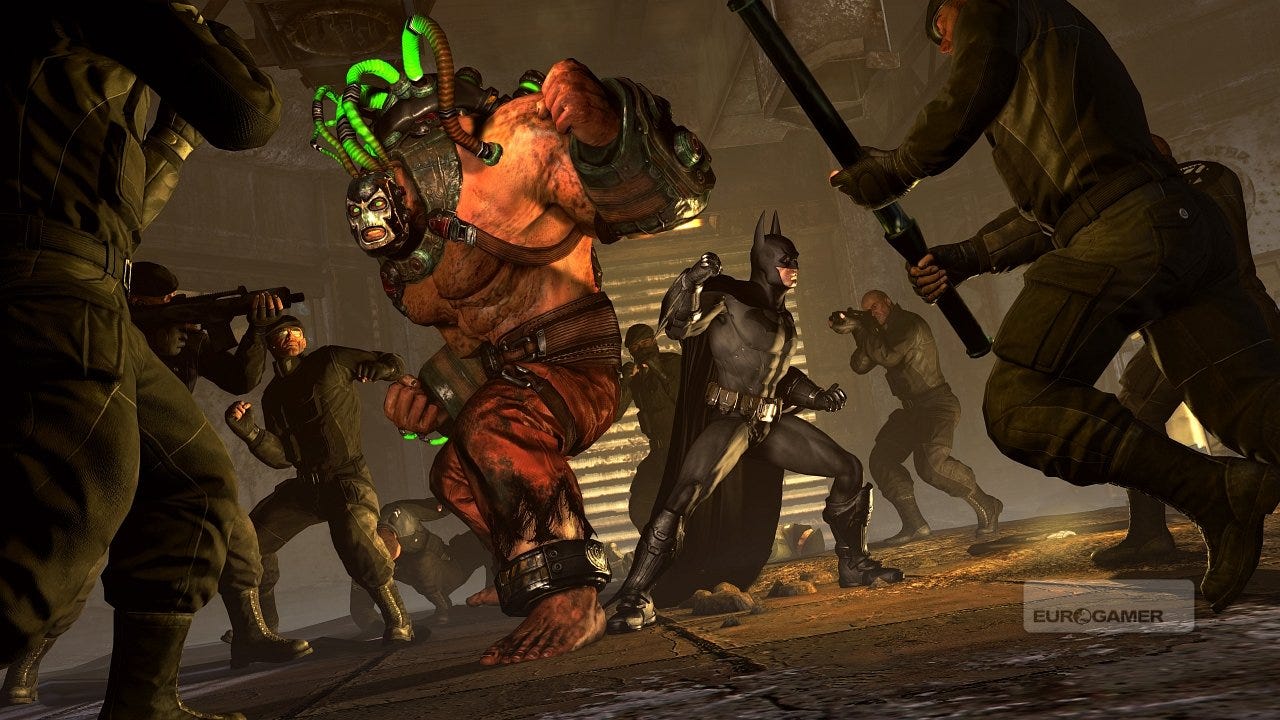
Rocksteady makes greedy use of the fact that Batman hasn't only got the best backstory, he's got the best enemies too. Arkham City is positively exhaustive with its cast, roping in an astonishing range of murderous megastars for the main campaign and then flinging out even more as you start to explore the side-quests. Given the kind of inmates we're dealing with here, it's suitably gratuitous.

The very best of these inmates have been given the Rocksteady once-over, emerging with unlikely kinks in their iconic elements. Just as the first adventure played up Joker's skills as a deadly kind of game show host, Penguin's been transformed into a grubby east-end thug with a beer bottle ground into his face in place of a monocle, while Mr Freeze is otherworldly and tragic in his refrigerated spacesuit and Hugo Strange is hulking yet somehow frail: hypnotic in voice, but measured and occasionally even sympathetic in person.

The city is the real star, though. If the first game hinged on a calculated deconstruction of Bruce Wayne's psyche, the sequel is more concerned with excavating the past of Gotham itself - and plotting its possible future.

It's a funny-books spin on Chinatown, at heart. The narrative drills down under the streets, past abandoned railway terminals and fragmented tenements and into a strange, clockwork fantasyland based on a 19th-century World's Fair. Then it heads upwards again, past circling news choppers and roving blimps and towards the lofty Art Nouveau ironwork of Wonder Tower, where mysterious forces are battling for the soul of this depraved metropolis.

The crust of the city, meanwhile, is exactly as you always wanted Gotham to be: covered in dirty snow and trash, latticed by searchlights and ramshackle Victorian fixtures. It's filled with Riddler's trophies in much expanded form - the best of them now creating the basis of an endlessly inventive series of pressure-plate puzzles, electrical mazes and remote-controlled Batarang gauntlets - and also with secrets for super-fans to spot. Here's the Monarch Theatre where Thomas and Martha Wayne were gunned down. There's a fleeting glimpse of a Harvey Dent campaign poster. I believe in that guy.

In other words, if Arkham Asylum was Metroid - a claustrophobic, tightly contained and intricate blend of gear-gating and backtracking - this is The Legend of Zelda: a sustained head-rush of deftly-controlled freedom with landmark Gotham buildings as the dungeons, while the streets themselves stand in for the rolling fields of Hyrule.

These streets are also home to random brawls, dozens of collectables and a smart range of side-quests, each one terminating with a famous name, each one hinging on an appealing mechanic. Whether you're patrolling the skies and hunting for the remains of a serial killer's victims or racing from one ringing phone booth to the next to trace a scrambled call, there are webs of distraction waiting for you everywhere you look.

It's hard not to be drawn in. Those question mark trophies, for example, which once landed you with a mere Achievement or two and some unlocks, now lead to what amounts to a small campaign in its own right - and the Riddler's far from the only Asylum alumnus who's been promoted in a surprising fashion.

The true surprise, though, isn't the new scope or the new cast, but the traversal. Arkham Asylum delivered a Batman so effortlessly tailored for videogames - unbeatable in a fistfight, useless under gunfire, equally at home plotting a spot of violence and deconstructing a crime scene - that you could be forgiven for not realising you only ever got half of him. Now, Rocksteady is handing over the rest, putting Batman right where he belongs: in the night sky.

Certainly, grappling and gliding were both available in the first game, but they were severely limited. The latter, in particular, had one tantalising cliff-top outing and was then reserved primarily for a dreamy prelude to a boot in somebody's face. Here, both have been thrust centre stage with the addition of a grapple boost (which fires you up into the clouds as a kind of running start) and a large open space to then coast over, cape billowing. Suddenly, Arkham City, like Crackdown and Just Cause 2, has become one of those games that's all about the pleasure of simply getting around. And that's one of the canniest, most overlooked and most essential pleasures that a game can home in on.

To cope with the larger scale, there's a new radar at the top of the screen and the ability to set custom waypoints (they show up, of course, as the Bat Signal). Both disappear when you switch to Detective Mode - a smart piece of rebalancing that should ensure players get to see more of the art team's actual texturing this time around. You'll need all the navigation help you can get, too.

It's true that Arkham City's not an enormously vast open-world, even when you take into account all the indoor levels that punctuate the main campaign, but it's intricate and it's filled with secrets. After four days of protracted Batexploration I was still discovering new things - and the game's best moments are often its most peaceful, as you ghost over the landscape, your earpiece delivering constant radio chatter from the criminals milling around below. At times, it's hard not to feel like the world's greatest detective, on patrol, sifting through all that noise and looking for the one signal that will send you into action.

There's a dive-bomb swooping move and a ground-pound, both reeking of the Mushroom Kingdom and suggesting that Alfred may have bought Young Master Bruce a SNES back in the day. Even putting aside all that - and putting aside a grapnel gun that is essentially a hookshot, and all those structural nods to Link and Samus - there's a wonderful feeling throughout Arkham City that this is the Dark Knight we might have been given if it was Nintendo rather than DC Comics that created him.

It's not so much a matter of specific influences as a general ethos. Rocksteady has the familiar Nintendo toy-box touch that ensures you're never given a gadget that's only good for one thing and you're never saddled with an objective that isn't inherently fun and rewarding, even if you're just moving down the street. Most of all, Arkham City feels like a Nintendo game in the sense that you can't tell whether the environment, characters or individual mechanics came first - all seem to have evolved in an intriguing harmony.

If it's lacking something, it's surprise. Arkham City has nothing that beats the first game's brilliant unveilings and fourth-wall mind-tricks (although it has a go at an equivalent) and it can't trump the central, crucial realisation that somebody had finally made a Batman game that was enriched by its license rather than subtly crippled by it. Instead, though, you get refinement: better bosses, slicker animation, and more to think about on a second-to-second basis.

It's a decent trade. Combat, one of the first game's sweetest elements, is now riddled with elegantly nasty new animations alongside new enemy types, new takedowns, smoke pellets and much simpler access to gadgets while fighting. On top of that, your arsenal itself has been reworked and expanded. The line-launcher now allows you to change direction mid-run, switching it from a fancy kind of bridging tool into an essential component of any good night out in the Bowery, while newcomers include the REC (an electrical blaster) and a freeze grenade that doubles as an incapacitator and a flotation device. 'You're going to need a bigger belt,' says Alfred at one point. If this goes on, we're certainly going to need a bigger d-pad.

Elsewhere, Catwoman crops up now and then, both in the campaign and with a few side-quests and trophies of her own. You'll need the online pass to get access to her, but she's not actually that different to Batman when it really comes down to it. Her combat is simply lighter, faster and crueller, while her traversal relies on pounces, ceiling runs and natty rhythm-action button presses as you shimmy up buildings.

The challenge rooms make a welcome return, ensuring that you always have access to the game's tooth-splintering combat and playful strain of predator stealth. This time, you can work through linked challenges as mini-campaigns, all of which come with a tactical element in the form of combat modifiers. One might impose a time limit, say, or stop your gadgets from working. It's arcade leaderboard heaven.

Heaven inside hell, eh? Prisons, murderers, lunatics: Arkham City's built of gloomy stuff, but it feels uncommonly like escape each time you load it up. It's escape of the best kind: into a different world where your actions might save lives and where you're decisive, dynamic and rarely given to starting conversations with gambits like, "OK, rate the top five chocolate bars for me, leaving out Mars."

Is it over? Unlikely. Rocksteady's latest certainly knows how to drop the curtain, but it feels like a dark second act or the middle section of a trilogy. If that's the case, it's tantalisingly tricky to figure out what the studio can do next.

First they gave us a hero; now they've given us his ideal playground. And along the way, they crossed off one of the trickiest entries on my own personal to-do list: an entry that's right there in between Meet Ty Pennington and Finish that Robert Musil book .

Become Batman. Done.

9 / 10

Batman: Arkham City is released 21st October on PS3 and Xbox 360, and in November for PC.

Read the Eurogamer.net scoring policy

Comments (144)

Comments for this article are now closed, but please feel free to continue chatting on the forum!

  • Loading...hold tight!