The Game Developers Conference is perhaps where PlayStation Home's heart is. After all it was there, in 2007, that Phil Harrison unveiled Sony's vision of a networked virtual world for PlayStation 3.
As announced at last month's GDC, Home has since been downloaded 19 million times and has seen many evolutions. And now more changes are occurring with the launch of new tools designed to increase the options developers have when it comes to creating games for Home.
But what does this mean for the average PS3 owner? Will the changes be enough to make those who have left Home want to return? Eurogamer sat down with Jack Buser, director of Home for Sony Computer Entertainment America, to find out.
Eurogamer: What does the GDC Home announcement mean for gamers?
Jack Buser: These new tools will give our game development community the tools they need to build better games than you've ever seen before in Home. The new client will allow games to have better graphics, more robust physics and online, real-time multiplayer capability.
This will allow us to build game types like online multiplayer first-person shooters, racing games... All kinds of game types that maybe you haven't ever seen before in PlayStation Home.
Eurogamer: So you're saying they're going to be better looking than any games we've seen in Home - but how will they compare to regular PS3 games? Presumably they're not going to be right up there with, say, Killzone 3?
Jack Buser: One of the great things about PlayStation Home is that it's leveraging the power of the PlayStation 3 hardware to provide these 3D immersive experiences that normally you wouldn't be used to seeing in social games.
Also, the game types that we see in PlayStation Home cater much more towards the core PS3 demographic. So you're going to see things like shooters on the platform which, traditionally, social games don't necessarily support.
In terms of graphical capability per se, I wouldn't really draw an overarching comparison. I'd leave it up to the consumer to decide, when they're playing these game, how they feel about the graphical quality. Personally, I think some of them are absolutely beautiful.
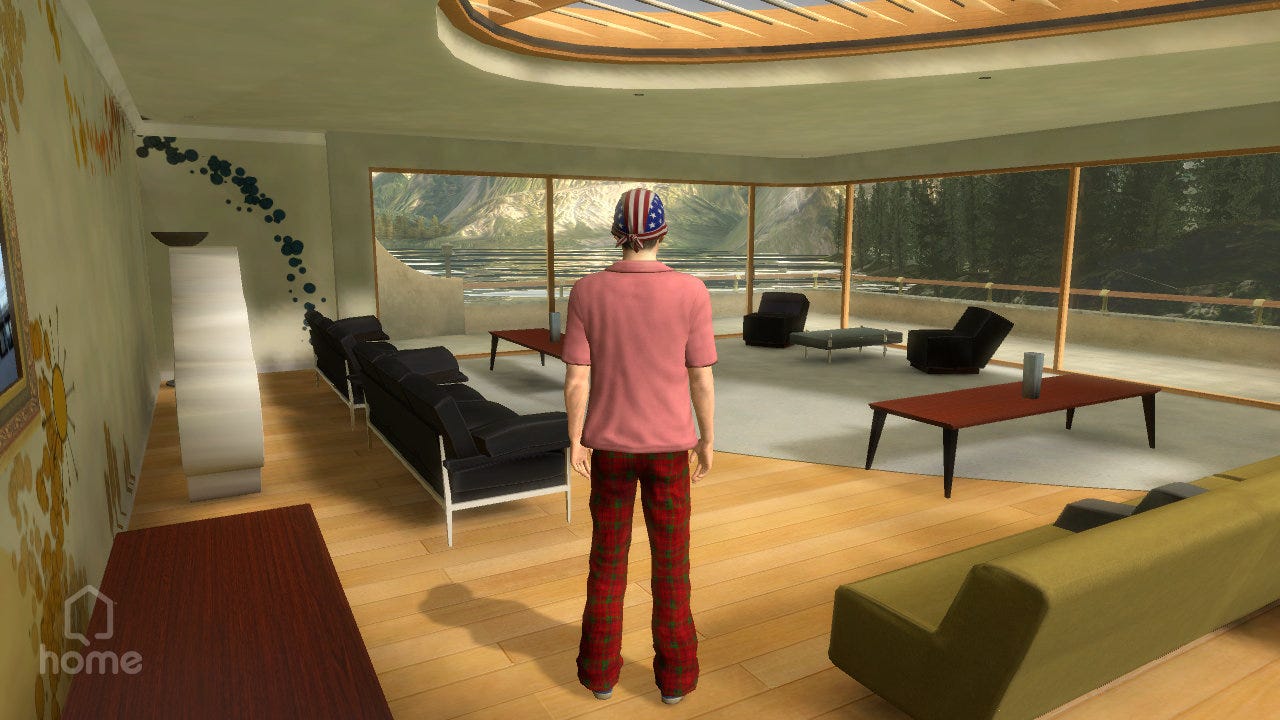
Remember this? 'I'll just chill here on the deck.' Amazing.
Eurogamer: But there are already online racers and shooters with really great visuals available for PlayStation 3. If I already own Killzone 3 or MotorStorm, why would I bother booting up Home to play those other games?
Jack Buser: Well, there are a few big differentiators to playing games inside PlayStation Home rather than standalone retail games or our downloadable games. The first of these is that you're playing these games as part of a continuous world.
So as you're wandering around this world, you might just find a game and find yourself as part of that game without really knowing you've joined a game. Or you might just see a group of people huddled round a game, wonder what it is and wander over to check it out, in a very seamless way.
One of the most fun things in PlayStation Home is wandering around the world and finding all the great games there are to play, that maybe you wouldn't know about otherwise.
Secondly, I'd imagine a big differentiator is the business model. Many of these games, like Home itself, are free to play.
At conferences like GDC, we toss around the word freemium. [Home racing game] Sodium 2 you can play absolutely for free - boot up Home, we don't charge anything, go over to Sodium 2 and start racing. That is very differentiated from traditional retail or downloadable games where you'd have to pay.
So if you want to play with your friends on Sodium 2, you can just tell them to come on in , it's free and you don't have to buy anything.
The dream.
Eurogamer: What's in it for you, then?
Jack Buser: The freemium business model is a new business model in games that's gathering a lot of traction on social game platforms in general.
The core philosophy is that these games are free to play and you don't have to buy anything, but if you want that extra edge you can buy a special weapon or booster or some sort of special something, at a very low price point, generally via microtransactions, which gives you an edge in the game.
You don't have to but you can if you want to, and that's the core of the experience. You'll have some subset of the overall audience that will want that edge.
Eurogamer: But doesn't that mean gamers who do just want to play for free are at a disadvantage, compared to those willing to spend money?
Jack Buser: It depends on how the game is designed. A game like Sodium 2 is designed to be a balanced experience. You come in and race with your friends. If somebody wanted to purchase the booster using a microtransaction economy, then it's a matter of game balance.
There's a lot of talk about how to overcome the challenge and that's one of the more interesting things going on in game development right now - how do you incorporate this business model with game design? We're fortunate to have PlayStation Home developers who have really mastered this aspect of balance in their titles.
Eurogamer: You've just announced that Home has been downloaded 19 million times. Obviously that's a huge number, but it's still less than half the installed base of PS3. Considering Home is free, you're saying it's a great service with all these free games, why is it that less than half your userbase is interested in it?
Jack Buser: First off, I should say we're very excited about that number. For any service built into a piece of hardware, that's a very significant.
Eurogamer: I'm not saying it's rubbish...
Jack Buser: Right. There are a couple of things you have to do to get into PlayStation Home. First of all, you have to be connected to the internet - not everyone's PS3 is.
Second of all, you have to be connected to PlayStation Network. Some hardware is sold into territories where Home is not available. Then you have to come into Home.
So there is a process, and it is free, and we're extremey happy with the attach rate we do have, but you do have to register for PSN and be online.
Who would win in a fight between your Home, XBL and Wii avatars?
Eurogamer: So do you think there's a registration block? Basically people can't be bothered to go through the admin required to get into Home?
Jack Buser: I'm not so sure. I really think that in terms of getting people into Home, it's just a factor of how many people are playing games online, how many people are registering for PSN then coming into Home.
That said, to have that attach rate so high is really a testament to not just Home but also the PS3 userbase. That's a very, very high attach rate for a service on a piece of hardware.
Eurogamer: I know you're not saying what the number of active users is. But anecdotally, I know a lot of people who installed Home on their PS3s and have since lost interest in the service, and haven't been back. Is that a problem you're conscious of? Or do you think that's just the minority?
Jack Buser: There are two big factors which go into an active userbase. The first of these is acquisition - getting new users to come in and try the service. One of the great things about Home is that it's built into the Cross-Media Bar, it's core to the PS3, so that acquisition is really efficient for us.
The second factor is retention. One of the things we've found to be the killer app for retention on the platform has been games.
A lot of users who are coming into Home now are presented with a new Home navigator which allows them to access content relevant to them. This allows them to to get into these games and see the kind of experience we're providing now.
Bear in mind Miis are at a disadvantage, due to lack of fingers for gouging.
We also see a lot of users returning to the service now they see these kinds of games are available on the platform, and that many of them are free to play.
So we're quite happy with the direction the platform's growing in right now. This focus on games has really treated us quite well.
Eurogamer: What would you say to someone who hasn't booted up Home since they first downloaded it? How would you persuade them come back to the service?
Jack Buser: First of all, just come back in and play some of the games. Sodium 1 is currently live, Sodium 2 is coming soon, try out the Midway, Novus Prime, Dragon's Green...
There are so many great games on the platform which are ready to play. If you haven't fired it up in a long time, I think you'll be pleasantly surprised.
Jack Buser is director of PlayStation Home for Sony Computer Entertainment America.