Sony's Peter Edward

A chat with the head of Home.

In December last year, following a series of delays, PlayStation Home launched - or the beta version did, anyway. At the Develop conference last week, platform director Peter Edward delivered a speech titled Home: First Term Report. In it he discussed how the last seven months have gone and the lessons Sony's learned.

Afterwards, Eurogamer sat down with Edward to quiz him further. Read on to find out when the beta phase will end, what he makes of Microsoft's trash-talking and why there's no virtual mace for female avatars who get gang-stalked. [You're not going to call him Petey E then? - Ed]

Eurogamer: In your Develop speech, you mentioned the "trials and tribulations" you experienced in the run-up to the launch of Home. Were there more of those than expected?

Peter Edward: I don't know that I had any expectations. To be honest, it was probably more complicated than we expected it to be. You don't realise the complexity of an undertaking of this nature until you start to get into it - then suddenly it dawns on you just what you're taking on.

That's why it took us a while to get Home out there. We wanted to make sure it was working and it was right and it was going to give people what they wanted. It's an evolving service so obviously it's going to update and get better over time, but we wanted to make sure what we put out there initially was at least something we were happy with.

Yes, it's been really difficult and there have been lots of pitfalls along the way. I don't think we knew what we were letting ourselves in for when we started. But then who does? That's what's exciting about our industry, most people don't know what they're taking on when they start something and they only find out halfway through.
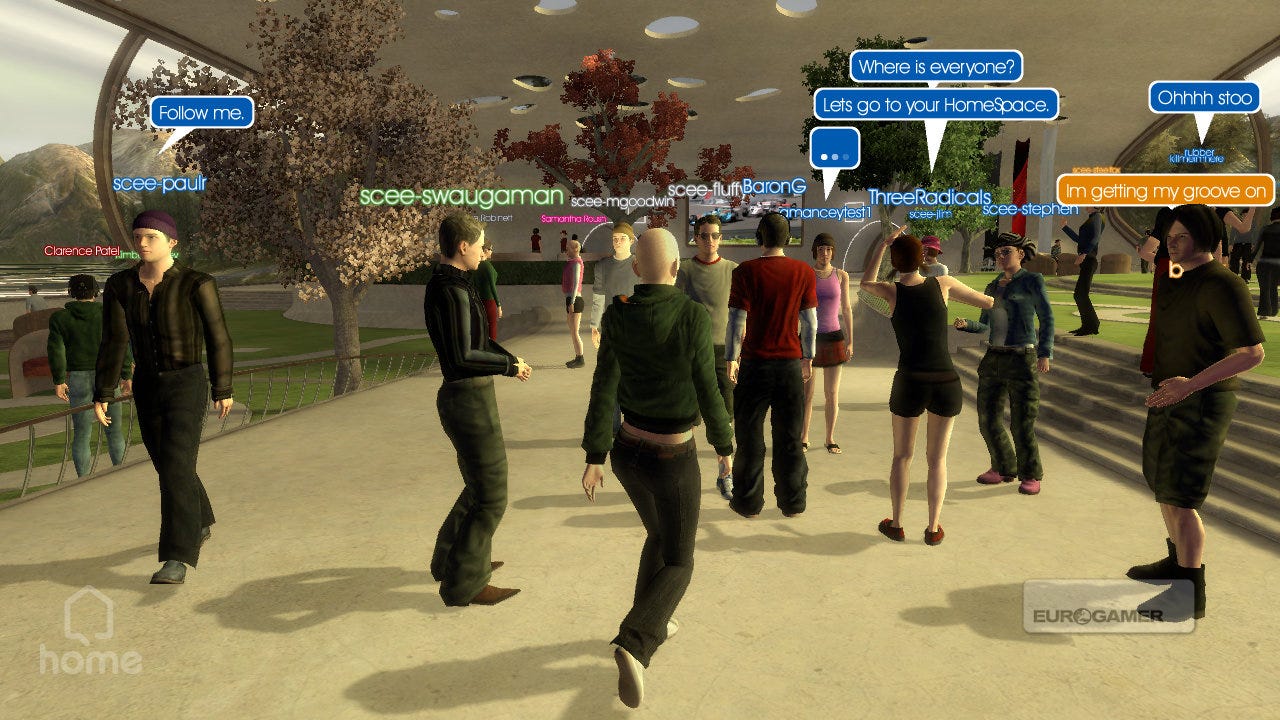
1

It's in beta until it's not, basically.

Eurogamer: How long will the beta phase last for?

Peter Edward: Until we're ready to not call it a beta any more. We don't really get that fixated about it. Anyone who wants to access Home can, there are no barriers to entry, so in that respect it's not like there's anything holding users back.

We're still developing it, we're still working on it, we're still improving it. We'll remove the beta name when we're happy that it represents something that is not final, because it'll always be evolving, but at least represents a kind of final quality. We don't have a specific target for when that will be.

Eurogamer: So you don't have a list of certain criteria which need to be met before you can remove the beta label?

Peter Edward: No, not as such. We have more philosophical targets for when it should come out of beta.

Eurogamer: What did you think of the initial reception Home received?

Peter Edward: It was kind of what I expected. There was a lot of interest in it and there were a lot of people who were very sceptical about it, and I think a lot of people's opinions changed after they'd seen it. Some people thought it was way better than they thought it was going to be, some people thought it wasn't as good.

I like to think a lot of the sceptics have slowly come around. Even people like Kotaku, who are famously sceptical about most things, have been saying some quite positive things about us lately. People have recognised this is an evolving service and they've given it a chance.
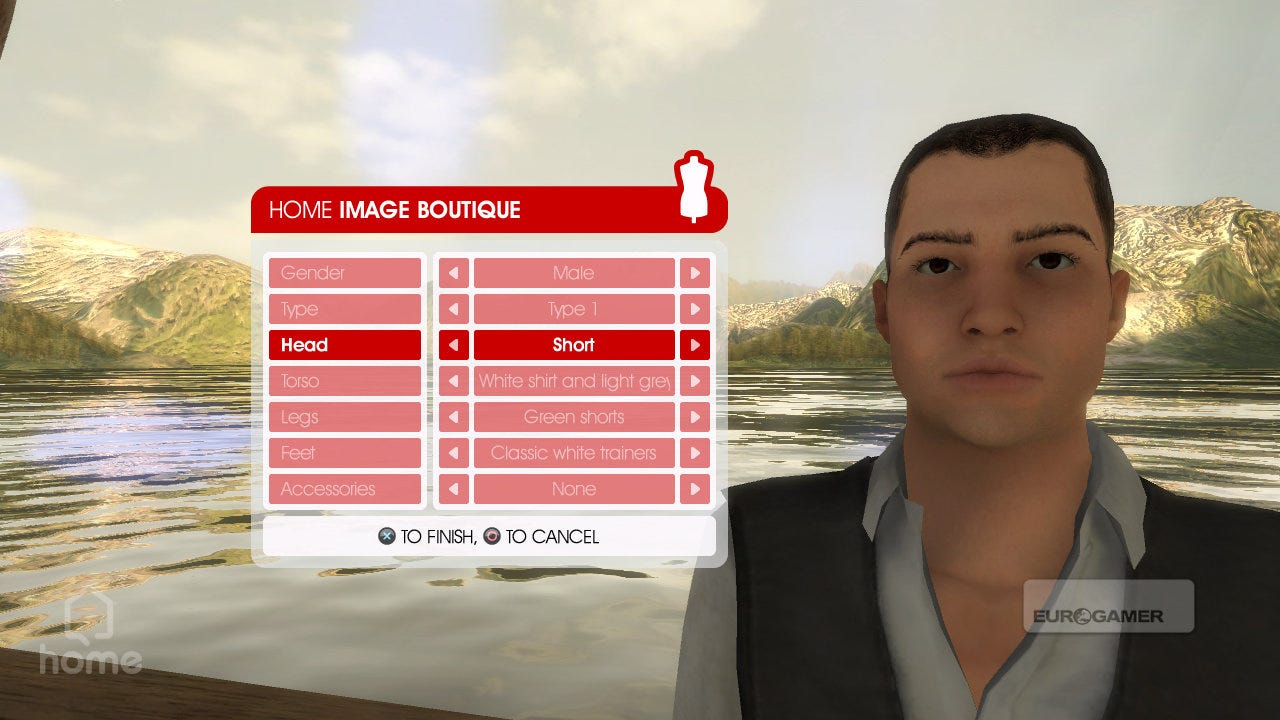
2

Tom's wearing classic white trainers for real. The lines are blurring.

Eurogamer: There were quite a few delays to the launch of Home. Why did you finally say, 'Right, this is the time'? Was it because you'd reached a state where you thought it was ready? Or did you think, 'We can't delay this yet again, it's gone on too long - we just have to shove it out and hope for the best?'

Peter Edward: We released it because we felt it was ready to be released. You can tweak things ad infinitum and you can always make something better. But it had got to the point where we thought it was good enough to put it out there so people could see it, and then continue to make improvements. It wasn't at the point where we thought it was perfect, obviously.

You don't want to tweak and hone something so much that when you give it to people, you can't incorporate any elements of the public's reaction to it. So we've been able to see how people use it and react to it and make some tweaks along the way. We felt it was time.

Eurogamer: Speaking of how people use it, I've found that if you've got a female avatar you tend to get surrounded by big groups of male avatars, which is, you know, a bit freaky and unnerving. Are you aware of that issue? Do you have any ideas for dealing with it, or do you think it isn't a problem which needs to be solved?

Peter Edward: Yes, I am aware of it. To a certain extent it's a function of the internet generally.

Eurogamer: It's full of mad stalking men?

Peter Edward: Well... There is a smaller percentage of women who get a lot of attention, regardless of what platform you're talking about. Home just brings that to life a bit more with the avatars.

I think it's calmed down a bit and will continue to do so as people realise having a woman in there is not such a big deal. And also when they realise that actually, a good percentage of women in there aren't actually women, as is standard with the internet.

3

"What shall we do this evening?" "Let's respect women."

Eurogamer: I actually am actually a woman, just for the record. You haven't thought of offering something like downloadable mace? Maybe you could shake the Sixaxis to spray it.

Peter Edward: The thing is with those sorts of things, unless you know for certain the person using it is really a woman, it's open to just as much abuse. We're very confident in our moderation ability and our process. If anybody is giving you grief there are a number of different ways in which you can get that person out of your face.

Rather than try to put measures in place to prevent people doing things, we want the community to establish acceptable levels of behaviour and almost police itself. There are a lot of people within Home who will push back against griefing and say it's unacceptable.

Eurogamer: Microsoft's hit the headlines several times over their policy with regard to the use of the word "gay" on Xbox Live. Sony doesn't seem to have suffered the same controversy. Is this because you have a different policy? Have you learned lessons from their experience?

Peter Edward: I can't really comment on the policy. Home uses exactly the same moderation policy as the PlayStation Network as a whole, we all the same text filters and operate on the same matrix of severity of complaints.

Again you want to give people the freedom to express themselves, but you don't want to give them so much freedom they're able to abuse each other ad infinitum. So yeah, we have swearword filters and abusive word filters but you have to be quite careful what you put in those lists. It's a fine line. I guess if we're not in the headlines maybe we have learned some lessons somewhere.

4

"I wonder if I can jump off the balcony."

Eurogamer: Do you keep an eye on what Microsoft is doing in terms of their avatars and community activities?

Peter Edward: Yes, obviously. But when we started working on Home, we were very conscious not to pay too much attention to what other people were doing. Because then you run the risk of developing something that's basically answering your competitors, rather than developing something that's addressing your community's wants and needs. Obviously we're aware of what other platforms are doing, but we don't use that as our to-do list.

Eurogamer: Microsoft is keeping an eye on you, it seems. When Home first launched Aaron Greenberg described it as "Second Life for hardcore gamers". He said, "It feels like 2005 tech in 2008." How do your respond to that?

Peter Edward: He's entitled to his opinion. I don't think it is 2005 technology in 2008. Graphically it's a very good-looking platform; the fact we've been nominated for a Visual Arts Develop award speaks to that. We've also been nominated for a Technical Innovation Develop award. I don't want to get into a platform-versus-platform discussion

Eurogamer: Oh go on.

Peter Edward: The Second Life thing comes up quite a lot but I think it's a very different platform to ours. It's easy to make those comaprisons because they're both 3D, avatar-based virtual worlds. But Second Life is very much a PC experience, a solo experience.

There's much more of a wild west approach in terms of what's allowed to happen there - which is great, if that's what you're into. PlayStation Home gives you a more secure environment where it's impossible for someone to create their own animations and objects.

Eurogamer: So we're unlikely to see a brothel in Home? Not even a Red Bull-sponsored one?

Peter Edward: Haha! Well, who knows what might happen in the future... But we're very conscious of what people expect from Sony as a company and the sort of implicit trust people put in a brand like that. Second Life is more of an experimental platform really, where anything goes. That's one of its selling points. Home is more family-oriented, it's less of a solitary thing.

5

I hadn't seen this. Oh my life.

Eurogamer: What about something more wholesome, like a nudist camp?

Peter Edward: I'm not going to say yes to that, because then it'll be all 'Home developer discusses nudist colony'.

We have an age-rating system within Home, but at the moment if someone says they're over 18 that's because those are the details they've inputted. We have no way of knowing whether those details are true or not. Before we can be a hundred per cent certain of a person's age, things that are truly adult in content would be very difficult to approve.

Eurogamer: In the Q&A after your speech today, the issue of Europe's Home being behind other regions' was raised. Even community manager TedtheDog has admitted this is a problem. You said that localisation is an issue, but why does it cause such a big hold-up? Surely you can translate into the different EFIGS languages simultaneously?

Peter Edward: You can, but it is a big, complex job. It's not just a case of translating a text file and shoving it in. It also depends on where development started, because if it started in Europe development will tend to have localisation planned from day one. If it started elsewhere in the world it might get done later in the development cycle, which slows things down.

6

The Resistance 2 space, complete with ironic propaganda. And probably real propaganda.

Eurogamer: Why not at least give the UK the English-language content soon after it appears in the US? Surely that would only require minor tweaking? How come Americans can hang pictures off their hard drive on the wall of their Home apartment, and we can't?

Peter Edward: There are something like 29 PlayStation territories within PAL and 23 languages. There are different legal bodies governing those countries, individual legal requirements, ratings and boards... Anything that deals with moderation and copyright becomes massively complicated.

The issue with the picture frame stuff is yes, I can put my holiday snaps on there, lovely. But what if I put some copyrighted material up or worse? How do different countries require us to deal with that? That's were it gets complicated and slows down. It's being worked on and it's something the European guys do want to put out there.

Eurogamer: So is the gap between content arriving in Europe and the rest of the world going to narrow, or is it something we'll just have to live with?

Peter Edward: Clearly it's something we want to narrow. It's not a desirable situation for users or for us. It's something everybody wants to fix. As for how long that's going to take... The games industry generally has suffered from this issue for 20 years, so I don't think we're going to make instant progress. But everybody is working to make a difference.

Peter Edward is Home platform director at Sony Computer Entertainment Europe.

Comments (49)

Comments for this article are now closed, but please feel free to continue chatting on the forum!

  • Loading...hold tight!