No More Heroes 2: Desperate Struggle Review

Beaming.

Version tested: Wii

Nathan Copeland, a 7-foot African-Irish breakdancer voiced by the bastard child of Liam Neeson and Samuel L. Jackson, slouches heavy on a leather couch. He is framed centre of a widescreen window in an office apartment at the top of a skyscraper in which people who earn more money than you go about earning more money than you. On either arm purrs a lithe, olive-skinned twin. They have matching afros, skimpy swimwear and the sort of high heels that make you proud to be a biped.

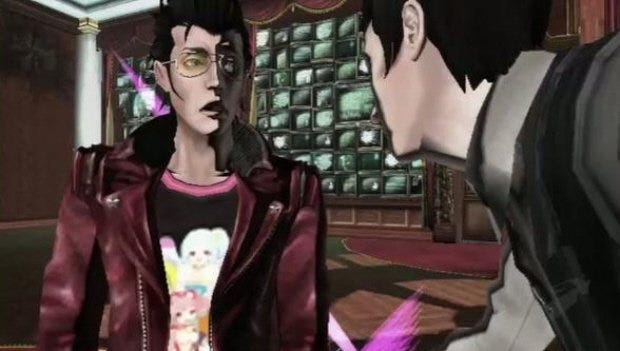
The lift doors carrying Travis Touchdown to the unlikely scene tsshck apart, and he steps out, aviator sunglasses masking quick eyes. Nathan Copeland holds the silence for a second before rising to his feet and using the momentum to lift the twins into the air. In a single arcing motion he hurls them at Travis Touchdown, who steadies himself against the incoming fleshy projectiles by placing his weight onto his back foot and firing his beam sword to humming, luminous readiness. Catching the twins mid-trajectory, Travis flurries his weapon back and forth across their twitching bodies, each suspended in midair by anime cliché.

Nathan Copeland leaps in slow motion towards the scuffle, his arms turning into two oversized ghetto-blasters as he does. The scene freeze-frames for a moment and the orchestra ducks sheepishly under the silence. Nathan and Travis catch eyes and the camera drops like a yo-yo to the floor, just in time to catch the coconut donks of two identical lipstick-wearing heads drop torso-less in front of it. Beat.

1

The batteries on your sword run down with use, and must be replenished either by picking up a new set from a crate or, alternatively, shaking the Wiimote mid-battle.

The world un-pauses and No More Heroes 2's director Goichi Suda presses the beam sword into your palms. Three minutes later, or however many continues it takes you, Copeland is vanquished. Travis Touchdown has cleared the second boss on the road to revenge and, perhaps more pertinently for his pubescent players, to the knickers of the pretty French girl who's promised you maybe-sex should you defeat them all.

If Dante's Inferno sought inspiration in 14th Century Catholic nightmares, then No More Heroes 2 peers into the wet dreams of every 14-year-old boy with a boner and a power fantasy. The result is no less fearful, but, if approached as a celebration of juvenility rather than evidence for its condemnation, far more enjoyable.

It mixes toilet humour with lightsabres, decapitation with banal one-liners, themes of stiff-lipped revenge with themes of pet care, Telecaster riffs with violin soliloquies and John Woo action mechanics with Famicom-aesthetic mini-games. And somehow, in amongst all of the confusion and tension and mess, a videogame of coherent vision and engaging execution emerges.
2

The graphical engine has undergone a major overhaul and the result is one of the best looking Wii games of this ilk

All of this, of course, was true of the first game, Suda 51's two-fingered punkish salute to who-knows-what. GTA seen through a glass darkly, Travis Touchdown's debut was structured around 11 wonderfully diverse boss fights, interspersed with visits to clothes shops, the gym and the job centre. It was a glorious hotchpotch of design ideas, a 200 rpm spin cycle of adolescent rampage and perhaps the closest that gaming has come to its Never Mind the Bollocks, full of filth, fury and impotent anti-establishment sentiment.

This sequel borrows the framework unquestioningly (upping the number of boss fights to 15), but strips out much of the mess that muddied the debut. Gone are the vast majority of the awkward biking sections that delivered Travis to and from his jobs, in their place a simple, understated menu system overlaid onto a town map, each destination a mere click away. Via this interface you buy new clothes for Travis to flounce around in ahead of his next fight, or toddle home to play with your vastly overweight cat (who, like Professor Layton's hamster, desperately needs a calorie intervention).

To fund your clothes habit and pet's diet in-between assassinations, Travis takes on mundane jobs once again, but these are rendered as multi-level Famicom-esque mini-games, far more enjoyable than the borderline tedium of the comparable sections in the first game. As with Retro Game Challenge, these contemporary imaginings of games-that-never-were are so well-designed and enjoyable that spending time hoovering up 8-bit rats and spiders for cash to buy a new belt or leather jacket feels like a reasonable proposition.

In battle too, No More Heroes 2 is a slicker beast than its forebear. Played with either the Wiimote or the Classic Controller (I prefer the latter for its precision) you lock on and switch between enemy targets, using a mixture of melee and beam-sword-based attacks to slice and dice your way through their health bars (represented by a neat, opaque clock face gauge that runs down with each hit).

Maintain an unbroken streak of hits and a pixillated tiger in the bottom of the screen will rise to its feet with each strike, before turning red when ready to trigger a hyper-focused mode, during which you can slash at enemies in double-time. It's a far more effective and measured system than the slot reel approach of the first game.

3

Once again, No More Heroes 2 celebrates videogame culture. The main quest is fired by Travis' wish to avenge the death of his local independent videogame store owner.

Most of the easygoing fighting is done in the run-up to each boss battle, where you clear corridors of enemies before opening up the next pathway, and these fights usually require only the lightest amount of strategy, allowing you to play with your enemies and try out different techniques. Conversely, the imaginative boss fights demand tactical thinking, as each opponent has numerous attack patterns that must be countered or overcome before they're beaten.

Once again, the boss fights are where Suda 51's creativity shines. One early battle sees you face off against a football player and his 23 cheerleaders who together join up to form a giant robot, known as the Santa Death Parade. There are returning cameos such as when you battle the brain of a character you defeated in the first game, or the two halves of Destroyman, who you sliced in half during Travis' debut, gentle fan-service that helps maintain a sense of continuity.

4

More violent, rude and ostensibly titillating than its predecessor, No More Heroes 2 treads a fine line between comic book brashness and grim vulgarity.

There is no denying that No More Heroes 2 is a more streamlined, svelte game than its predecessor. It boasts tighter design, more robust visuals and a settled sense of identity that makes it a better, more solid proposition. But in smoothing the rough edges of the NMH vision, this sequel has also lost something of the exuberance, so barely contained in the debut.

You no longer receive phone calls down your Wiimote from Sylvia, nor have to bat away baseballs in an impromptu mini-game, nor avoid a sprinkler system that will electrocute you via the beam sword handle if touched. It's not that anyone wanted to see these particular nuggets of creativity replicated in the sequel, but rather that they haven't been replaced by anything.

The game's concessions to traditional game design make No More Heroes 2 a more palatable, satisfying experience. But in doing so, you feel Suda 51 and his team have moved away from Grasshopper's boisterous 'Punk's Not Dead' slogan. Travis Touchdown may not have donned a suit and got himself a desk job - after all, he is still decapitating hot twins - but he's inched towards institutionalisation, with all of the benefits and drawbacks that entails for the young and wild heart.

8 / 10

No More Heroes 2 is out now in the US, and will be released in Europe by Rising Star Games at the end of April.

Read the Eurogamer.net scoring policy

Comments (84)

Comments for this article are now closed, but please feel free to continue chatting on the forum!

  • Loading...hold tight!