Version tested: Xbox 360
Given the involvement of hotshot RPG superstars like Final Fantasy creators Hironobu Sakaguchi and Nobuo Uematsu, it should come as no surprise that Lost Odyssey is utterly, utterly traditional. There's no fannying around with real-time combat here, like there was in Final Fantasy XII, just reams and reams of random battles, exploration and cut-scenes. Over the course of its 40-odd hours, it progresses at a glacial pace, taking a good few hours after you fire it up just to reach the barest semblance of a plot (which, just so you know, involves an immortal called Kaim trying to discover why he's been alive for so long).
In this, it is identical to every single other Japanese RPG to have ever existed. Indeed, there is little here to address the many failings of the form. Characters enter battle with earnest catchphrases like 'only the strong survive', and leave it only after punching the air to celebrate success. Battles are random - very random: playing through one stretch of the game twice triggered about seven encounters the second time after precisely none the first time. You'll spend at least half of the game searching through bins and rifling through strangers' drawers while they watch you without caring. The hero is - and I've forgotten how many times we've seen this before - an amnesiac. And the story, which is spread across four discs, frequently veers into saccharine sentimentality.
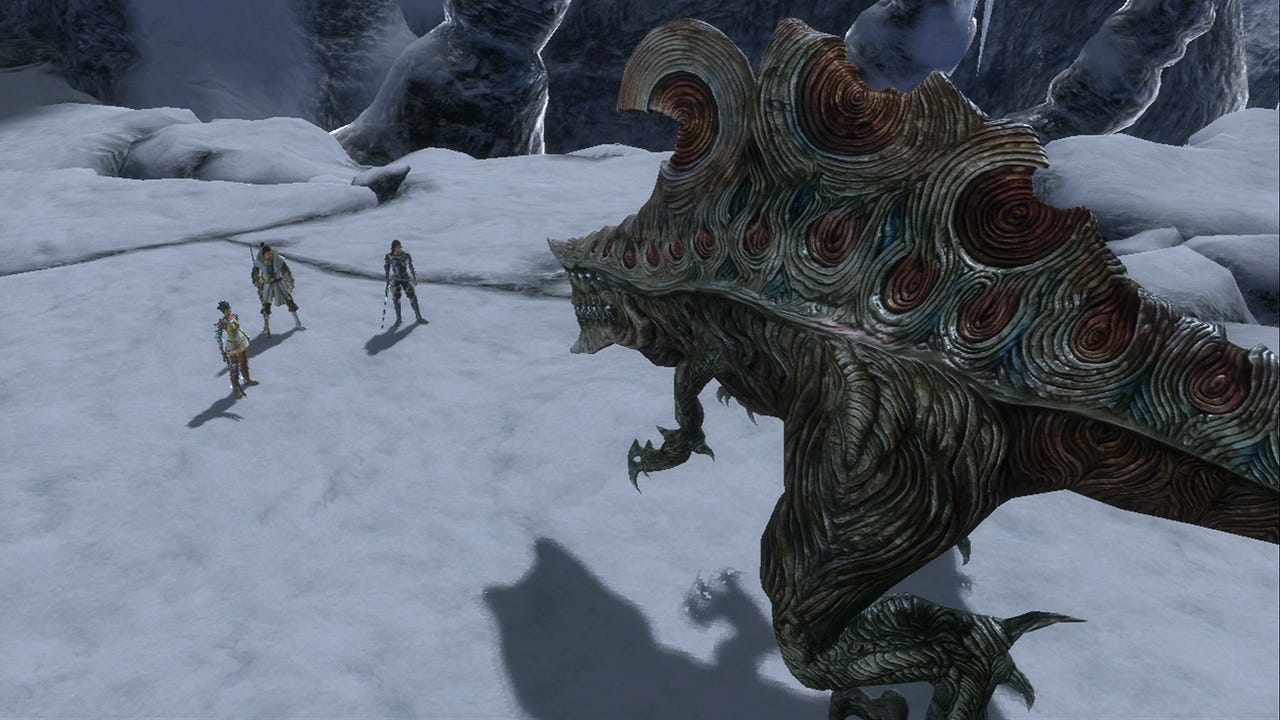
Lost Odyssey contains everything a good JRPG should, including a pointy-nosed stompy monster.
There are the inevitable stealth bits, treasure hunts, and item auctions, assembled into what could only be called bite-size chunks if you have a planet-sized mouth. Don't even think about sitting down to play Lost Odyssey if you haven't got an entire hour to play it: most save-points are between 20 and 40 minutes away from each other, and many of them are nearly an hour apart. Then there are moments of utter absurdity, like the bit where a queen flashes her chest at some armoured guards to secure safe passage to a foreign king, or the bit where you're forced to play through a series of funeral-based mini-games. Technically, it's all over the place, with neat tricks like depth-of-field effects offset by minor glitches like a smattering of eye-hurting frame-rate stutters. Even for what is a resolutely traditional Japanese RPG, cut-scenes are noticeably long, and there are lots of them.
Yet, for every head-scratchingly bonkers bit, there is an equally astonishing eye-catchingly awesome bit, like a sky full of flying ice shards, dealing all sorts of cold-based destruction, or the bits where various gargantua stomp around laying waste to cities. And the cut-scenes may be long, but in general the story they tell is a decent one, and they're jazzed up by the extensive use of 24-style image-in-image and split-screen editing techniques. The dialogue is respectable, and it's backed up by voice-acting that's generally good, with Kaim's immortal ennui encapsulated in a monosyllabic Keanu-Reeves-in-Point-Break monotone.
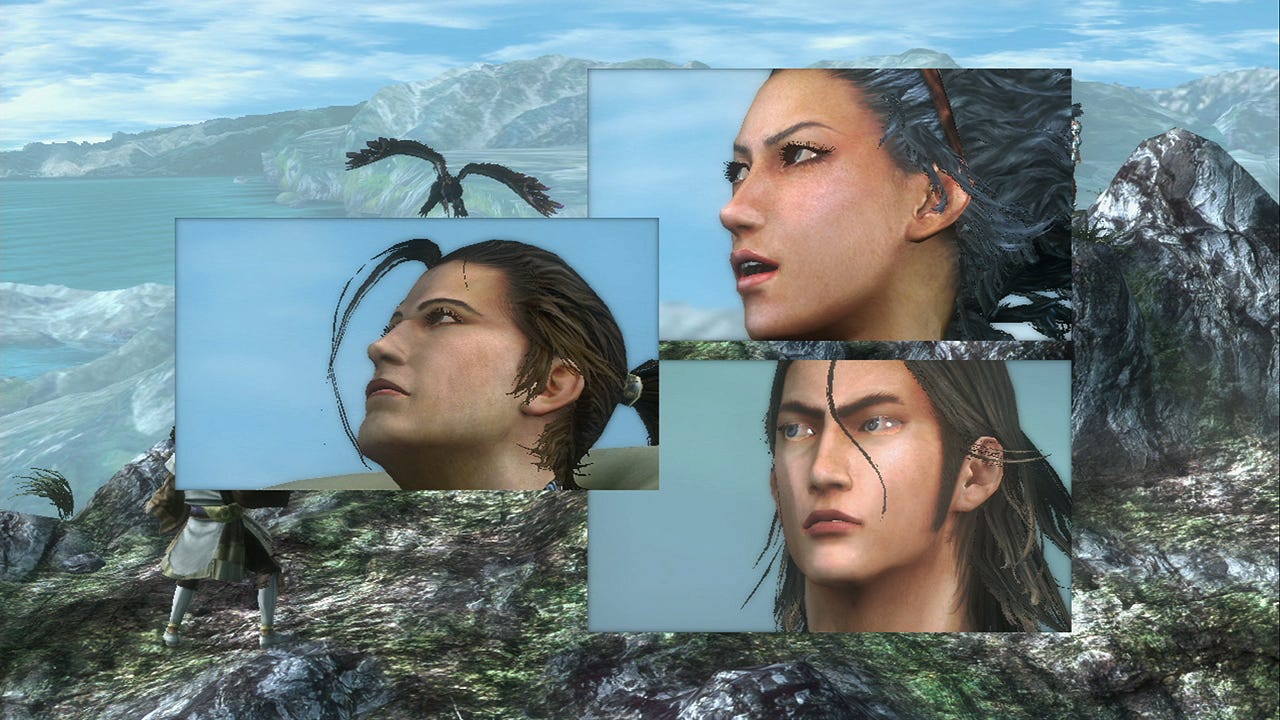
It also includes plenty of cut-scenes, spiced up by a bit of image-in-image action.
You can even forgive the problematically spaced save-points, because you'll be spending mountains of time playing Lost Odyssey anyway; in spite of all of its ups and downs and traditional failings, it's very difficult to turn the game off. Just when you think your patience is wearing thin it'll reel you in with another teasing narrative thread, or ensnare you with another new skill or item, or it'll throw a new game mechanic for you to play with.
Given the involvement of Mistwalker's hotshot superstars, it should come as no surprise to find that it's superbly polished. Its production values are universally high. The main musical theme, for example, treads the same doleful ground as Michael Galasso's soundtrack to In the Mood for Love. The character design and environments are superb. And over the course of the game, Kaim uncovers various 'dreams', or short stories, that are written by award-winning Japanese novelist Kiyoshi Shigematsu, and translated by Jay Rubin, a Harvard professor who is better known for his translations of Haruki Murakami.
Like any Japanese RPG, the true appeal of Lost Odyssey can be boiled down to its story, and its game mechanics. Lost Odyssey's mechanics are unreconstructed and utterly old-school, but they're polished to within an inch of their decades-long life, benefiting from modern-day tweaks. It's astonishing how effective the sprint button is, for example, taking much of the pain out of all the exploration and backtracking. And there are all sorts of neat touches, from a cube-based music mini-game to a trashcan-dwelling, gift-giving creature called a Pipot, who pops up every now and again. Most of the polish, however, is to be found in Lost Odyssey's combat system. It is, essentially, the usual blend of turn-based attacks using elemental magic or upgradeable weapons, but there are a few new features that improve it dramatically.
The first, and perhaps least important, is the guard system, in which the front rank of characters create a barrier that protects those located behind them. Not that unusual in an RPG, but here it's formalised, with the barrier in question given a name and some hit-points, to make its impact on your strategy more obvious. More important is the second feature, the skill system, because it goes some distance to alleviating the sort of fatigue traditionally engendered by random encounters. One of the best things about Lost Odyssey is the rapid pace of character progression, with almost every random encounter yielding some new achievement - mainly because of the way the skill system works. Characters learn skills either from other characters or from equipping items, and generally it only takes one or two encounters for at least one of your characters to learn something new. What's more, the sheer variety of skills to learn, and the limited number that can be equipped at any one time, lends the combat system an ever deeper, more rewarding complexity.
You'll need to wander round town talking to people, before rifling through their belongings to acquire money and items.
That complexity is further enhanced by the final feature: the ring system, which adds a rhythm-action element to the otherwise standard turn-based battles. Throughout the game you can create and equip magic rings to your weapons, giving them various extra powers, but to trigger them you need to press a button at just the right time during your character's attack. As with the skill system, it can inspire a fair amount of micro-management if you want to tailor your equipment and skills to specific enemies. That might not be to everybody's taste, but it's actually pretty satisfying to delve into the further reaches of the system and, in any case, you're rarely compelled to. Indeed, if micro-management item synthesis and skill-swapping isn't your thing you can get by perfectly adequately by just upgrading every now and then.
Those are the mechanics. As for the story, during its better moments it scales emotional and narrative heights that many other games simply cannot match. The plot is so essential to the appeal of the game that it's impossible to go into too much detail without ruining the experience, but it's fair to say it contains the usual mix of geopolitics, warring states, political intrigue, and magic technology. It opens up in a pretty linear fashion until there comes a point at which it dramatically splinters, taking off in various different directions. It's unconvincing in some places, and finds itself home to many familiar failings - brattish kids, over-emotionality, and too many twee bits (especially at the end of the second disc, which consists of a good ten minutes of people crying about someone you have little reason to care about) - but it also contains moments of unparalleled magnificence.
And the women have massive, barely-concealed, breasts.
Many of those moments are contained within the Shigematsu short stories. These dreams add so much more depth and emotional resonance to the main storyline even if, like me, you're so stone-hearted that you fail to cry while reading any of them. It would be interesting, in fact, to know which came first: the stories or the story. Did Shigematsu's stories inspire the main narrative thrust? Or was he asked to write them to fill in the gaps? Either way, they add another dimension to the storytelling, so while an amnesiac hero might have done before, the emotional richness of the story is fairly unparalleled by any other JRPG. Certainly, no other game has managed to capture such a breathtakingly elegiac tone, or created such a compelling account of the immortal longing for mortality.
And that, really, is the reason that Lost Odyssey manages to overcome its many flaws. If you just fundamentally don't like the genre, then there's a chance that Lost Odyssey will fail to convert you. If you're too attached to the sorts of innovation introduced by the likes of Final Fantasy XII, there's a chance that it's just too old-fashioned for your cutting-edge tastes. But if you've got the patience to sit through its slow build-up, and if you're open-minded enough to allow it to transport you, then it will take you to places that other JRPGs haven't even dreamed of visiting.
8 / 10
