Heroes of Telara

Serving up new technology in MMOs.

The MMO market is a tough one to crack. When Eurogamer launched its MMO channel early last year, it was in a mood of anticipation of a market that was about to be blown wide open, of what looked like a year's worth of stellar big-budget launches that would stampede through the breach made by World of Warcraft, and seize the mainstream.

16 months later, it hasn't worked out that way. In the premium subscription market, game after game has been delayed or scrapped. The anticipated flood of launches has actually been a halting trickle, and the couple of contenders that have managed to set sail - amid much fanfare and cracking of champagne against their hulls - have promptly floundered against their own over-ambition, or the granite cliffs of WOW's imposing Wrath of the Lich King expansion. Meanwhile, there's been frantic gold-rush into free-to-play gaming - and doubtless, some people somewhere are making some money in that mess, but not many seem to be making good games, Sony Online's recent Free Realms being the noble exception.

So it's a much warier atmosphere out there now. But there are still sufficient riches to be made that barely a month goes by without some new company surfacing, pockets stuffed with venture capital, hoping to make its backers' fortunes in MMOs. Last year, one of these was Trion World Network, and at this year's E3 it was ready to show its first project, fantasy MMORPG Heroes of Telara.
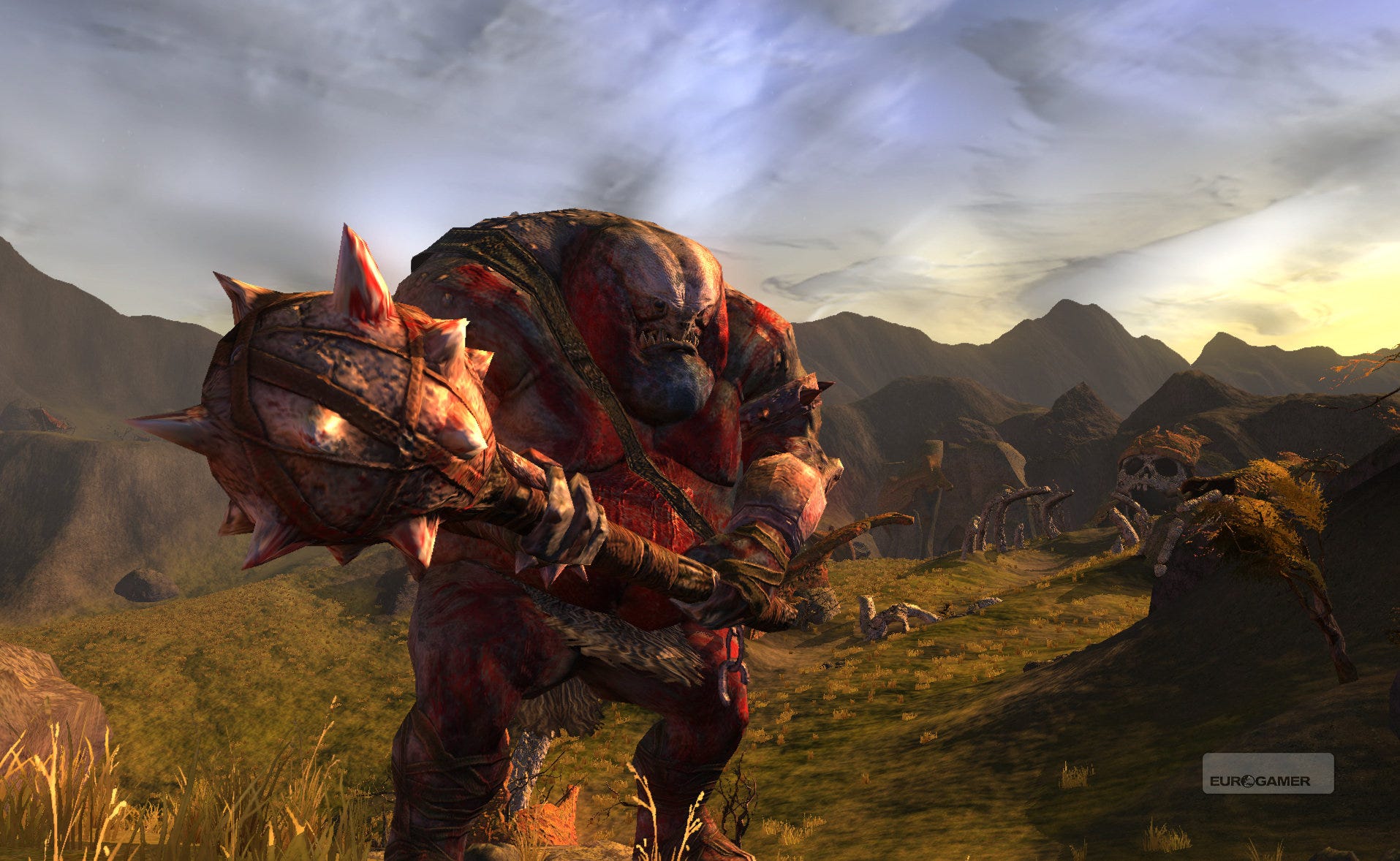
'Heroes of Telara' Screenshot 1

Ogre has big mace.

Trion is unusual in that it's banking on neither a big licence, nor a quick-buck raid on free-to-play gaming, to make its mark. It's banking on technology. Server technology, to be exact. The company's vision of server-based gaming (explained by chief executive Lars Buttler in a recent GamesIndustry.biz interview) reserves only video and audio rendering and the user interface for the game client, handling everything else - AI, physics and the very state of the game world you're in - on Trion's servers.

Most MMOs are halfway towards this state of play by default, but Trion's complete dedication to it makes it possible, Telara lead Russ Brown reckons, to create a much more flexible "live" world that you can currently see in its MMORPG competitors. The world-state can be changed on the fly by both developer and player, and events can more easily be triggered at a scheduled time.

"It allows us to trigger and tell the servers what the client needs to do," he explains. "So once the client has something like a dragon model, animations and a city, you can have the servers tell the client, hey dragon I want you to attack the castle... or the port. This allows us to give you more situations, more encounters, without necessarily patching the client."
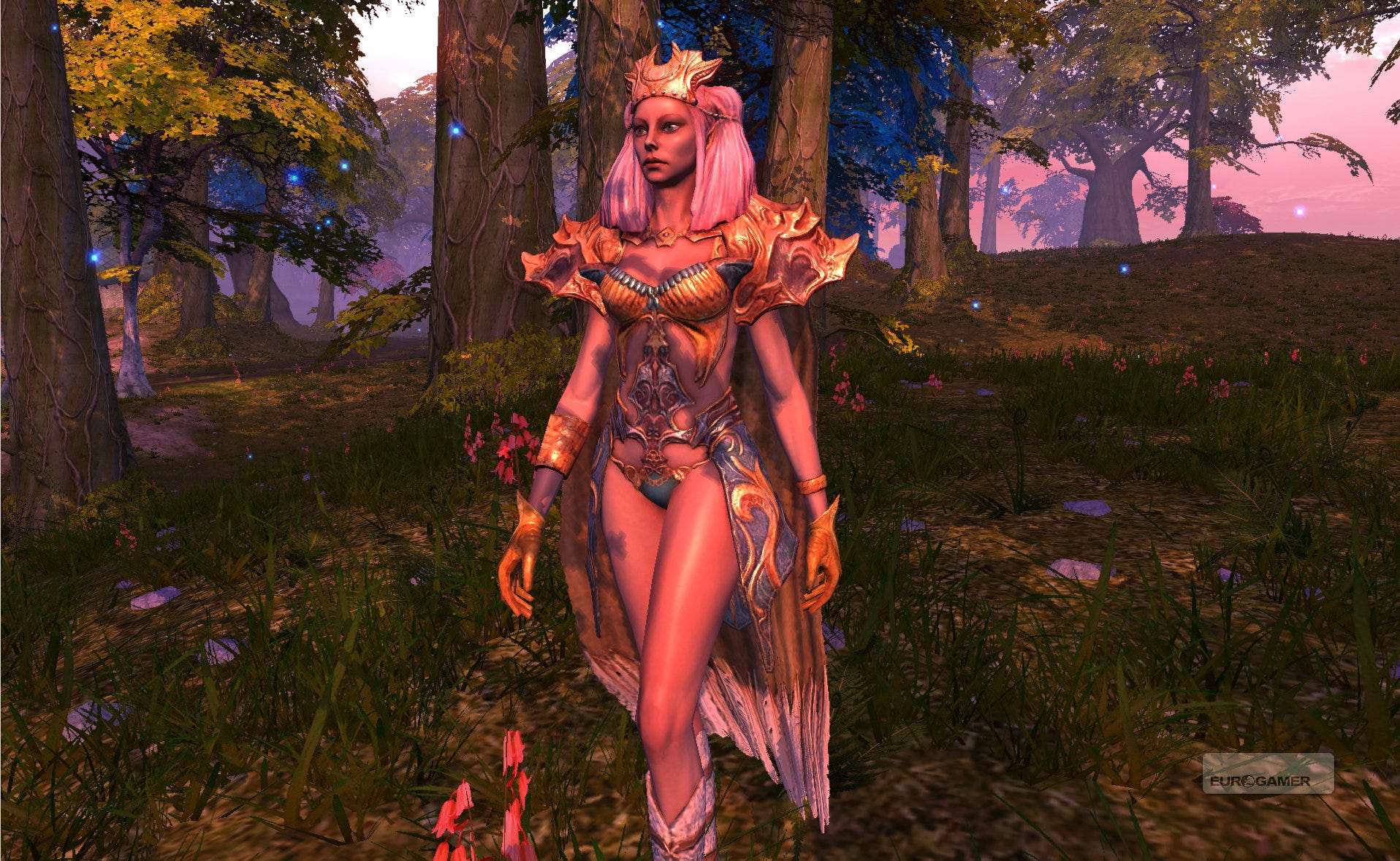
'Heroes of Telara' Screenshot 2

Lady has skimpy costume.

That last part is probably the key differentiator for Heroes of Telara. Several current MMOs have taken steps to shake up the genre's famously static worlds - Lich King's story-driven zone phasing, for example, or Warhammer Online's city siege system. But genuinely new content is impossible in these games unless it's delivered by a patch. Usually, an exhaustively play-tested, months-in-waiting patch. Trion is proposing a much more fluid world for Heroes of Telara that will constantly surprise its players, and hopes, once and for all, to break the excitement-to-apathy patch cycle that more or less constitutes MMO players' three-monthly period.

There's a second part to Trion's new flexible server system - a distributed architecture. "We allocate so many cores to each system," says Brown, "so we have so much horsepower going to physics, so much going to AI, so much going to world simulation - unlike a traditional MMO where you allocate your cores based on geographical location in the game, saying this island has so many cores or this continent has so many cores." This, he explains, will prevent server-side lag when large player populations congregate in a single area for one of the game's scheduled events.

Hardly a shy débutante, Trion has three games in production using these systems - an "MMO action RPG" being developed in conjunction with a Sci-Fi Channel TV series in San Diego, an MMORTS being made by Petroglyph in Las Vegas, and Heroes of Telara, whose production is based in Redwood City near San Francisco. The technology does sound intriguing, but this level of commitment shows a fairly aggressive level of self-belief from Trion. Can Heroes of Telara justify it?

It's hard to tell, mostly because Trion has chosen to seat its innovative infrastructure in a design and world that are desperately, dispiritingly generic. This is absolutely straight high-fantasy RPG fodder of a sort that normally doesn't succeed unless it has words like "Lord of the Rings" or "Dungeons & Dragons" on the box. In MMOs, it hasn't done so since SOE unleashed its own generic hotch-potch of fantasy cliché, EverQuest, ten years ago. It can be saved by good timing, great artwork or a moment of inspiration, but Telara seems to be blessed with none of these things. It's technically accomplished and blandly pretty, but nothing in its world grabs the attention.

'Heroes of Telara' Screenshot 3

Goblin has strange hair.

There are the standard four class archetypes: mage, cleric, warrior and rogue. You can play them all on one character, levelling them independently as in the recent free game Runes of Magic, and switching between them in town. There will be "a lot" of sub-classes available, according to Brown, and these can be switched between on a single character at any time, as he demonstrates by changing from a balanced Warrior to a low-defence, high-offence Berserker in the middle of combat, before diving into a Warhammer-style open quest. Sub-classes don't need to be levelled independently, developing in tandem with your main class. Later on we see the Gravelord, another melee fighter who can shoot from range and command pet skeletons. Combat is a straightforward affair of clicking skills on a bar.

The potential for live events afforded by the server-based structure of Heroes of Telara is demonstrated when we return to the peaceful, gated medieval quest-hub town that we set out from. The gates are broken, buildings are on fire and NPC vendors and quest-givers are gone; the town is being ravaged by a sizeable demon and his imps. Demon duly defeated, there's an explosion of fireworks and the townspeople reappear to cheer the victor - but, Brown notes, you could also leave the town to burn to the ground, which would render its amenities unavailable for a while.

On the surface, it's not much different from the instanced events or semi-instanced "phased" world-states you can currently see in WOW and other games, but the difference in Telara is that these events are triggered for everyone on the server, and they can be shaped live by GMs rather than scripted and patched in by designers. It's an exciting step towards an immersive, "living" world, but it does come at a potential cost of convenience - crucial NPC services becoming unavailable to players when they need them, for example. Trion will need to pick its way through this minefield with care, and Brown notes that traditional instanced encounters will also be available.

'Heroes of Telara' Screenshot 4

Desert has rocks.

Heroes of Telara is aiming for a PC release in 2010. On the evidence of its E3 showing, its intriguing technology and fluid live events could, if well-managed by an on-the-ball live team, create a distinctly lively and engaging experience for the fantasy MMO fan. The open-ended class system sounds liberating, too.

But if it wants to attract a broader audience and bring home a sizeable slice of that ever-elusive MMO cash pie, Trion will have to try to squeeze a little more personality into Heroes of Telara's derivative fantasy setting. Providing a place players really want to spend time in is one of the hardest and most important tasks facing any MMO developer, and at the moment, the world of Telara looks just like any other, and risks not being noticed at all.

Comments (14) Latest comment 3 years ago

Comments threads automatically close after 30 days, but please feel free to continue chatting on the forum!

  • Gurgeh #1 3 years ago

    "they can be shaped live by GMs rather than scripted and patched in by designers"

    Been there and done that - it is not technology that stops GM events from current MMOs, it is cost. Back in the day both Everquest and Asheron's Call had GM events, then came the lawsuits from the low paid workers. Presto, end of GM events.

    If someone has the balls and the vision there is room for a new MMO. WoW is coming to the end of the Arthas story and Blizzard are not spending money on developing it the way they used to - if anything the opposite.
  • DrMGinius #2 3 years ago

    Is true it looks generic.
  • sneetch #3 3 years ago

    No! Skimpy costume lady links to picture of ogre again! This is the worst day ever!!

    And WoW will carry on strongly for a loooooong time. Arthas may be done but the Emerald Dream awaits. There's acres of possibilities for the next expansion or two.
  • JCHilton #4 3 years ago

    This article has pictures.
  • Sycopat #5 3 years ago

    Picture has caption
  • actionfitz #6 3 years ago

    Comment has 'not as good as Generic game x' remark.

    (and typos :/ )
    Edited by 1 at 20/07/09 @ 12:34
  • actionfitz #7 3 years ago

    @ Gurgeh

    'Blizzard are not spending money on developing it the way they used to - if anything the opposite.'

    thats because Actiblizz are so strpped for cash tbh, its not like they own some of the biggest selling franchises in the industry or anything... its not like they'll soon be reaping in cash from millions of idiots who don't mind paying £55 a console game...

    oh wait.
  • mingster #8 3 years ago

    This sounds so generic it untrue
  • Gurgeh #9 3 years ago

    @Actionfizz:

    "For the quarter ended December 31, 2008, Activision Blizzard recorded a GAAP operating loss of $148 million ....Activision Blizzard's GAAP operating loss for the calendar year 2008 was $0.2 billion."

    Hmm

  • BigJonno #10 3 years ago

    It struck me that it's not the fantasy world that bothers me, I like generic fantasy settings, it's the tired warrior/mage/cleric/rogue archetypes. Live events are a huge draw for me, but they better have more than that to set themselves apart.
  • Rubarack #11 3 years ago

    Potentially having a live event every couple of years or so in one of the 6 servers or so is nice, but hardly a big selling point.
  • Eisenstein #12 3 years ago

    There is a good reason why MMORPGs like WoW let the client handle so many things: it makes for a smoother experience if the connection isn't perfect. Instead of standing still, not reacting to input and then getting a OOS/timeout you still can move around and do things in such a model until you get resynched with the server. The downside is of course that it allows for exploitation (replacing textures, replacing models, teleport hacks).
  • MightyMouse #13 3 years ago

    I actually think this sounds good as long as they can get some decent writers involved. The vast majority of fantasy settings are basically pretty generic; it's the detail that they live and die by.
  • TSYNDMonkfish #14 3 years ago

    This game could be the best thing since that imaginary drunken night in with Girls Allowed - but I doubt I'll ever know because the whole fantasy world thing has been done to to much, plus, as BigJonno said, its the same class types, again & again.

    What MMO players are crying out for (OK, what I'm crying out for) is something different - like a Planetside2, or an ARMA MMO, or that Vampire Bloodlines type game that CCP are working on
    Edited by 1 at 20/07/09 @ 15:44