Heavenly Sword
Our take on the PSN demo.

By now you'll have read our recent Heavenly Sword first impressions. By now you'll have downloaded the Heavenly Sword demo released on PSN last week. By now you'll have been able to finish it approximately 47 million times. By now you've probably decided it's too short and doesn't really show us anything we didn't know.
There have definitely been complaints. First up, it lasts about five minutes. Second, it's heavy on Quick Time Events, where control is reduced to prompted button-presses as you slide down ropes or leap from tumbling pillars. Third, combat isn't as complex and nuanced as something like Ninja Gaiden or Devil May Cry. Fourth, the framerate's a bit wobbly.
I happen to rather like it. It's short, but then it's a demo. It's easy, but it's a demo. We already know that the rest of the game - pegged at between 10 and 15 hours long - widens combat to take in Jet-Li-style defensive ranged manoeuvres, puzzles, various boss fights, playable sections involving Nariko's odd little friend Kai, and a wealth of cut-scenes put together with the help of Andy Serkis. If the one in the demo's anything to go by, facial animation, lip-synching and the rest of it are about to take a King Kong-sized step forward.
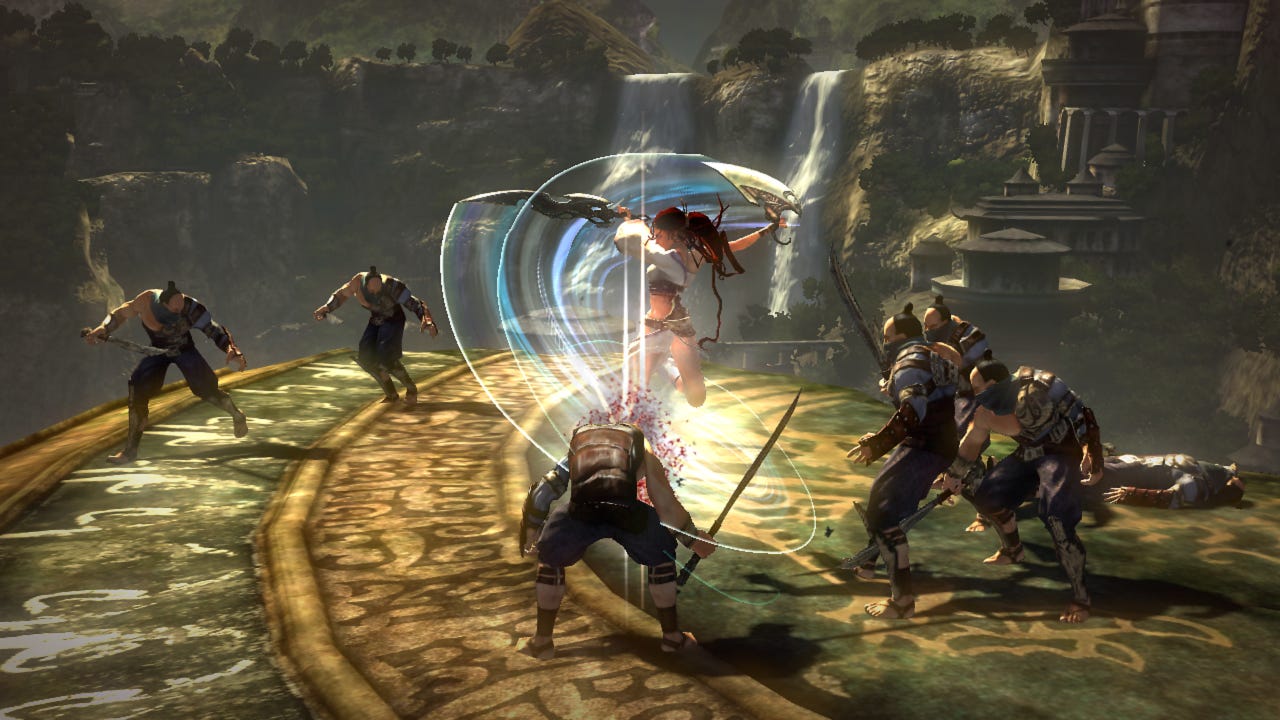
Not that I'm defending the use of Quick Time Events. They're tolerable, but they need to be kept to a minimum unless they're sort of the point, like they are in Fahrenheit, in which case they have to be done well. In the Heavenly Sword demo, you have to hit analogue-stick directions and rhythmically tap the X button in a pair of related action sequences, and you could easily argue that they're merely there to make you feel like you're doing something besides just fighting and watching movies. That said, examples of games that got away with them include Tomb Raider Anniversary and God of War (9/10s both), so let's not panic just yet. It'll be interesting to see how much Ninja Theory adopts them for the real thing.
Combat, meanwhile, could do with a bit of defence. It's not Ninja Gaiden or Devil May Cry, but then Ninja Theory probably wants to shift some units at retail. The result is something that tapers into God of War's category, if not particularly its orbit, and can be summed up thus: button-mashing works, but experimentation yields simple, effective gains.
Initially you'll be hammering the square and triangle buttons - your main attacks. The combo list is simply these two in rhythmic sequence. For bothering to use them both - and taking it slowly rather than simply pummelling them - you'll get to witness Nariko spinning like a vortex, booting people into the air and then juggling them, winding ferocious blows together with ease, and twirling laterally through the air in a giddy blur of metal and flaming tresses.
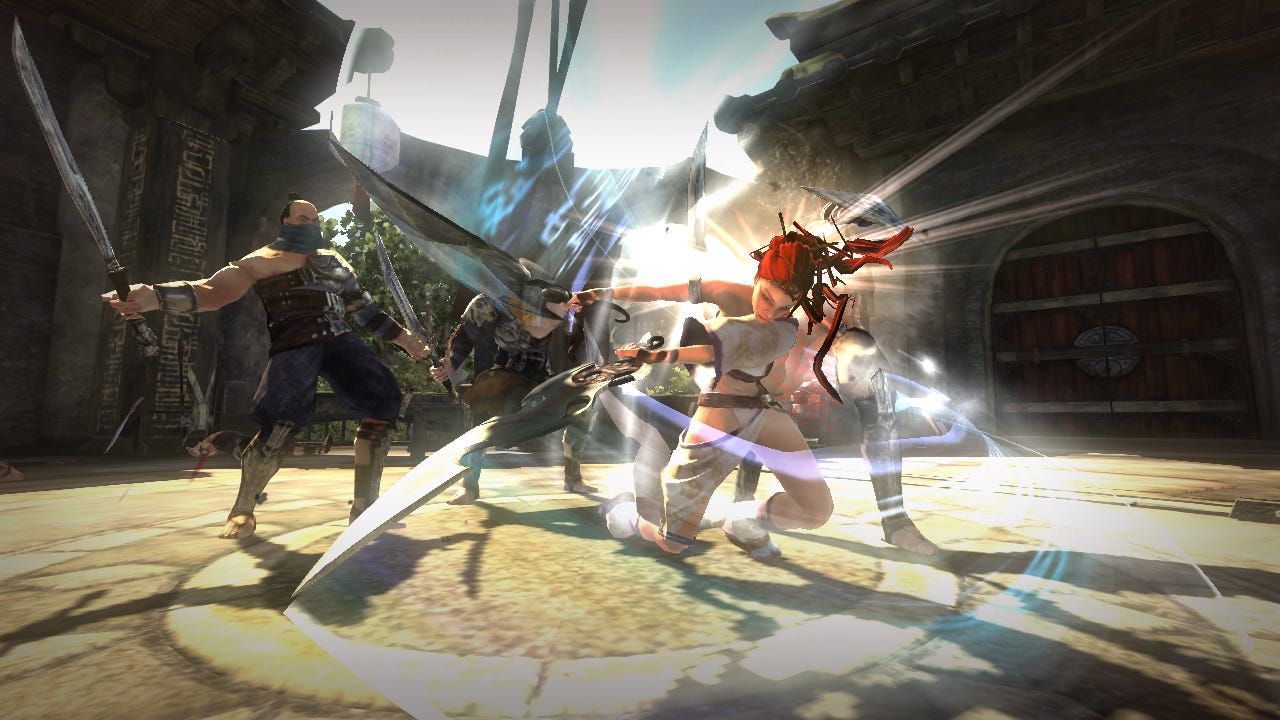
(Somewhere off-screen, Hayabusa can be heard snorting with derision).
So alright, yes, that's a bit simple, but it ignores completely the other things you can do. There are two alternative stances, for instance. By gripping L1 as you rain down moves, you'll perform ranged attacks, spinning your chain blades like Ivy out of Soulcalibur on her day off, while R1 brings on the heavy stance, where you'll sacrifice manoeuvrability and pace for force, using the big blade to smash your enemies around the close confines of each arena-like battleground.
There's also the ease with which Nariko can counter, and go aerial. Counters are as simple as timing a triangle-button stab to coincide with an approaching enemy of a certain hue. Those blue, orange and red tints are meant to help you do this, giving you an idea of which stance will block the incoming attack.
Again, the accusation is that it reduces defence to one or two responses. But while this is to some extent accurate - indeed, Nariko blocks a lot of attacks automatically, and can dodge-roll out of the way with right-analogue movements - it also rather misses what seems to be the point of the demo: quickly mastering the spectacular.