Version tested: PlayStation 3
In echochrome, the solution to every puzzle is that seeing is believing. If you can align a pair of platforms so that they appear to be one, they are. If you can position a hole so that it appears to be above a beam, it is. Although the beams, staircases and pillars that make up each stage are positioned normally in 3D space, gravity bends and distance becomes nothing in accordance with the player's perspective.
As a little man walks along these paths suspended in the air, all you have to do is guide him between the holograms scattered across each stage and then return him to the starting point, but like Portal last year, the game's capacity to reduce vast distances to nothing means that doing so requires a mixture of lateral thinking and, as the game progresses, dexterity. Overall, it's an arresting concept.
Initially the game sets out its five "laws". All you manipulate in echochrome is the camera, which can be rotated, raised and lowered around each of the 56 levels unique to either PS3 or PSP that are hung in white space, and the first law, perspective travelling, is the one where you connect pathways by aligning the edges. The second law, perspective landing, is about aligning a black hole in one beam so that it appears to be above the area you want to reach; if your man passes then over it, he will fall through and land where you want him.
Law three, perspective existence, allows you to bridge gaps between pathways by obscuring them with pillars, while the fourth, perspective absence, allows you to avoid the effects of black holes and white spots, the second of which propel you into the air, by obscuring them in the same way. The last law, perspective jump, lets you use those white spots to jump to other ledges, even though they may be very far away and high above, by angling the camera so that the second ledge appears to be close by.
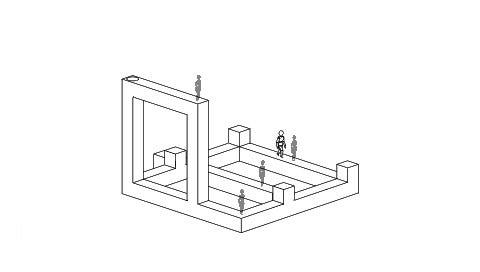
The game is basically the same on PSP and PS3 but with a different set of levels.
Having emerged from a brief tutorial that demonstrates each concept, you have the option of playing through the game's 56 levels at random by selecting the "freeform" menu option (with retry and skip-level options when you pause), visiting the "atelier" menu to select them directly, or using the same menu to play through them in groups of eight. The game records your best eight-level course and individual stage times for leaderboards.
Early progress is satisfying as you start to anticipate solutions and become fluent in the game's language. Anyone walking past the screen will think what you're doing is magical, unable to grasp the concepts at a glance. Within an hour of starting, the initial concepts become more complicated as bumps, additional holes and jump-spots slow your progress, and the canny level designers deploy platforms that won't easily align.
At this stage the other controls become useful, like the ability to stop and "think" by pressing triangle, or to snap beams together with the square button in order to reduce the fiddly process of aligning them perfectly. You can also rotate the camera faster by holding R1, or have your avatar walk faster by holding X. When you fall through a hole or throw yourself into the air, you can allow your little man to fall away and rotate the camera so that he descends around corners and into gaps. Success, when you utilise this expanded range of abilities and logic, should be sweeter.
Except it's not, and it's because echochrome may appear magical from a distance, but once you understand how it's done, and have played through a few dozen levels, the novelty wears off, and all that remains is the rather cold process of grinding away until some combination of the game's five laws guides your little man successfully between his objectives. Even the most imaginative levels - and some of them are ingeniously constructed - are rendered charmless.
As the weariness starts to set in, minor quirks in the controls become seriously irritating. The "thinking" button is a bit unresponsive, and since you often want to use it to check your movement just before your man reaches the tip of a ledge and turns back on himself, that delay is frustrating. The "snap" button doesn't always work the way you expect, either, and certain edges refuse to align except in particular positions.
Worse for the game's long term prospects, the ability to toss yourself round corners and into awkward spaces is too difficult to master, because even with the ability to change camera rotation speed, precision is difficult to attain; the analogue acceleration and inertia needs to be closer to something like Halo's aiming, but is rather rudimentary instead. And despite the inclusion of rankings, you can't upload replays. A system similar to RedLynx Trials 2: Second Edition, with near-instant replay downloads and closely integrated leaderboards, could have encouraged more competition over times, in spite of the other problems.
Some of the levels spell out words. This one doesn't, we just thought we'd mention it.
All of which is a shame, because as a magic trick to show other people, echochrome is tremendous. The white levels use nothing but black lines to describe each platform, pillar and gameplay object, and gentle string music plays over the top. Elsewhere, using the "canvas" level editor, it takes five minutes to put something together (figuring out the relationship between the d-pad-controlled cursor and the camera is the only stumbling block), with Sony to release bundles of the best uploaded examples as free downloadable content.
There are also times, albeit few, when the artwork by Dutch artist MC Escher that inspired echochrome in the first place shines through. As the perspective shifts across a particular axis, up becomes down, and your brain spasms slightly as it struggles to process the seemingly contradictory information. I'll remember playing echochrome most for when it did that. Otherwise, at USD 9.99 in the States, it does enough to warrant the score below, but don't be surprised if it doesn't mesmerise you as much as the videos did when you first saw them.
7 / 10
