Dead Space Review

Mostly armless.

Version tested: Xbox 360

If you're in the future, and you work on a spaceship, and you get a call telling you to go and check out some remote colony because contact has mysteriously been lost, do yourself a favour and call in sick that day. Skive for your life. The only reason space colonies, and the drifting spacecraft spookily orbiting above them, stop communicating is because they've been overrun by bloodthirsty monsters. This is scientific fact.

Unsurprisingly, this is exactly what has happened to the USG Ishimura, a deep space mining vessel - or "planet cracker" - which has been tearing up chunks of some distant dead world in the quest for greater profits. When it all goes eerily silent, the crew of the USG Kellion are despatched to investigate and you, as petty engineer Isaac Clarke, are along for the ride. Isaac has a personal reason to hope all is well on the Ishimura. His girlfriend, Nicole, is on the ship and the last contact he had with her was a disturbing plea for help.

Needless to say, things don't start well. The Kellion shuttle crashes, and the investigators are attacked by fleshy shambling things as soon as they enter the Ishimura. Isaac is separated from the two other survivors - computer technician Kendra Daniels and gruff military man Sgt. Zach Hammond - and must make his way through the bowels of the ruined vessel to organise an escape plan.

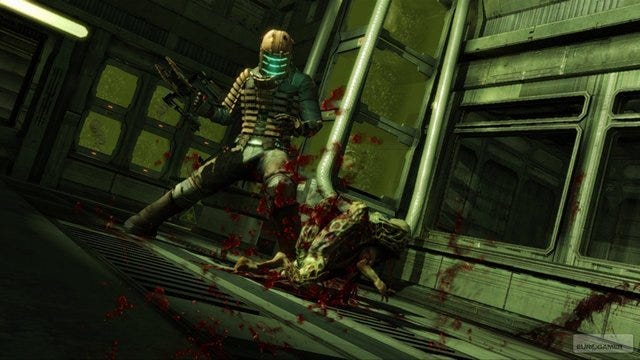
It's a journey that is never less than visually stunning, thanks to some painstaking attention to detail in the graphics. Motes of dust drift lazily in the air, mist curls up from ominous shafts, flickers of light illuminate skittering shapes in the distance. Isaac's protective suit (which you can upgrade throughout the game) is a curiously old-fashioned mixture of textile and brass, with weave and rivets clearly visible as you prowl the darkness from over his shoulder. The textures don't always keep their detail at close range, but considering the frame rate is rock solid and there's absolutely no screen tearing that seems like a minor compromise. This level of technical polish holds true on both 360 and PS3 versions, you'll be pleased to hear.
1

The foot stomp is useful for opening crates - and for squashing smaller foes.

Control is instantly intuitive, but then it should be, since the game has basically stolen the meat of the control scheme from Resident Evil 4. There's no jumping, climbing or crouching, with environmental interactions carried out by following button prompts in the appropriate place. You can move and open doors while aiming, while the d-pad offers quick access to your four weapon slots. Health packs can be stockpiled and used with a hot button. Isaac picks up a couple of augmented abilities along the way - Stasis, which slows down objects and enemies, and Kinesis, which allows him to grab or drag objects from afar. These are sensibly activated by the face buttons modified by the aiming button, as is reloading, so all your combat options are instantly accessible whenever you have your gun raised. There's never any fumbling around trying to do two things at once in the thick of the action.

To aid with the immersion in Dead Space's grim tale, all the info you need is conveyed on-screen without resorting to health bars or pause screens. Or rather these elements are used but in such a way that it feels part of the gameworld rather than a mood-breaking interruption. Isaac's health is monitored by a glowing blue gauge on the back of his suit, next to the dial which shows how much Stasis energy he has left. It's not always successful though, since when you're backed up against a wall by gibbering space mutants it can be impossible to see how close you are to death. Holograms are the key to everything else, with your inventory and incoming video messages relayed through floating semi-translucent screens which pop up next to Isaac. You can even rotate the camera around and through these screens, revealing a rather nifty 3D effect.

The back of Isaac's suit is also where his air supply is displayed when you enter decompressed areas, or rooms where the air is toxic. As with all of the abilities and weapons, you can increase the effectiveness of the suit's features by upgrading them with power nodes. These are found sporadically - usually as a reward for braving a tough section or defeating a nasty foe - and can be used at workbenches. Upgrades are applied using a circuit diagram, with each power node filling one space in the circuit and coloured spaces denoting the different areas open to improvement. Armour and air supply for the suit; capacity, damage and reload time for weapons; duration and range for Stasis and Kinesis. It's not a very elegant system, but with a lot less power nodes than slots it forces you to choose your favourite features and work out the most efficient way to boost them. You keep the same stats should you start a second playthrough after completion, so this is clearly a feature aimed at the repeat player.

Combat itself is immensely satisfying. Remember the satisfaction you felt in Resident Evil when you first exploded a zombie's head? Dead Space takes that concept to its logical extreme, with a play model that not only allows but actively encourages you to shoot your enemies to pieces, one bloody limb at a time. The alien monsters - or necromorphs as they're called - reanimate dead human tissue, ya see, and repurpose it into grisly new forms. This means that headshots or a volley of hits to the torso won't do the job.

You need to shoot legs off to slow them down, blast away their arms and pincers, sever their heads until there's nothing left but old meat. Combine this with the Stasis power, so you can methodically dissect monsters as they slowly lunge towards you, and you've got a gimmick that remains fun even after eleven hours of gameplay (the time on the clock at the end of my first run, by the way). Battles in zero gravity are even more amusing, as defeated enemies drift gruesomely upwards, spraying gore and body parts as they go.

4

These brutes look terrifying, but prove pathetically easy to kill once you add Stasis into the equation.

Yet while the core combat element never stops entertaining, it never really evolves either. By the end of the fourth chapter (there are twelve in total) you'll have access to all the game's seven weapons, few of which change the gameplay in drastic ways. The Line Gun is a beefier version of the plasma cutter, sending a wide blade of energy scything through your attackers. The Force Gun repels creatures with a shockwave, and can splatter smaller enemies, while the Contact Beam charges up slowly and then fires out a powerful energy blast. Gore fans will gravitate towards the Ripper, which fires out a remote saw blade which you can direct from a distance. The flamethrower and pulse rifle work much as you'd expect.

Each comes with an alternate fire mode, some of which aren't really explained all that well, but since almost every enemy simply races towards you, drooling and snarling, the times when you really need to choose the best tool for the job are minimal at best. The very first weapon you get - the plasma cutter - is as effective at the end of the game as it was at the start, even without many upgrades. As such, the threat of the monsters never really has the power to terrify. Provided you're reasonably frugal with the ammo, you're always capable of dismembering anything that comes your way.

This doesn't speak very highly of the game's pace or balance, and it's this area that renders Dead Space less impressive than it first appears. You spend a huge chunk of the story running backwards and forwards across the Ishimura, fixing a series of core systems at the behest of Kendra and Hammond. Each time you fix one element, they pop up to tell you something else is malfunctioning or missing. It gets to the point where you half expect them to ask you to find some toner for the photocopier and fetch them a sandwich from the shop. Each maintenance job takes the form of a fairly basic puzzle, where the solution always relies on Stasis, Kinesis or a combination of the two, with the treks in between punctuated by scripted monster attacks. There are certainly moments that make you jump, but the game struggles to maintain the pervasive atmosphere of dread so acutely captured in the opening section.

It turns what should have been a nail-biting fight for survival into a wearying series of petty chores, forcing the gameplay into a predictable routine for the first two-thirds of its playing time. As far as horror goes, nothing kills the mood faster than predictability and when you have to include dialogue for your characters commenting on the seemingly fruitless repetition of what they're doing, that's usually a sign that the pace of a game needs closer attention.

It doesn't help that many of Dead Space's features feel overly familiar from other, broadly similar, titles, and the Resident Evil 4 controls are just one of the borrowed elements boldly on display. There are automated stores where you can turn schematics into new weapons, stock up on ammo and health, sell unwanted items for cash and store your inventory overflow in a virtual safe, not unlike the storage chests in Capcom's classic. The Kinesis power is Half-Life 2's gravity gun in all but name, while the slowdown effect of Stasis echoes the temporal monkey business of games like TimeShift.

Back-story is dished out via text, audio and video logs left lying around, a narrative method which can't help but recall Doom III and BioShock. The mangled monsters could have slithered out of Quake, and even the zero gravity sections owe some small debt to the magnetic puzzles in Prey. It's a grab bag of existing concepts, a Greatest Hits of horror/sci-fi videogaming, and while the end result is never entirely disappointing, it's a shame that none of the wonderfully realised environmental elements - vacuums and zero gravity in particular - are ever used to elevate the rote gameplay beyond surface details.

6

The golden rule: if it looks bloody and meaty, you should probably shoot it to bits.

Having come up with a stunning game engine, it also seems that EA couldn't come up with something more original to populate it. The concept of exploring alien-infested spaceships is hardwired into gaming DNA, and Dead Space relies so heavily on established survival horror rhythms that experienced players will be able to anticipate most scares and revelations before they arrive. That it all builds to a climax that is both narratively ridiculous and predictably videogamey (clue: giant boss monster with obvious weak spots) merely strengthens the lingering whiff of missed potential.

Isaac himself proves to be a fairly pointless lead character, too, unlikely to inspire much in the way of empathy or interest. With only two brief glimpses of his face bookending the story, and absolutely no dialogue, it's hard to invest in his search for his lost girlfriend, especially since the game neglects to develop this element in any meaningful way until its rather inept pay-off at the end. Gordon Freeman can get away with being a mute witness to apocalyptic events because we've viewing events through his eyes, and because he's not required to convey any emotional storytelling. Isaac, by comparison, acts like an emotionless automaton even when faced with the most horrific sights and the human factor - always a key in driving a horror story - suffers as a result.

None of these criticisms will detract from your enjoyment, provided all you want from a game is the opportunity to repeatedly turn evil monsters into red mush in gorgeous HD detail. Dead Space easily delivers on that promise, but fails to turn its polished production values into something truly memorable over the long haul.

7 / 10

Read the Eurogamer.net scoring policy

Comments (189)

Comments for this article are now closed, but please feel free to continue chatting on the forum!

  • Loading...hold tight!