Dante: from text to TV

Fiction burns.

To judge the significance of a figure to a particular culture, you don't need to assess the weight of scholarly opinion concealed in a long-forgotten corner of a library, nor to seek out the affirmation of cobweb-brained contemporary intellectuals. You simply need to go out on the piss in his home town.

Dante Alighieri is Italy's great literary figure, and Florence was his home. We've come here for the global unveiling of Dante's Inferno, a story-driven action game from EA based on the first part of The Divine Comedy. Yes, there are Dante museums, statues, memorials and monuments, but his cultural resonance is felt most keenly on the street, in the Dante ice cream parlour, or the numerous Dante bars tucked away in the elaborate network of medieval streets. It's essential to experience them all to get a real taste of the man. Heck, his chops are even on the local coins.

The broader cultural influence of The Divine Comedy stretches far beyond the banks of the Arno river, and even the Italian border. In modern pop culture its words and themes have been kidnapped by artists such as Radiohead and Sepultura, as well as inspiring the name of Neil Hannon's band. It's there in movies like Se7en and Hannibal; or, more strikingly, the 1935 Spencer Tracy flick, Dante's Inferno. And it's proved rich pickings for videogame makers, having been notably ransacked by Capcom for its Devil May Cry series while receiving furtive nudges, winks and admiring glances in countless others.

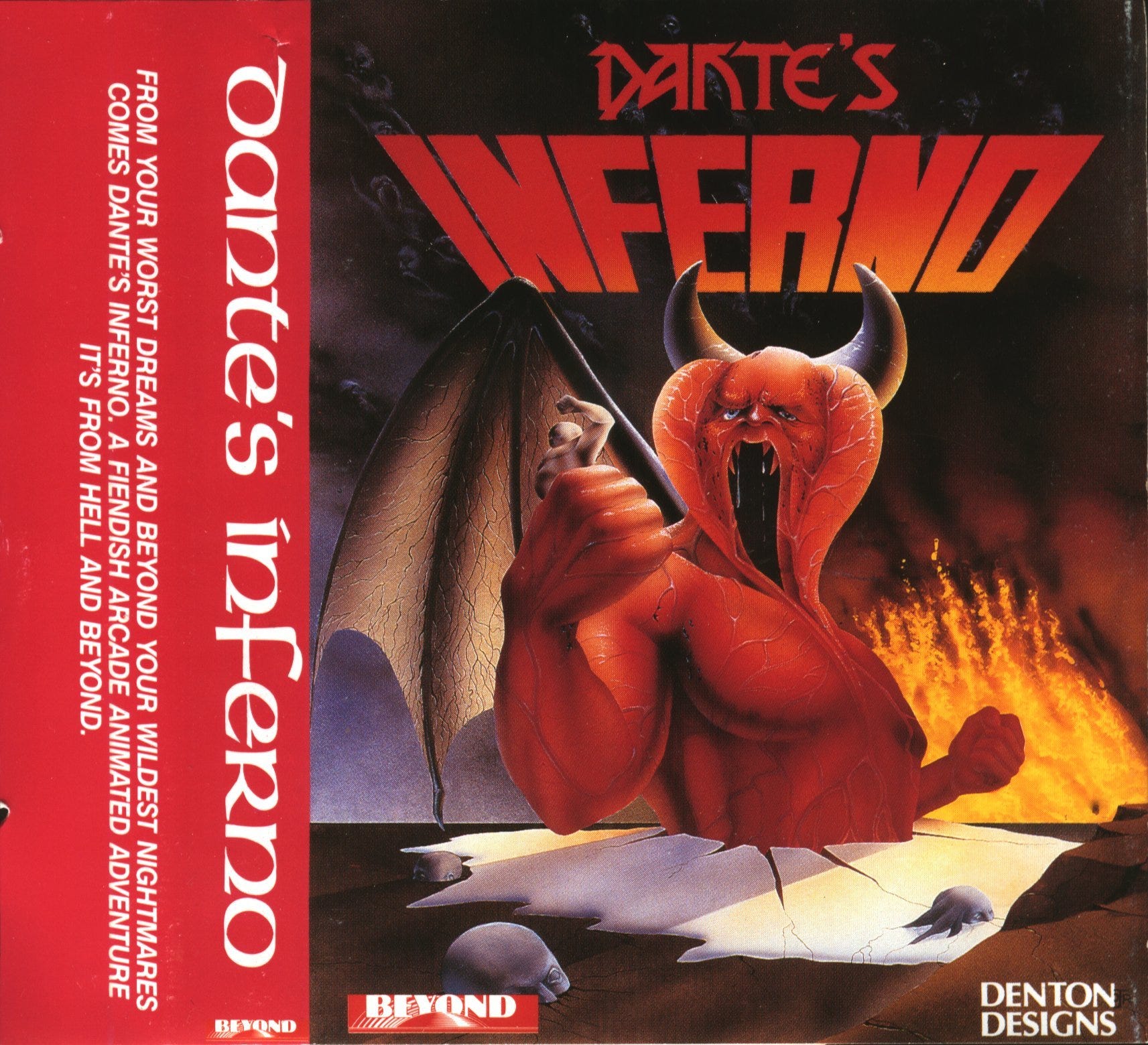
But EA is the first to attempt a direct adaptation since Denton Designs had a crack on C64 in 1986. On the one hand, it's a naked God of War clone; on the other, it's a mark of the publisher's self-proclaimed desire to prove that classic literature is not the preserve of the bookstore, the movie or the TV adaptation.

Great license may have been taken with his videogame reincarnation, but Dante Alighieri's real-life story of love, loss, high political drama and exile, during which he composed arguably the greatest poem of the European Middle-Ages, requires no embellishment. So, before we examine EA's take on the text, a little background.

Born in Florence in 1264, Dante was married at aged 20 to Gemma Donati, but the great love of his life was Beatrice, his muse. She died in 1290 and Dante never fully recovered from this loss; her memory would shape his writing until his own death. Dante became an intensely political man, entering civic life in 1295 and becoming a governor of Florence in 1300. It was in this role that he clashed ominously and decisively with Pope Boniface VIII, his nemesis.
2

Dante on C64. Nine circles in eight bits.

After resisting intense papal pressure in defence of his own clear moral vision, first to free charged agents of the Pope, then to bankroll the warmongering of Charles II, an ally of Boniface, he sealed his fate. Corruption charges were fabricated, and in 1301 he was exiled from Florence and told he would be burned alive if he ever dared return. It'd make most people think twice.

This background is crucial to understanding The Divine Comedy, and the themes EA is trying to capture in its videogame adaptation. Fraudulently chased out of town, Dante started writing The Divine Comedy in 1308, completing the final part, Paradise, just before his death in 1321.

It's a personal epic in which he outlines his rigid and detailed view of human morality, free will, and the Christian afterlife, but also rails against his corrupt political enemies (the Pope is pilloried as the "chief sinner"). But above all, it's a poem about love; specifically, the poet's love for Beatrice, for whom he journeys through Hell and Purgatory to be reunited in Paradise.

Which makes EA's choice of the button-mashing action genre, with Dante cast as a scythe-wielding demon slayer, a little odd, to say the least.

"It's one of the great love stories of all time and I don't think that's too esoteric a theme for a videogame," insists Jonathan Knight, exec producer, writer and director of the project. "Everybody deals with love, right, so it should be in games."

A former arts student and one-time playwright, Knight fiercely defends his team's interpretation of the text, although he is not unaware that the portrayal in particular of Dante could ruffle some feathers, not least amongst Florentines.

"It's a good question; I don't know ultimately," he says. "Everyone will have their own reaction; we're not too worried about it. Look, I've read the poem at least six or seven times now; I read it again on the plane over, I'm doing a lot of the writing in the game myself. I take it quite seriously. But yeah, we're making a videogame so we're going to take some liberties." He's getting defensive, but the point is clear enough.

"I think it might be a little bit of a leap of the imagination, but I think people like Dante, like Shakespeare as another example, these are guys who in their time were fascinated with pop culture. They didn't intend for their work always to be put up on such a pedestal and so it's not unusual that a new medium like videogames is going to treat that kind of subject matter. I'm sure when they made the first TV show based on one of these great works of literature, the first movie, play - it's always going to be a little controversial perhaps for some people."

3

"Get your own name, mate" - Capcom's Dante in Devil May Cry.

Well, Shakespeare's theatrical output was populist by definition; and Dante's obsession with pop culture depends on your definition of the term. His clear, specific aim with The Divine Comedy, which he set out in a letter, was "to lead men from a state of wretchedness into one of happiness". We'll drink to that. But within that is a moral purpose, which EA is seeking to preserve in its game.

Most obviously, this will be captured in the game's structure. The nine circles of Hell, that sliding scale of sin from flesh to malice which Dante so fastidiously constructed - notably against the grain of accepted medieval thought - are practically written up as off-the-peg level designs. And the concept of free-will and the indeterminate nature of the afterlife is rendered, a little crudely, in a BioShock-aping choice mechanic where Dante can either Punish or Absolve a wayward soul.

Dante also went big on the topography of Hell, with EA recreating landmarks, rock formations and buildings according to the verse. "If you know the poem you'll recognise them in the game," reckons Knight.

And then there's the poetry itself. "There's going to be a lot of commentary from Virgil [the classical Roman poet, and Dante's companion in the text] and other characters in the game, and there's a lot of the poem that's going to be in the game," says Knight.

"Even if they only say a few words, it's going to be based on the poem. So I think a lot of that will come across, and I hope at the end of it that it feels you're fighting your way through this interactive version of the literature, but in a way that doesn't get in the way of having a good time, which is really what it's all about."

That's the stuff EA is keeping; but changes are manifold. The story itself gets the most brutal scything. As Knight notes, "If you've read it you'll know it's not famous for its conflict and drama." So EA has "beefed it up". Out goes Virgil as guide, now reinstalled as the dislocated voice of the poem; in comes Lucifer with a vastly expanded role over his appearance in Inferno in the centre circle of Hell.

Frozen in ice, Dante's devil has three faces, with the great traitors Brutus, Cassius and Judas being tortured in his foul mouths, while three pairs of eyes and wings twitch savagely. Now that's what we call material for an end-of-game boss.

"Yes, Lucifer is kind of the ultimate level boss in the ninth circle," says Knight. "He's a great character and also a challenging one and we're not talking about him a lot today except to say obviously you can expect him in the game.

"We gave him a bigger part that he has in the poem. Virgil talks about him, and it's pretty obvious it's his kingdom, but in terms of his appearance in the poem it's fairly limited and that's definitely a place where we've taken some liberties and given him a much bigger part in the core story of Dante and Beatrice."

But it's Dante's character which undergoes the most controversial transformation. And we're not just talking about dressing him up as a soldier and giving him a magic cross and that hooded guy's razor to play with. In the game, EA is presenting him as a "deeply flawed character" who is "guilty of far worse sins than the poet was". Ooh, he wouldn't like that. Not a jot.

5

Dante, pre-EA steroid abuse period.

But Dante as double-hard warrior-bloke isn't that big a stretch at least, since it's recorded that he fought in the military in 1289. And there's a menacing, thuggish quality to his statue in the Piazza di Santa Croce in Florence. We wouldn't spill his Peroni.

Would Dante approve of his sinful, rampaging virtual self? Not likely, since he hated materialism; but then he had no qualms about grave-robbing the author of the Aeneid for his own purposes.

Having seen almost nothing of the story in-game, we're not in a position to judge whether EA's hope to tell one of the great love stories through the medium of an intentionally mindless beat-'em-up has a genuine likelihood of success. It's a big ask, to say the least; and EA is, of course, acutely aware of the need to avoid Inferno being dismissed as a mere God of War clone (which in gameplay terms it is; albeit a very promising one).

But if the game does well (and you can read our first impressions, and check out the brand new trailer), you know what's coming next.

"If you don't focus on the first one you'll never make the second one," chips in Redwood Shores studio boss Glen Schofield. "So that's the truth; focus on this one, and yeah obviously we'd love to make all of them."

Whether they get the chance, of course, remains to be seen.

Comments (31)

Comments for this article are now closed, but please feel free to continue chatting on the forum!

  • Loading...hold tight!