Rift Review

Plane sailing.

Ah, disappointment, shall I count the ways I've known thee?

Warhammer Online, with your action-packed zones that came to feel as claustrophobic as an ill-fitted, testicle-crushing pair of trousers. Age of Conan, how you delighted and enthralled us with your storyline – for the first 20 levels. And how could we forget Aion's psychedelic rush of saccharine colour which descended all too quickly into a bad trip of soul-withering grind?

In many ways, we massively multiplayers are our own worst enemy. We demand that MMO games launch with a level of polish and content that could only ever come from long-term refinement and evolution. Include cherished features from another title and you're building a clone, deliver a revolutionary concept without adhering to expectations and you've dropped the ball.

You're damned if you do and damned if you don't, but such is the way of MMO development. Only the true outliers like Eve Online can afford to take a deeper level of risk, growing organically with their playerbases.

Into this market enters Rift, Trion Worlds' first foray into games publishing, riding on the back of a mind-boggling level of investment and steered by industry luminaries including Scott Hartsman (EverQuest II) and Ken Allen (Lord of the Rings Online, Dungeons & Dragons Online), to name just a couple.
1

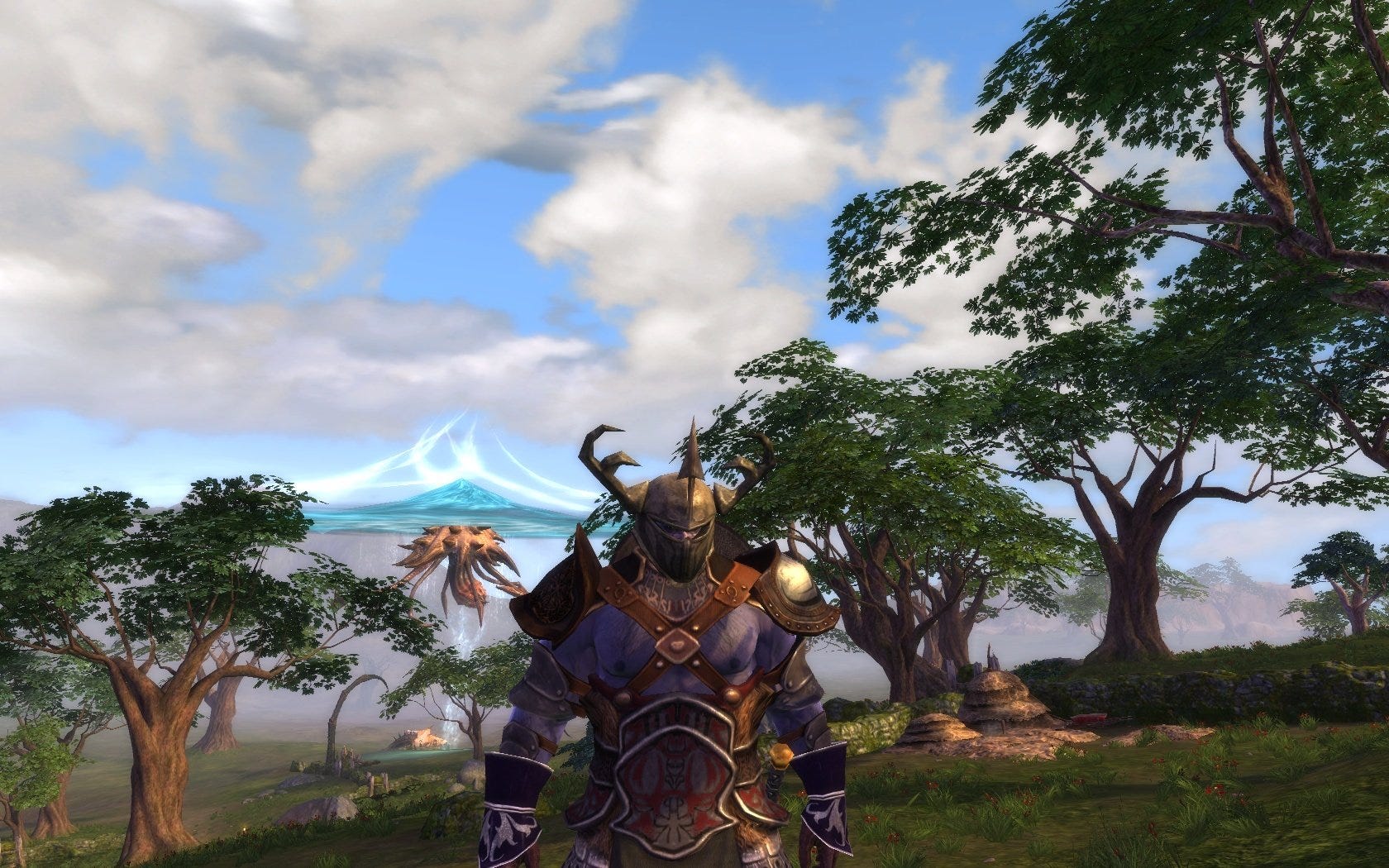
The game employs state-of-the-art nipple shading.

It's an impressive CV, and it comes as no surprise to learn that Rift takes its inspirations from a broad range of MMOs released over the last decade. The interface is highly derivative of World of Warcraft's; the art direction shakes EverQuest's hand enthusiastically and asks after Aion; the public grouping system makes your heart sigh at what might have been for Warhammer.

And so it would be easy to consider Rift as simply an accumulation of previous endeavours with a few twists. This is true to an extent, but to do so is to ignore some of the braver decisions made in development. Consider the soul tree system, for example, where the four character class archetypes (cleric, mage, warrior and rogue) each gain access to eight sub-classes.

We take it as a truth self-evident that all role-playing games should incorporate punishment – if not outright prohibition – for reneging on decisions made during character development. Not so in Rift, where each character has access to four specs, each a combination of three sub-classes. For a modest fee, even these can be reset, making experimentation and risk-taking part and parcel of the learning process.
2

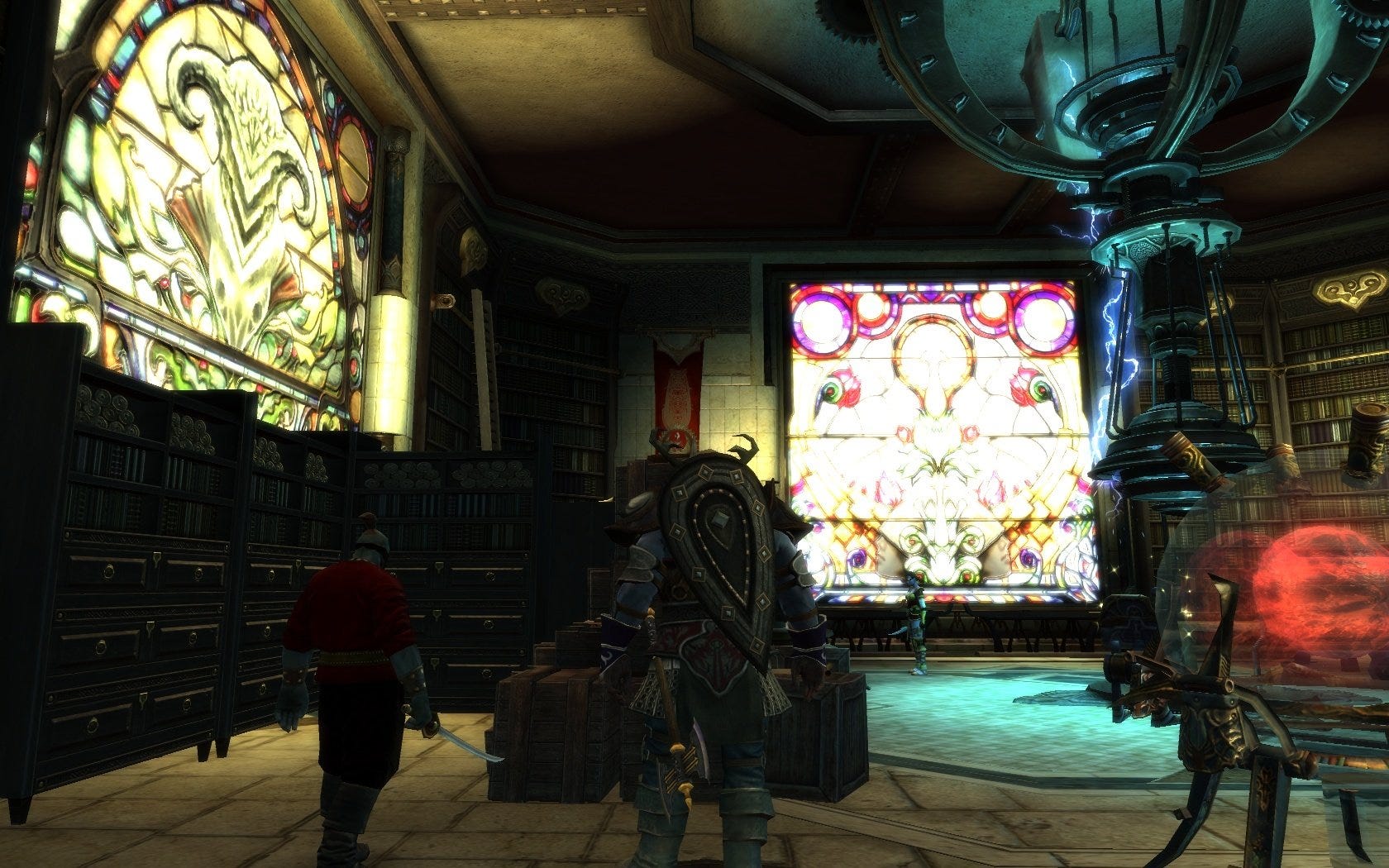
Inside the capital city of Meridian.

Rather than cheapening the investment in your characters, it adds depth and a chance to experience entirely new sides of the game, minus the long, lonely grind to the end of the levelling tunnel where your friends sympathetically await your under-geared return.

No longer should you find yourself confined to the bench while a more experienced tank is given priority on learning a new boss encounter. With a few changes, most classes can bring something vital but fresh to the group, whether it's a much-needed injection of off-healing or an invigorated focus on raw damage.

This complimentary approach to adapting and adjusting your class extends into the player-versus-player Warfronts of Rift.

We'll never truly escape the kind of player whose definition of teamwork amounts to wiping their own filth across their faces before throwing themselves single-handedly into an insurmountable army of enemies, a lone and pointless suicide agent for the cause. But as a largely objective-driven affair, Rift's Warfronts demand co-operation and an understanding of the team's movement and positioning. In Black Garden, players compete to gain possession of the Fang of Regulos, retaining it in order to accrue points. In The Codex, one node proves particularly advantageous to maintain, granting a greater points bonus.

Playing a tank, I feel empowered to assume a remarkably tank-like position on the battlefield: protecting the team's objective carrier, soaking damage by making an extraordinary nuisance of myself in a group of enemy players, diverting crowd control skills to the direst threats. The pick-and-mix approach to talents allows players to compliment their traditional role with the necessary tools for self-survival, a system that goes beyond the simplistic roles of damage-dealer, meat-shield or healer.

Rift's synergistic approach to game design can also be found in the crafting system, where players can take up to three skills covering the staples: alchemy, weapon-smithing, armour-crafting and the like. With each crafting path tied closely to one or more of the three gathering professions, the game encourages cautious consideration in a balance between profit and self-sufficiency.

If there's a criticism to be levelled at the game, it lies in the questing, an area that betrays a lack of confidence in the evolutionary approach underpinning every other facet of Rift. More Burning Crusade than Wrath of the Lich King, the old-school mentality of genocidal gathering dominates in Rift's world of Telara.

But it does, at least, steer clear of cheating the player through repetition of objectives. If you're an old hand of fantasy MMOs then the system won't offend; it will merely leave you content, if a little uninspired. Certainly, the more patient leveller, with one inquisitive eye on the lore, will find greater satisfaction from this area of the game.

3

'Black hole sun, won't you come...'

The story's salvation lies in the living stage on which events unfold. Left unopened, the titular rifts bloom and ripple across the landscape like molten glass against Oblivion skies. Once opened, they blossom into a variety of deadly flavours: in one zone, they reveal themselves as conduits for darkness, spilling demonic hordes into the surrounding area. In another, mutated vegetation cascades from the sky.

Sealing these rifts is a multi-stage affair, beginning with clearing some trash before ramping up towards meaner and keener elite bosses. For the most part, these final enemies can be dispatched with the ever-reliable 'tank-and-spank' approach, although variation through Trion's live programming should keep things interesting once players have settled into the pace of this dynamic world.

Rifts aren't just static, random events that pop onto your map to be savoured or ignored. Left unchecked, rifts will ultimately dispatch invasion forces that march across the land towards NPC settlements, transforming the environment in their wake and forcing your quest givers, transportation masters and town merchants into battle. Maybe even into death, serving to add a sense of urgency to the shifting landscape.

If you're the type of player determined to plough through the levelling process with only the bare minimum of social interaction, then you may find the frequency and ferocity of these invasions overwhelming to the point of frustration. Far better to embrace them and appreciate that rare forging of social bonds with strangers. Marching from one event to another in the raid group you've just bumped into makes for a breathless change of pace in the linear questing.

Beyond the world and its lore, a game with a player-versus-environment focus like Rift lives or dies by its dungeon content, the mechanism for obtaining the most precious loot. At present there are an impressive 10 dungeons spread throughout the world, offering a satisfying challenge to appropriately levelled players. Bosses are well-tuned and ease you into the strategy of the game as you rise through the levels.

At the current level cap of 50, these instances will also offer an Expert mode, featuring not just arbitrary tinkering with health pools and damage but adding entire new wings, story development and bosses. At present, only one raid encounter exists in the game, although more is promised soon, and Trion has thus far delivered on its promises to tweak and refine the game post-launch. We have high hopes for the endgame potential of Rift.

The emotional baggage of damage meters and 'Gear Score' elitism currently hangs heavy over Telara, and there's a sense of caution in forming groups and assuming roles, given the embarrassment of options available. Trion has promised a dungeon-finder tool in the near future, but it's to be hoped that this remains a server-specific affair at first, to ensure that the blossoming sense of community and personal reputation remains.

4

Steampunk flavours add to the Defiant faction's techno feel. This is a mechanical trumpet.

As for the user interface enhancements so enthusiastically embraced by the WOW community, an API is in the works, but its scope has yet to be detailed. Whether the game would suffer from the addition of add-ons that allow players to brag about their damage or reduce boss encounters to hand-holding exercises is a debate that rages on the official forums.

We're accustomed to making certain allowances for a freshly minted MMO: there will be bugs, servers will collapse without a moment's notice, and there will be nagging concerns around the breadth of content. But Trion has proved that it is possible to produce an exquisitely polished, content-rich MMO from the moment of launch, setting a dangerous precedent for upcoming releases in the process. Bad news for publishers, great news for the rest of us.

That Trion has managed to meet every expectation set in the past few years, from achievements to fully-fledged crafting and economy, while also bringing a truly innovative feature to the table is a testament to the will and determination that's driven Rift's development.

If you simply cannot bear the prospect of another fantasy MMO replete with all of the traditions that have come to define the genre, then Rift is unlikely to change your outlook. But if you hanker for a new world – one that feels familiar yet fresh, with an atmosphere of discovery and experimentation – then Rift stands proudly, ready to greet you with open arms.

8 / 10

Read the Eurogamer.net scoring policy

Comments (54)

Comments for this article are now closed, but please feel free to continue chatting on the forum!

  • Loading...hold tight!