(Trion Worlds is currently taking applications for the upcoming Rift: Planes of Telara beta. Sign up on the official website.)
During our visit to Trion Worlds to play its debut MMO, Rift: Planes of Telara, Eurogamer sat down with the magnificently mutton-chopped Hal Hanlin, design producer for Rift, to discuss endgame content, working with a hand-picked industry team and the opportunities for introducing change to a persistent online world.
Eurogamer: Hello, Hal. Could you give us a bit of background on your career in games?
Hal Hanlin: Sure! In 1997 I was kind of at a loss for what to do with my life. My wife asked me what I did not realise then was a pivotal question: "If money was no object, what would you do all day?" I was snarky and said I'd play video games.
A little over a year later, I got a position as system administrator at a video games company in Boulder. After a couple of years, they ran a game design submission challenge to determine their next product. I took a week off of work, took my little 486 laptop to the mall, sat in the food court and wrote three designs. Of over 100 submissions, two of mine rated pretty high and one was a finalist. Based on that, they offered me a position as a designer and I have never looked back.
Eurogamer: And what drew you to Trion in particular?
Hal Hanlin: I came to Trion because they had the three things it takes to make awesome games.
One, world-class talent. When I saw who I would be working with, I was amazed. There is so much talent and experience here that it's a genuine honour to work in this office. In most game companies, two or three shipped games gets you a senior position. In my experience at Trion, that's the minimum bar to get an interview.
Two, world-class technology. The Trion platform is profoundly powerful and the toolset that has evolved to build our game is stunning.
Three, world-class money. Let's face it, great games are usually not cheap to make. Trion has the backing to do what they promised to do.
All of that added up to a no-brainer.
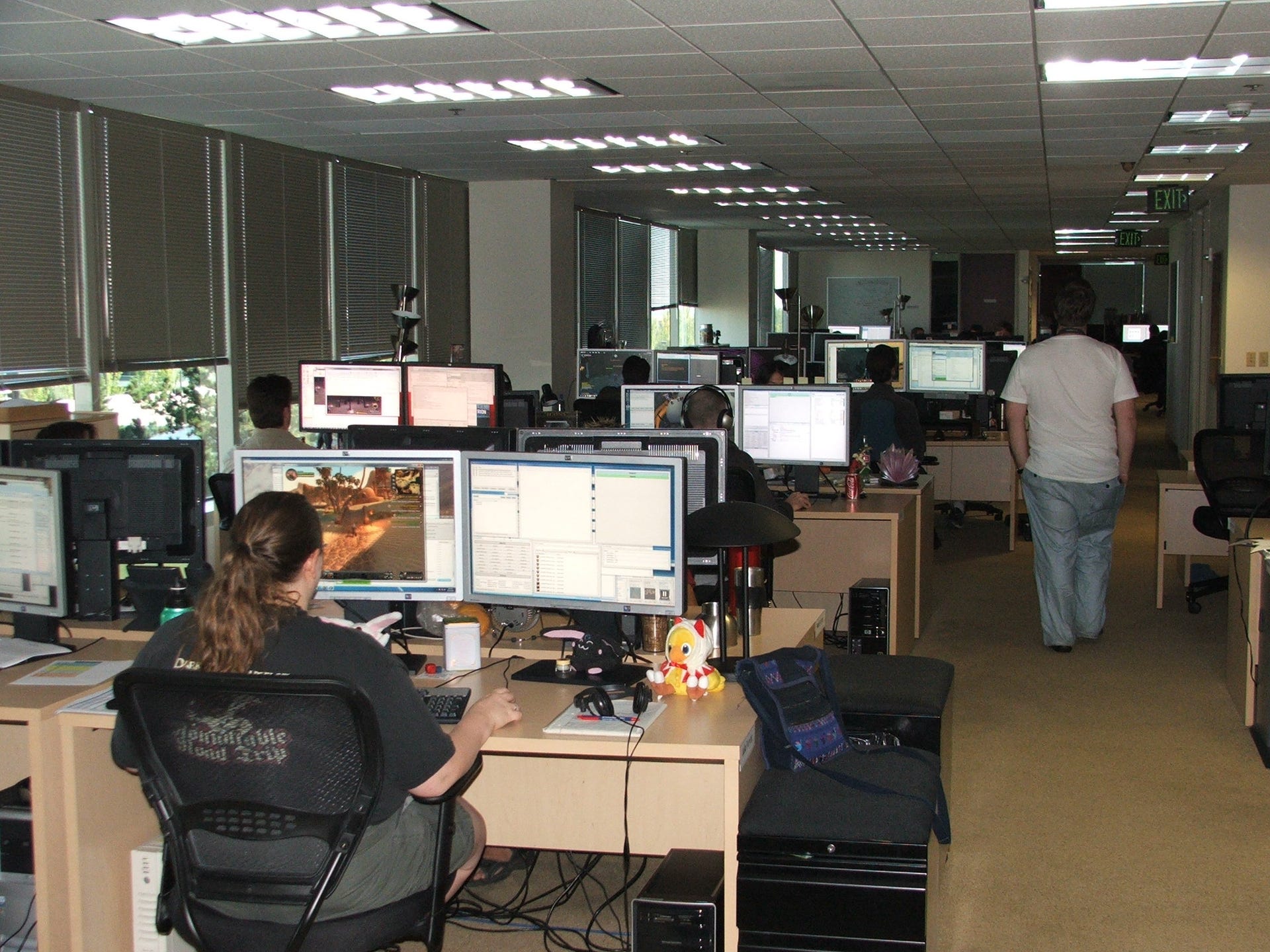
Seven people evaporated when I used the camera flash.
Eurogamer: With the industry pedigree brought into Trion, there's the potential for egos to clash. How have you all handled that?
Hal Hanlin: Something that happens a lot in the industry is that when you make a couple of games, you grow an ego. You start using sentences that start with: "I have X years in games and I..."
What is hilarious at Trion is when someone new comes in and tries that. The meeting stops for a moment, and generally one of the members points out that the rest of the room has at least that many years and sometimes even created entire genres. Once that is clear, we can get back to work and egos are put on the shelf.
Something that cannot be ignored is that Trion designers take and give brutal feedback every single day. They don't tap-dance around a problem. Comments are generally concise, clear and accompanied by the all-important: "I would suggest..."
Almost everyone here has been the target of web criticism of a game they made. They know that the harshest designer commentary pales in the face of what can happen when games go live, so they say what needs saying. Almost everyone here has some amazingly healthy armour now.
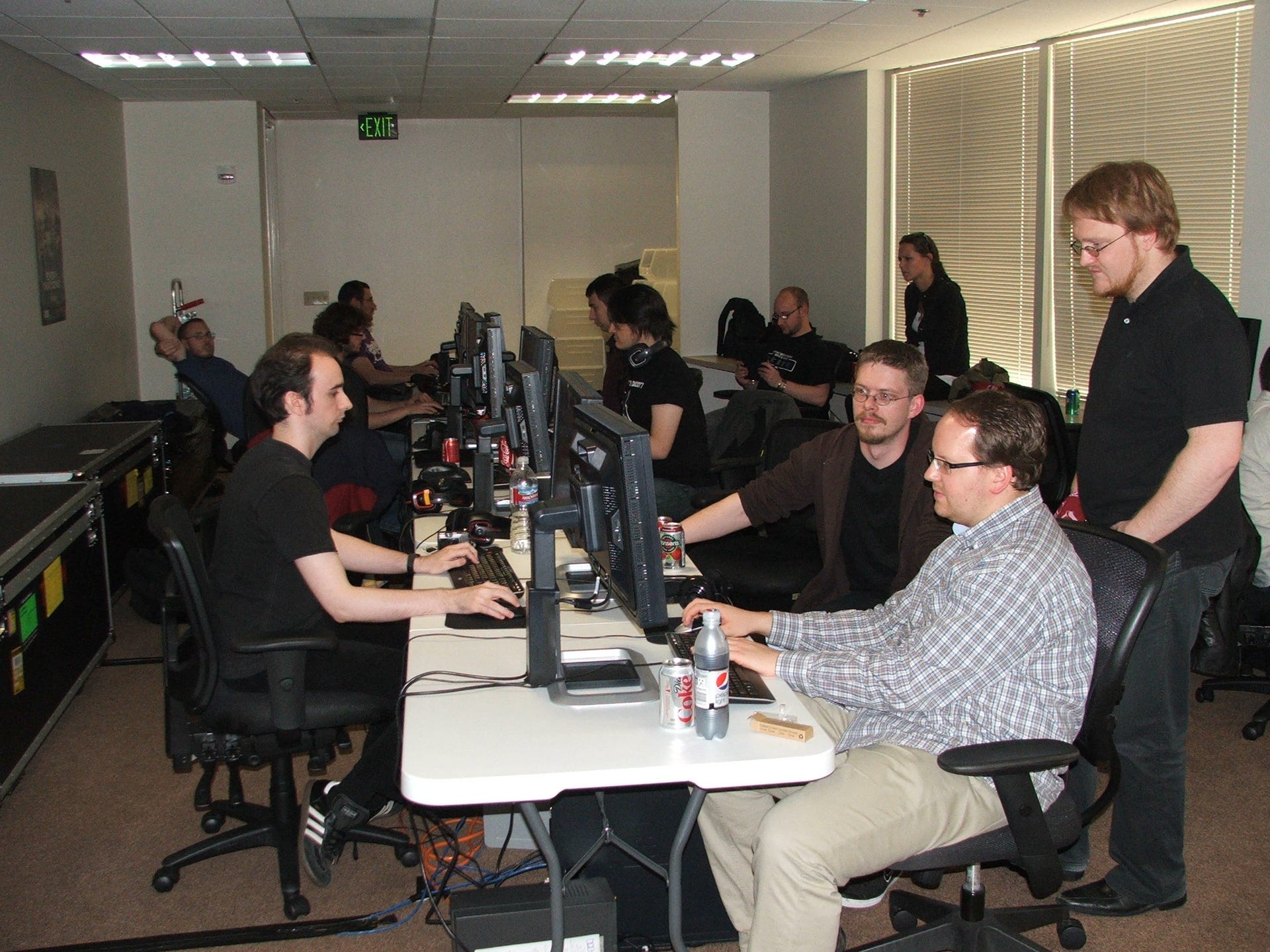
Hal is currently observing Chop-tober.
Eurogamer: You mentioned this morning that you expect players will want to bring 20 friends to the world. Has Trion targeted a specific number of subscribers for profitability?
Hal Hanlin: Sorry, that's a question for someone in a suit. I completely trust the people at all levels of this company – not a common thing – and I do my part. Others obsess over server loads, profitability and their specialities. I obsess over the details of design and making sure that everyone has what they need to make a game you want to bring your 20 closest friends to play.
Eurogamer: The unique feature of the game, of course, is the rift system. What proportion of levelling do you imagine coming from rift fights versus questing?
Hal Hanlin: The question isn't how much do you have to rift in order to level cap. You can level cap just playing quests if that's what you want to do.
You have an opportunity to improve your gear, get a lot of consumable items, obtain things called focuses and then the essences which further increase your character's equipment. But you are not required to.
Scott Hartsman [chief creative officer] has a mandate that when you come into the game there are a wide variety of things that you can do. We're not trying to spoon-feed you – the idea is to come in and say, "Wow, I want to level up my crafting or I really want to come on some dungeon runs with my friends." So he's made sure there are multiple paths when you want to play the game.
Eurogamer: And how many different Rift events are there in the game at present?
Hal Hanlin: Well, that number grows weekly. At present we are at over 100 events. However, the most awesome fact of our system is that we can continue to add events now and forever. So long as we are using NPCs that your computer has already (the stuff on the disk), we can make it reappear anywhere, doing anything we want, basically. What we have now is what I think of as a base coat. We will continue to increase the number of events to the point where it makes sense to stop.
More is not better. Better is better. When we reach a point where people feel overloaded, we can tune the system to have fewer active at a time. We can have some that only happen once a month and others that are very frequent. We can cherry-pick to focus on the rifts people enjoy the most... man, there's just so much we can do.
The other thing to remember is that rift events are only one piece of the puzzle. We have Invasions and Footholds as well. Planar attacks take many forms and we are lacing the various dynamic elements together all the time. We are avoiding random chaos, while still striving for a thrilling new experience each time you return to Telara.
Eurogamer: Is there a danger that the rift side of the game could become stale over time? How long does it take to develop and implement fresh puzzles and ideas?
Hal Hanlin: I can make one in five minutes. To make a good one? A little longer. But the key is, our entire system from the very base tech all the way up to user interface is designed for presenting new experiences for the player.
The way we do that is, each individual AI functions on a brain of needs, wants, desires and alliances and it knows how it's supposed to work in the world. It can play off the player class ability set so you get a player experience from enemies that makes sense.
Just changing those two things, we can introduce new gameplay through the rifts very quickly, whether it's an invasion with a boss with a new ability set, new NPC adds or a change in tactics. We allow you to experience each one as a fresh challenge rather than a tank-and-spank which you've already experienced.
Eurogamer: Scott Hartsman introduced us to the game saying, "We have a finished game that people are playing at endgame". From a design point of view, can you expand on that for us?
Hal Hanlin: One of the things you can do is that you can return to previously visited dungeons and have new experiences, with new bosses and increased areas in the dungeon. There'll be more game difficulties and better loot. There will be raids, above-ground raids and rift raids taking advantage of the rift system.
You can participate in a pick-up raid and there are three in testing – there are many more coming. The great thing about our system is that if a piece of content is incredibly popular, we can build on that and introduce more content.
We also have the full crafting, we have the faction notoriety system, there is a guild levelling system where you can actually have your guild level up and give access to perks – unique guild-usable items that give you special abilities within the game, so the biggest guilds will have the highest perks. We've been doing that with our alpha build and it's a lot of fun.
Eurogamer: It's early 2012, a year after launch. Where do you see Rift standing in the MMO market?
Hal Hanlin: Rift appeals to a lot of people who have played MMOs and want an HD experience in an MMO setting, but it also appeals greatly to people who have just a desire to always be able to go round a corridor and see something new. Our longevity is going to be better than a lot of MMOs introduced to the market, because there's always something to see that's changed. We want to maintain a level of familiarity so a zone won't be radically different but I will see things I didn't get the first time around.
Because of that I think we're going to be sitting very comfortably in 2012 and beyond. If I had to put it all into a nutshell it would be that through our ability to deliver new content seamlessly to the players, we can be more responsive to player needs and desires. Because of that, they'll tend to stick with us and bring 20-30 friends.
Eurogamer: Trion is making much of responding to the player community for updates to the game. There's obviously a risk of alienating as many as you please by doing so. Can you see why that might be a concern?
Hal Hanlin: It absolutely makes sense and one of the most important skills a developer can have is the ability to say no – whether it's someone like myself saying something has to be done by such a point, a designer who feels something will break the vision, or an artist saying no.
Some of what we get from the community will be gems, some is simply not going to work in our world. We have a lot of latitude in our game so we can have alternating realities and be more outlandish. At the same time, this is our IP and we will not put arbitrary things in just because people are screaming for them. This is not a committee animal.
(Trion Worlds is currently taking applications for the upcoming Rift: Planes of Telara beta. Sign up on the official website.)
Hal Hanlin is design producer for Rift: Planes of Telara at Trion Worlds. The game is due for release in early 2011.
