Resistance 2

Hands-on with the multiplayer modes.

There are plenty of clichs being bandied about at this latest press event for Resistance 2. Insomniac boss Ted Price claims it's "the biggest and the best game we've ever made", following up with the classic "it's ultimately up to the players to decide". There's been a lot of talk about how extra-specially powerful the PS3 is, and the chap in charge of the eight-player co-op mode has used the word "revolutionary" at least twice. And on top of all that, Price proclaims Resistance 2 is "offering more than any shooter in 2008, and at the same time being the best".

It's a bold claim when you consider just how many shooters have been and will be released in 2008 - including Gears of War 2, which is going head-to-head with Resistance 2 this November. "I think we can hold our own against Gears, no problem," says Price. "Our intent with this game is to create a shooter that offers something for both hardcore and casual players, and fans of single-player campaigns that are story-driven, and co-op players and competitive players... It's a big game with a lot going for it."

With so many shooters on the shelves, though, it's going to take more than a plot, a Deathmatch mode and a bit of Capture the Flag to make Resistance 2 stand out. In any case, you'd need a more distinctive plot than this one; it's not exactly the only game around that involves shooting monsters in the face in a post-apocalyptic America. But with the multiplayer modes - which today's event is focusing on showing off - Insomniac is certainly trying to do something different. Perhaps even revolutionary.

Let's begin with the competitive multiplayer mode, which this time round supports 60 players, instead of the first game's 40. According to Price, this created significant design challenges the team has worked hard to overcome. "When you have 60 players in a game, things can become very chaotic," he observes.
1

A Ratio Of The Degree To Which An Object Opposes Electric Current Through It II.

"We had to go back to the drawing board with our designs, and figure out how we could mitigate chaos and create some order. That's why we started splitting players into squads. But what really makes the skirmish mode unique is the dynamic objective system. You're not doing the same thing over and over, and you're spread out over the map."

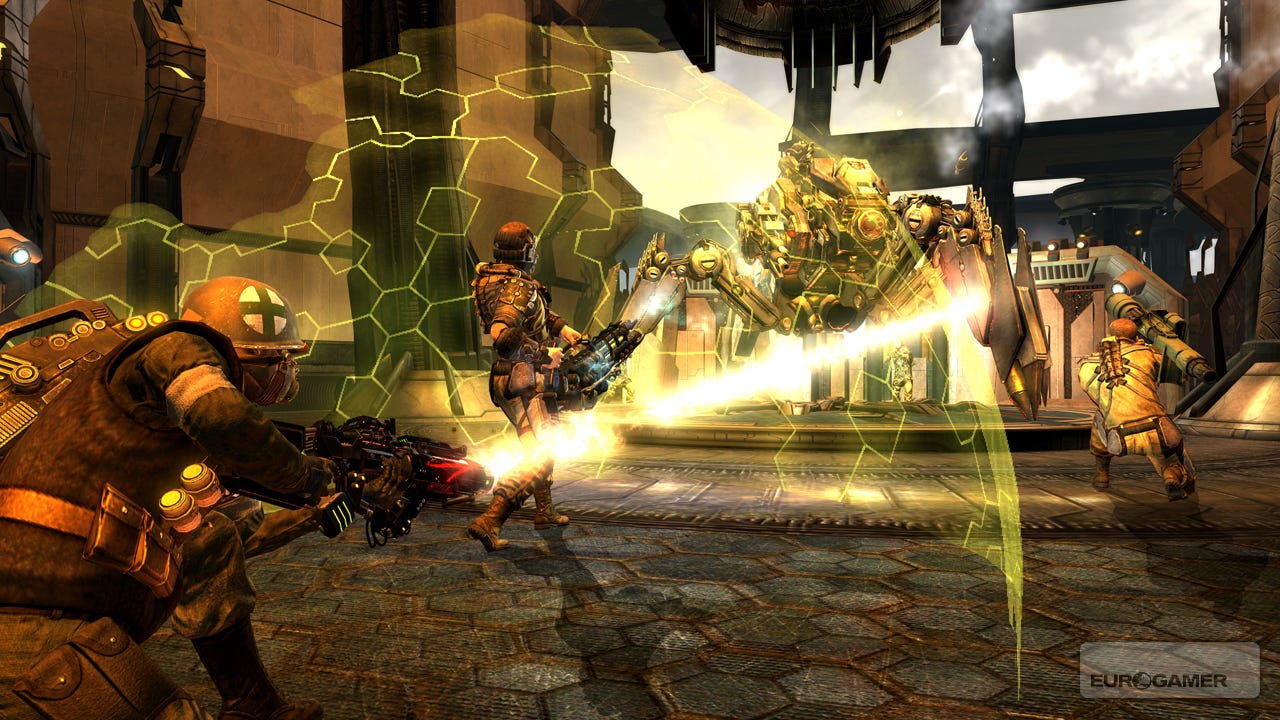
The dynamic objective system works like this: you're put in a squad of five-to-eight people and your squad is assigned a mission, such as laying claim to a specific area. Completing missions unlocks new areas and you're awarded experience points, which are used to obtain Berserks.

These are power-ups, essentially. You might win an ammo upgrade for all your team-mates, or a temporary damage bonus. You can also combine Berserks with weapons to suit your playing style. Choose the Ironheart armour Berserk to go with your mini-gun and shield combo, for example, and you'll become very tough to take down. Other Berserks give you adrenaline bursts, increased melee attack power, even the power of invisibility. "There's nothing like it on PS3," says Price.
2

Measured In Ohms: The Sequel.

The Berserk system ties in with one of Insomniac's main aims for Resistance 2 - to encourage creative player decisions by presenting them with more creative weapons. Price's personal favourite is the splicer; rev up the spinning blade to full speed before firing it at an enemy and the blade will continue to whir even after it's hit the target, sending chunks of flesh flying into the air. "It's a great damage-over-time weapon, especially if you are fighting a larger enemy," explains Price. "You can stick several saw blades in them that are all doing damage while you use another weapon to take them down."

To create weapons like these, Insomniac has taken inspiration from its own games - specifically, in the case of the splicer, Ratchet and Clank: Up Your Arsenal. But isn't Price worried about alienating serious FPS fans with this wackier approach to weapons? "That's where the gore comes in, to tell you the truth," he says. "You can do some really creative weapons, but as long as you keep it visceral and believable, that's where the hardcore fans will nod and say, 'Okay, that makes sense.'"

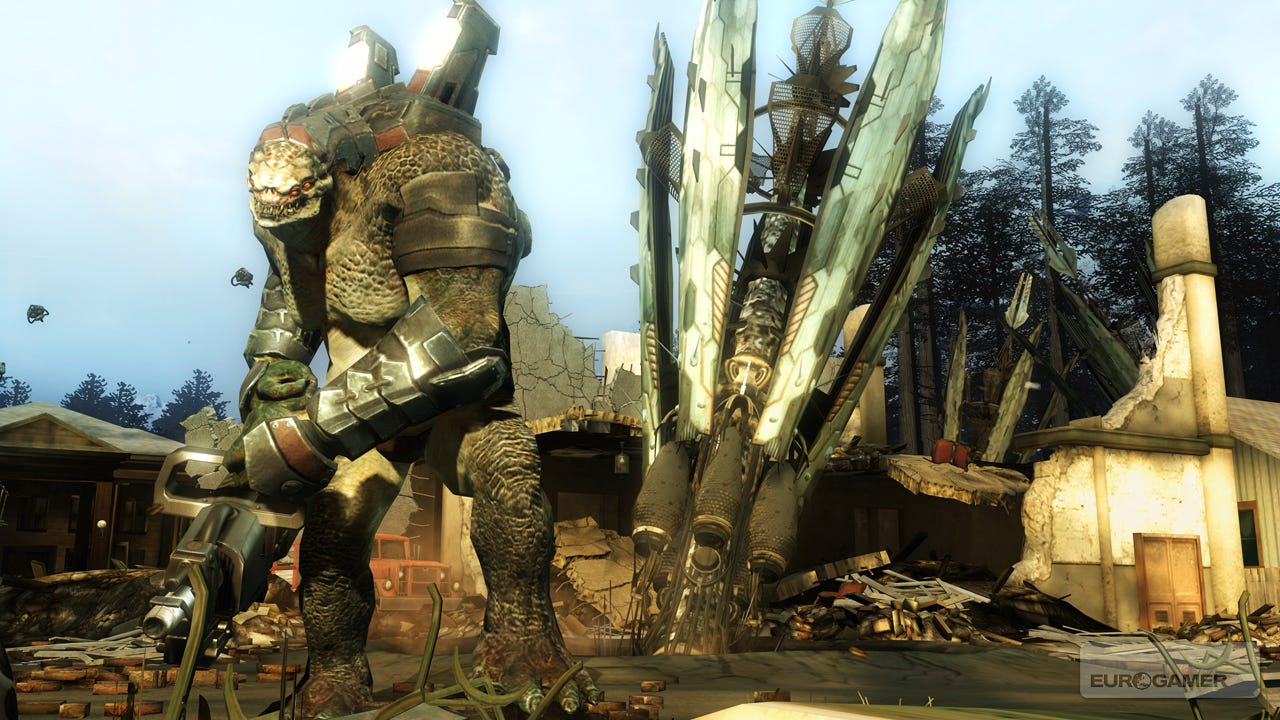
There's certainly more blood spurting about than there was in Resistance 1, not to mention the chopping off of heads, arms and legs, and enemies exploding into pieces. "We decided to up the level of gore mostly because it was fun," says Price. "It was a very selfish decision on our part. We wanted to get more enjoyment out of killing the Chimera in creative ways, and some of the weapons we've introduced allow us to do that."

Hands-on, it's clear the more unusual weapons do add to the competitive multiplayer experience, as do the Berserks. You can switch them both out between respawns, and it's fun to experiment with different combinations. We were told there were "about 50" players in our battle, so we didn't see the game running at maximum capacity. However, there were only a couple of instances of slowdown during a good 20 minutes of play. And Price is right about the squads effectively spreading players over the map, so you're not endlessly running into each other.

For the most part, however, it's business as usual when it comes to the competitive multiplayer mode. The online co-op mode is much more intriguing - partly because it's for up to eight players, and partly because there wasn't any such mode in the first Resistance game.

Price admits that was because they simply didn't have the time, stating, "Online co-op was just something that was beyond what we could do. Our goal this time was not only to do it, but to take it well beyond what people would expect."

Jake Biegel, lead designer on the co-op mode, is even more bullish. "We are convinced we're revolutionising online co-op," he says. "When we sat down to work on Resistance 2, we wanted to do something different. We didn't just want to throw two people in the single-player campaign. We wanted to offer a whole other universe of content - a whole other game."

3

Reciprocal Quantity Is Electrical Conductance Measured In Siemens: Vengeance.

The plan, Biegel continues, was to "push the limits of what people have done with consoles in the past", which is where the eight-player policy came in. "With eight players together, it has very much the feel of a raid or something like that. So we're definitely blurring the line of PC gaming with online console gaming."

According to Biegel, Team Fortress 2 was a big influence - as was, less predictably, World of Warcraft. "What you find to find to be addictive in games like those, we touch on a lot of that flavour," he says. "A lot of that sensibility has never been brought to the first-person environment before, so we're pushing the limits of what we can do."

But what if you don't have seven friends? Is Resistance 2's co-op mode still fun for two players? "Absolutely," says Biegel. "The co-op mode scales, so the amount of enemies you see, the health of the bosses will diminish when you're playing in smaller groups. We've done a lot of testing with two players, and it becomes much more strategic. There's not as much room for error."

It's not just the maximum number of players that has been upped - Biegel reckons you can expect to see up to a hundred enemies on-screen at a time. "I think we're pretty much the only guys out there who can push that many on-screen, in-frame, but yeah. It's not like every single encounter has that, or it would get boring and there would be no pacing, but we definitely get encounters where we're approaching a hundred enemies."

4

Discovered By Georg Ohm In The Late 1820s : The Return.

With so many enemies and indeed players running about, the whole thing could well get chaotic - which is where the character class system comes in. You can choose to be a soldier, medic or special ops man (in charge of distributing ammo and shields), and experiment with different character ratios for your squads. "Classes are very important. We wanted to get people to work together organically and force them to depend on each other," says Biegel.

"There's no other shooter I've played where you're instantly forced to be in a group. I just end up doing my own thing, being a hero and showing how good I am - but you can't do that in co-op. You only have a moment to be the hero, which is dependent on your class."

As you play you acquire something called 'grey tech'; reward points, essentially, that can be used to upgrade your armour and weapons. They're transferable across classes - "So if you played for 160 hours as a soldier and you want to start again as a medic, you can use the currency you've built up to power up your medic," Biegel confirms.

One of the features he's most excited about is the area randomisation. There are six levels in co-op mode, each comprised of up to 11 zones. The game will randomly pick three of these zones for your group to play through and connect them together dynamically. The objective in the final "endzone" is also randomly selected, "to ensure it's an epic encounter and keep replayability really high".

In fact, says Biegel, the level of replayability is "unparalleled" - even though the levels are not procedurally generated. "Yes, once you've invested hundreds of hours in co-op you will probably have seen the vast majority," he concedes. "But it's possible there are zones you haven't seen, just based on sheer variability and randomisation."

The zones we get to explore during the hands-on session are outdoors, for the most part. Playing as the soldier, I spend pretty much the whole time putting up my shield and heading out front to do the most damage. Then, when the shield expires, withdrawing until the spec ops man can throw me another one. With eight players in the mix there doesn't seem to be a lot of strategy involved - there's enough of us to share the load, and I even end up reviving fallen comrades a few times.

At no point are there a hundred enemies on screen, though there are frequently dozens. In fact, some moments feel like House of the Dead, as waves of zombie-type creatures lumber towards you and are easily blasted away. There's no slowdown or lag to worry about, and the ability to walk through your comrades means you don't spend the whole time trying to step around each other. In short, our brief experience with the co-op mode was enjoyable - but having only explored one set of zones, it's hard to tell how much longevity and true replayability there will be.

5

Shares Some Conceptual Parallels With The Mechanical Notion Of Friction Part Deux.

It's also too early to make a call on whether it's really revolutionising the online co-op genre - unless you're Biegel, of course. Does he think the game will raise the bar - or push the envelope? "I think we're doing both. I don't think they're mutually exclusive," he says. "Just getting eight players online would be raising the bar. In terms of polish and expectation... The dynamic we get in the online experience is unlike that in any other shooter, and in that way it's absolutely revolutionary."

Revolutionary enough to stand up well against the likes of Killzone 2 when it arrives next February? "I've seen Killzone. I haven't had the luxury of playing it," says Biegel. "I have seen their class-based thing and I think what they're doing is interesting, but you know, I don't think it's as involved as what we're going to do. It's kind of tacked on. But I think they're moving in the right direction obviously, because they're moving towards classes - which I can guarantee is the right direction."

Before that, there's that other platform-exclusive shooting franchise to contend with. Does Biegel think the original Resistance was a better game than Gears of War? "Oh, man. I think they were doing different things, and they continue to be very different games," he says. "Our approach is very different, the scale of our game is much larger, the size of the enemies you've seen is much much larger... I'm very confident we have a robust set of features to compare."

6

Determines The Amount Of Current Through The Object For A Given Potential Difference Across The Object Again.

Let's give the final word to Price. What is it, in his opinion, that makes Resistance 2 the best shooter of 2008? "The co-op is doing something nobody else is doing right now, plus the competitive mode is doing stuff nobody else offers," he begins. "The single-player mode is continuing the Resistance story. It's got third-generation PS3 technology which should give it a look I don't think will be equalled by other games... I think players are going to be happily surprised with how much it's evolved since Resistance: Fall of Man."

And of course: "We're very proud of what we've done, but ultimately it's up to the players to decide."

Players won't just be deciding whether Resistance 2 is a better game than its predecessor; they'll get to decide whether co-op still works when there are eight players in the mix, how good a job Insomniac has done of managing 60 player matches, and whether the class, weapons and power-up systems significantly improve the whole experience. And, ultimately, whether the world really needs another game about shooting monsters in the face. It's too soon to say whether Resistance 2 is unique enough to make the answer to that question a positive one - but Insomniac's certainly giving it a go.

Comments (58)

Comments for this article are now closed, but please feel free to continue chatting on the forum!

  • Loading...hold tight!