Ghost Recon: Advanced Warfighter Review

Happiness in magazines.

Version tested: Xbox 360

Much like Elder Scrolls: Oblivion, the absence of Ghost Recon Advanced Warfighter from the 360's launch line-up was a regrettable one. As one of the undoubted stars of X05, it looked for all the world like Ubisoft had finally done enough to propel the brand into the big league for the first time, after years in the shadows of its other Tom Clancy titles. No wonder people wept at the four month delay.

But never mind about that; we'd always much rather play a 'finished' version than some rush job drop kicked out of the door just to cash in on the launch frenzy and appease shareholders. Just as we hoped all along, the chance to savour a more rounded, polished version of the third in the action strategy series seems like a much better idea - especially now people can actually walk into a shop and buy a 360 without going on a mile long waiting list.

Sticking broadly to Red Storm's excellent formula, GRAW is once again a squad-based shooter (in 'over the shoulder' third- or first-person, the choice is yours) all about 'near future' warfare and kicking the butt of some nefarious megalomaniac and a posse of foolishly loyal insurgents. Being set in 2013 in Mexico, it gives Ubi full license to throw in a few obligatory 'weapons of the future' to add to the otherwise standard load-out that accompanies each 'ghost'. In this instance Scott Mitchell and his merry band come equipped with the IWS, or Integrated War System, combining satellite comms, 'enhanced survivability', and the odd new weapon thrown in for good measure.

In plain English, the effect that all this new technology has had on the gameplay is somewhat more pronounced than previous efforts, and in the main each addition improves things in subtle ways. For a start, you now call up a tactical map at any time (back button) and issue basic move and fire commands to your units without physically having to shepherd them around the map. This comes in especially useful when you can call on the services of the AUV, a mini flying-saucer-style eye-in-the-sky recon unit that you can direct wherever you want in order to scout ahead and see who's lurking where. With visible enemy units pinpointed, you can then direct ghost units ahead in the knowledge of where the imminent threats are, and get them to target specific areas in a slick, intuitive fashion.
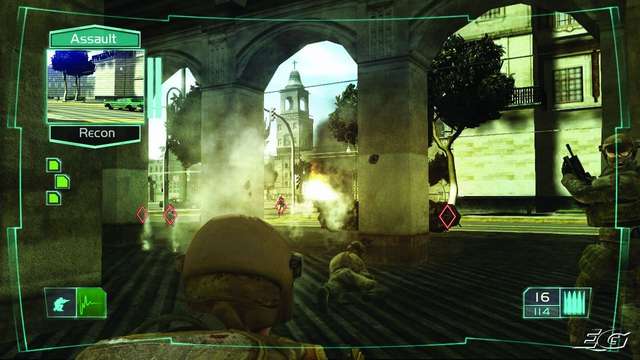
1

Looks like he's seen a Ghost.

While this might sound dangerous (and sometimes it is if you leave them too exposed), you also get the occasional use of a tank or an attack chopper with which to scout ahead and cause general mayhem. Needless to say, the enemy's still more than capable of dealing with anything you throw at them, but the new options available to you lend a new dimension to the combat, and make it feel a little less like a four-man killing machine, and more of the hi-tech war effort. For the first time ever, Ghost Recon feels a much more unique game, rather than just an outdoor Rainbow Six.

In addition to the new tactical map and commands is the new 'picture-in-picture' view that's permanently displayed in the top-left of the screen, showing what your other units (tank, AUV or squad members) can see at any given point. Admittedly, it's too small to see anything in especially useful detail, but it's great to have a chance to see what's going on - good or bad - from their perspective. With these 'live' transmissions now a standard part of your equipment, you also get beamed TV news bulletins during the game itself, rather than the old-style between-level cut-scenes that used to rather wash over you.

But by far the most immediately impressive 'new' element of GRAW is the overhauled graphics engine. 2004's Xbox effort certainly saw the series take a forward step in visual fidelity, but Ubi has gone all-out this time to make it among the most attractive games ever seen on any system. Using all manner of cutting edge lighting effects (HDR, or high dynamic range, being an obvious favourite new trick) and displaying a truly stunning level of detail, depth, variety and panache, the environments in and around the hot, dusty streets of Mexico City are among the best anyone's pulled off in a game. Truly showing off the benefits of next-generation technology and the immersive qualities of high definition gaming, the vibrancy and atmosphere from creeping around the terror-strewn streets is a hugely impressive sensation. Sure, you get used to it depressingly quickly, but every now and then you'll afford yourself a moment to breathe it all in and feel glad that games finally look as good as you always hoped they would.
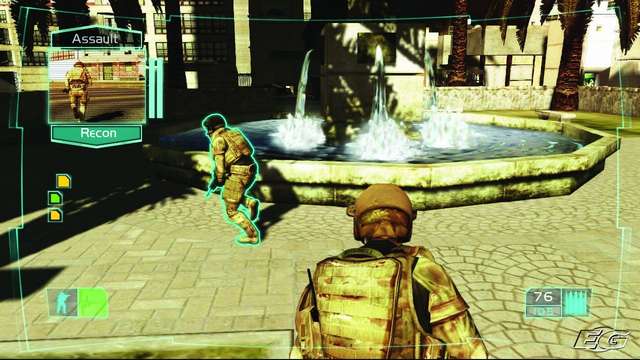
2

A bit like the Ready Brek kid, only more irradiated.

Thankfully Ubi hasn't skimped in providing equally convincing character models that move with effortless precision, each blessed with wonderfully natural movement transitions and the kind of animations so incidental you probably won't even notice how good they are - although we're still not convinced it's physically possible to do a sideways roll with a sniper rifle strapped across your back.

One of the most truly impressive new innovations in the game is the way your character interacts with the scenery. In the past, games have always generally insisted that basic commands like peeking around a corner, peeking up from cover or sidling up against a wall warrant their own button, but not in GRAW. Ubi has taken a breathtakingly simple yet intuitive step towards overcoming all of this clunky nonsense by introducing a series of intelligent context-sensitive commands. For example, walking up to a wall now puts you flat against it if you continue to hold the direction for half a second, and once activated you can then automatically peek out from a corner by holding the direction required. If you happen to approach a box or a barrel while crouched, the AI assumes you want to use it as cover and allows you to do the same again: press up and you can peek out from behind.

Even better is how well the fire commands work with this new system: holding the direction peeks you out, but also holding the left trigger puts you in a slightly zoomed-in mode (optional), allowing you to loose off a few rounds with the right trigger, let go and pop back in behind cover. If your target's just a little out of range then you can also click the right stick and zoom in any scoped weapon, click again for 15x zoom, click again to get rid of the zoom entirely and still creep back behind cover. With practice it all works so seamlessly that you have to admire Ubi for refining it so successfully.
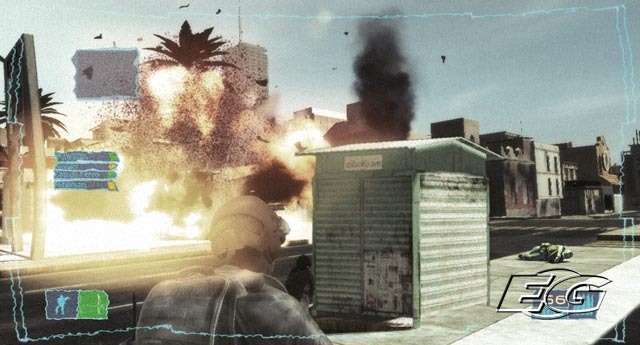
3

Things that make you go 'boom'.

As ever, you get to move your squad to wherever you want, simply hitting up on the d-pad to choose a cover point, up again on a chosen target, and all in the knowledge that they'll generally be pretty sensible about wherever they end up. Occasionally they do have a suicidal tendency to stray into your line of fire or expose themselves to enemy bullets when they're stationed at corners, but otherwise they're exceptionally easy to manage, and provide a huge boost whenever they're around.

On the odd occasion when you're forced to tackle missions solo, you certainly notice when your squaddies go AWOL. In fact, the game's already-quite-challenging difficulty level spikes alarmingly during these solo sorties to the extent where the game temporarily stops being anywhere near as much fun.

Part of the issue here is the game's normally wise decision to restrict your health top-ups; sometimes you might get a refill at a handy ammo dispenser, but otherwise that's your lot, and when you're expected to become a one-man army, such design decisions really weigh down your progress. Combined with some unwisely placed checkpoints, you'll be reaching into your pockets to fill up the swear box as the red mist descends after the 20th retry of the same solo section. Towards the middle and towards the end of the 11-mission single-player campaign, GRAW treads a fine line between challenging and annoying, and when it oversteps the mark you're reminded of just how frustrating the series can be when it wants to.

The silly thing is that none of this annoyance is down to unfair enemy AI; if anything, the computer dishes out a fair and challenging scrap throughout. It's just that if you've been unfortunate to reach a third checkpoint of a level on red levels of health, you'll almost certainly struggle through the last bit - with a choice of either starting over or battling on, thanks to a save system that doesn't ever allow you to go back to a previous checkpoint, strangely. What's even more crazy (and downright inconsistent) is that you can revive your downed squaddies an unlimited number of times (resulting in some truly hilarious moments where you find yourself doing it ten times in a row when they get mown down the second they're revived), yet cannot top up your own health despite your obvious medical nous.

While we're in hole-picking territory, GRAW's chock full of oddities if you look hard enough. As amusing as some of them are, some of the assorted bugs and quirks really chip away at the enjoyment value now and then, giving the impression that perhaps GRAW isn't quite as wonderfully slick and polished as it first appears to be.

In the 'funny' category, you might manage to make Mitchell adopt a Jesus pose and levitate around the level for a few seconds, or benefit from scenery popping out of view to expose a hiding enemy, or wince at (very occasional) epileptic animation or the terrible spelling mistakes and grammar issues in the tutorial text, but there's worse to come. If you're unlucky, some genuinely game-breaking bugs appear, forcing restarts and much frustration when objective triggers fail to kick in, or you get shot through a stone wall, or your squad ignores orders for no good reason. As easy as it is to be sympathetic to silly little bugs, when they cripple the game you can't help but think that the game's been rushed out. You can understand why it slipped in the first place, but we're less sympathetic to Ubisoft now; not at £50.

And before we finish our little rant, how many people have expressed incredulity at GRAW's hideous night vision mode? Given that this is supposed to be 2013, and that these guys are equipped with cutting edge equipment, why is it so horribly blurred, and why can't you see the scenery very well? Not only is it now far worse and less useful that previous Ghost Recons, but next to, say, Splinter Cell it turns some of the gameplay into a frustrating almost unplayable lottery where progress is only possible by learning where each group of enemies spawn from. Less annoying but just as nonsensical is how quickly enemy corpses disappear, meaning that if you're out of ammo and want to track back and stock up, you'll find the street cleaners have got there first. Potty. Why, Ubisoft, why?

5

Looks crate!

If this was just a single-player game, we'd have probably let these bugs and balancing issues drag the score down far more than we'd like. As impressive as GRAW undoubtedly looks on the surface, a thorough examination exposes the kind of brow-furrowing problems we expect to be kicked out of games claiming to herald a bold new era of squad-based gaming. However beautiful it looks, there's absolutely no need for inexplicable difficulty spikes, badly spaced checkpoints, stupid save-game methods, a detestable night vision mode and completely inconsistent health systems. Few games have had us beating up the sofa in quite such a concerted manner in recent months, which is a bad sign. In terms of actual enjoyment it's not even up there with Summit Strike, a game you can pick up for a quarter of the price. Placed in that context, it's hard to justify splashing out full whack for GRAW unless you're heavily into the multiplayer aspect.

The multiplayer is generally solid enough to counteract at least some if not most of the design flaws that might put you in a bad mood in the first place. Playable offline (4-playersplit screen or System Link) or over Live (for up to 16 players), you get a full complement of modes that all feel worthy of investigation, even if you're fed up to the back teeth of deathmatch, capture the flag and domination.

Needless to say, Ghost Recon sticks to the tried and trusted modes that everyone loves, and does so with a breathtaking selection of truly beautiful maps, all of which are specifically designed for the multiplayer portion of the game. Essentially split into three main categories, you can play solo, co-op or team versions of all the classics, including basic deathmatch (a.k.a. elimination/firefight), capture the flag, last man standing and domination along with several variations on a theme, including sharp shooter, thief, recovery, defend, hamburger hill and objective-based battles - all of which every shooter under the sun has tackled at various times in recent years, so there's little need to tediously run through what each of them asks of you. Suffice to say each and every one feels solid, well-designed and ought to keep the legion of online players happy for a few weeks.

6

The HUD stuff's called Cross-Com. So, er, this must be a Cross-Com shot.

But as much fun as playing these modes is with Ghost Recon weapons and such breathtakingly vivid maps, those of us that are bored of the same old modes can take solace in the fact that the co-operative modes are well worth checking out. For a start, four all-new levels are available, allowing up to 16 players to take the battle to the AI in much the same way as the single-player campaign works. Free from the need to order your squaddies around (other than over voice comms!) you can just get on with the business of shooting various rebels, recapturing buildings and destroying key pieces of equipment as you go.

In truth, though, they don't really feel anything like the single-player levels, and come across as extended deathmatch battles against fairly aggressive, dim-witted enemies that charge at you, fail to find decent cover and appear to be little more than cannon fodder. Sure, the bots flank you, and attack you in far greater numbers, but compared to the single-player AI it's very forgiving indeed.

Following on from that, the bots' AI in any of the other modes is similarly disappointing, and veterans will find them irritating more than anything. Also disappointing are the night maps, largely thanks to the dreadful night vision goggles rather than the actual design (which is pretty solid throughout, and uniformly look amazing), but the craziest decision of all is to not allow players to play the main single-player campaign in online co-op mode. Given this used to be a fairly standard feature in previous games, it's an odd oversight to say the least, and not one that's been made any better by the four co-op missions that make it into the package.

7

Missed.

Odder still is why the control systems between the offline and online are completely different. Having been exceptionally pleased with the new intelligent system, not being able to take proper cover during online matches feels daft. We realise that two entirely different teams worked on both portions of the game, but the difference are really quite pronounced, and in some respects jarring. The lack of left-hand/southpaw support is another odd omission, and one that has enraged a significant proportion of would-be players already.

By now you'll be more than aware that by the time we'd finished with GRAW, our previous unflinching goodwill had been well and truly gnawed away at. It's true that for the most part, GRAW's single-player campaign really does hit the mark, with some occasional on-rails set pieces mixing well with the tense, slow-paced precision of the strategic missions that pepper the 12-hour campaign. If it weren't for the bugs, the topsy-turvy difficulty spikes, inconsistent checkpoints, and ropey night vision we'd have no hesitation singing its praises all day long. The multiplayer does dig it out of a hole to a certain extent, but even then some of the design decisions are questionable and don't fully live up to the massive potential on offer. GRAW is one of those games that occasionally hits stellar heights, and when it does it feels like the perfect game for those who have a penchant for slower, challenging and more strategic shooters. But the truth is GRAW lets you down just when you start to believe in it, and the net result is that although it's still very good, it's simply not as polished or amazing as it should have been.

7 / 10

Read the Eurogamer.net scoring policy

Comments (301)

Comments for this article are now closed, but please feel free to continue chatting on the forum!

  • Loading...hold tight!