Version tested: PlayStation 3
Rico Rodriguez stands, head in the clouds, 1200 feet above sea level. The Southeast Asian island of Panau shimmers far below, a colourful patchwork quilt of diverse terrain, all couched within a Sonic-blue ocean upon whose surface ten thousand pricks of sunlight wink lazy. There's no time to fully take in this National Geographic photo spread of a vista, however. In twenty seconds a helicopter gunship will tear bullet holes through the cirrus wisp and silence - a problem when your feet are planted on two giant zeppelins' worth of compressed gas.
The twin 40-foot balloons are arranged side-by-side to look, from the ground, every bit like a gigantic pair of floating breasts. Beneath them hangs Just Cause 2's most recognisable skymark and seedy dance venue, the Mile High Club, a heaving celebration of juvenility and business ventures birthed on the strength of a pun.
Ten minutes earlier, Rodriguez leaped from a stolen jet at 1400 feet before falling 200 and latching a grappling hook into the airship's side and swinging overboard, the only way to gain entry to this most exclusive of videogaming's erotic venues. Five minutes earlier, Rodriguez skulked through its neon-lit belly, taking a moment to enjoy the dancers gyrating on tabletops, and to scout out the position of every barman polishing a hidden shotgun in between serving daiquiris.
Two minutes earlier, the bars now closed indefinitely and the dancers frozen in blood-flecked terror, Rodriguez pelted each of the airship's generators with a hail of Uzi fire, delivering with each resulting explosion a blow to the Panau government's ailing tourism industry. Now Rico Rodriguez stands, head in the clouds, 1200 feet above sea level, straddling a wounded airship, and listens.
The world is filled with collectibles from skulls to drug drops to powerful commanding officers.
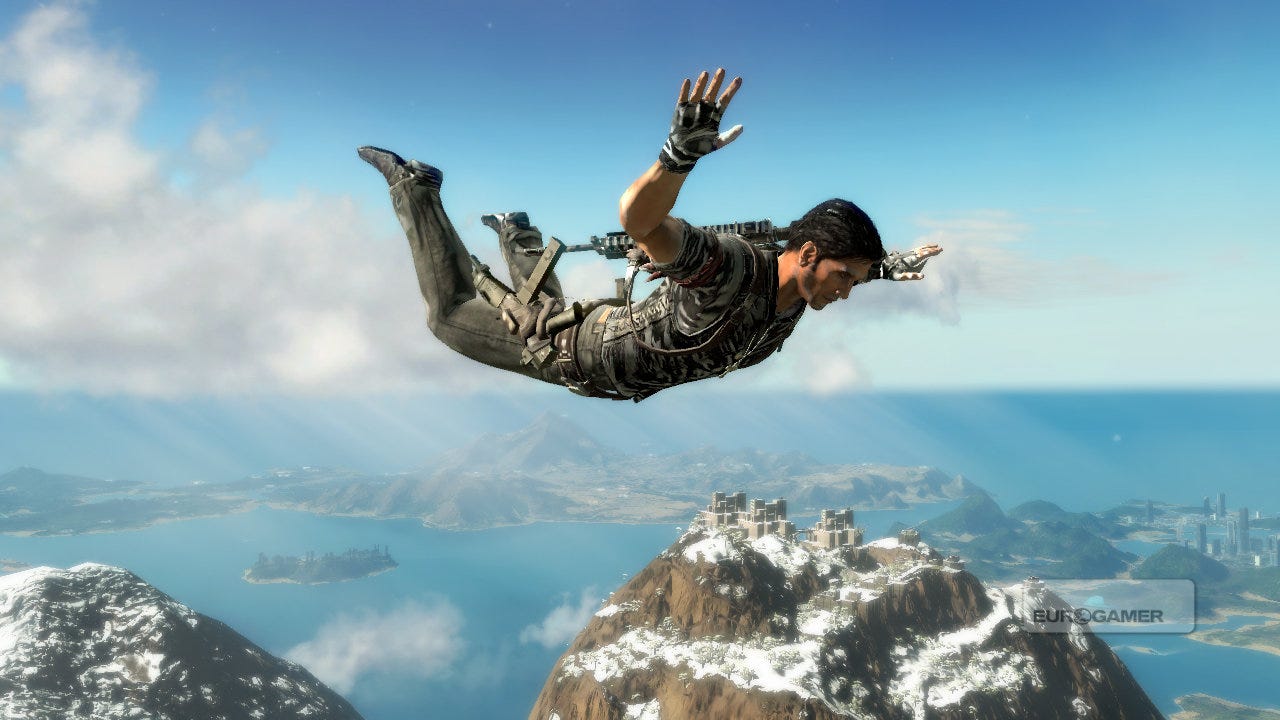
The unmistakable thwap of a chopper approaches. Rodriguez exhales long and leans his muscles with the easing of an analogue stick. He falls forward into the emptiness, swan diving into a base jump. 100 feet. 150 feet. 200 feet. An on-screen ticker charts his trajectory in rigid increments. 50 seconds later, Rodriguez pulls the ripcord and one of his limitless supply of parachutes snatches him out of the death fall. Rodriguez splashes into the islands shallows, windswept but otherwise without mark. Achievement unlocked.
Crackdown may have started the trend of rewarding players for leaping from a game's highest point, but never has the thrill been so keen as in Just Cause 2. In reaching Panau's summit, you must call upon your full range of abilities: hijacking or chartering a plane to climb the required distance before ejecting into the stratosphere and frantically firing your grappling hook in search of a latch point before you fall out of range. By the end of the exploit you will have enjoyed the game's two most enjoyable activities: admiring the picturesque island from afar, before plunging at breakneck speed through it. Achievement unlocked, indeed.
Crackdown-style races are scattered across the island, divided up by vehicle type: car, plane or base-jump.
A critique of any open-world game has to be done in two halves. In the first, you examine the world itself and the tools you are given to interact with it. This is an assessment of the parameters for fun, feeling out the boundaries of potential play and the likelihood that wonderful, unique experiences will flourish for every player within that framework.
On this count, Just Cause 2 is without equal. The island itself is a lush, diverse playground consisting of every type of terrain and weather imaginable. It is beautiful, a picture-postcard amalgam of Pacific landscapes, every inch the dream holiday destination. Avalanche Studio's skill is not only in realising a coherent vision but also in maintaining its framerate and detail regardless of whether you're viewing the fronds of a palm from 2 feet away or the curve of the coast from a thousand.
What's more, traversing the space is quick, seamless and joyous. The grappling hook, now permanently mapped to a shoulder button, is used to catapult Rodriguez around the world; in conjunction with his endless supply of parachutes, it can gain him instant height and momentum from a standing start. While it's possible to walk up to a car, Nico Bellic-style, and pull the driver out to take his place, now you can also simply hook yourself on to a speeding vehicle, spring onto its bonnet and either enjoy the ride as a surfer, or swing through the side door window to take the wheel.
And what if your destination is measured in long kilometres? A tap of a button will call in a friendly black market dealer, who, for a price, will drop a jet or a helicopter nearby for you to take to the skies in. Sometimes the jet will land on top of a passing car, or will fall awkwardly in front of a wall. But with the grappling hook, you can tether it to another vehicle, pull it free of the obstruction and be off in 30 seconds.
Everything is designed to propel you forward through the game world as effortlessly as possible. Aim your grappling target at the top of a plane tree and, as you catapult towards it, the game will shift your position slightly to the left or the right so you don't snag annoyingly in the branches.
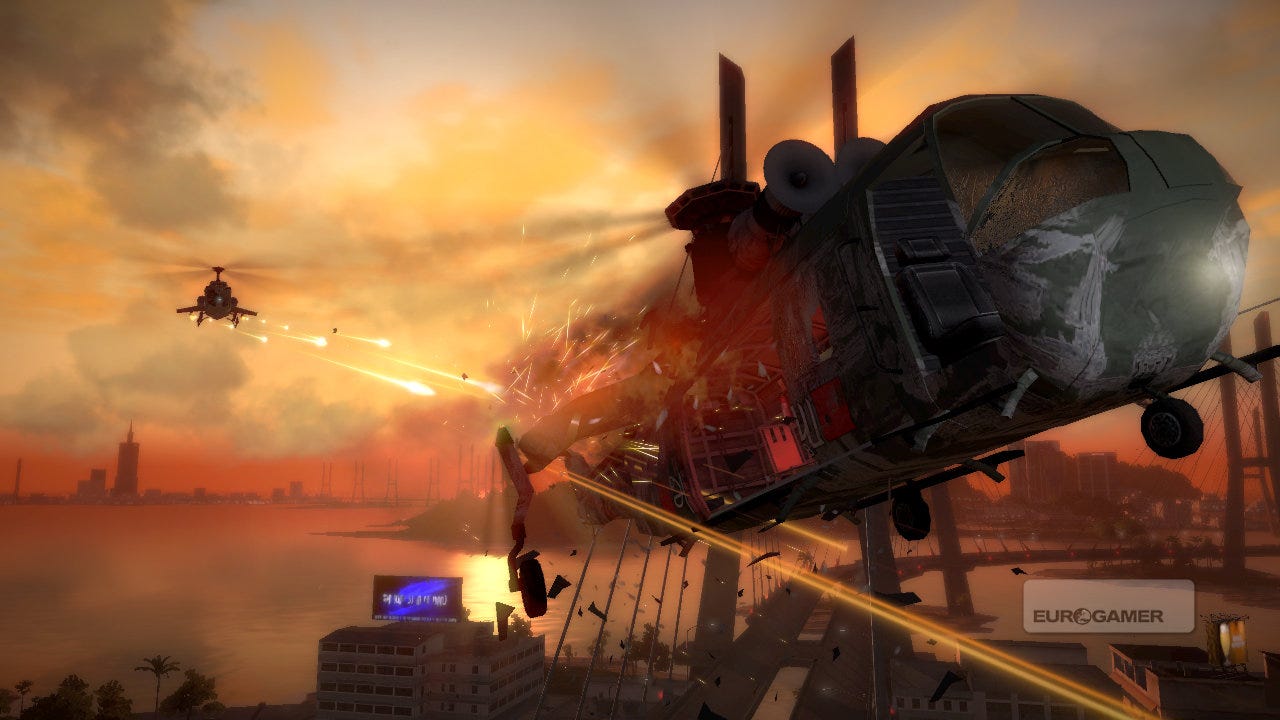
A cross between Spider-man and Bionic Commando, Rico Rodriguez provides, via this one tool, the most versatile avatar for a player yet seen. The throb of an antagonistic military helicopter is no longer a trigger to seek out cover. Rather, you angle your view to the skies, take aim, and haul yourself towards its cockpit for a mid-air hijacking that even an awkward QTE can't spoil.
The story isn't helped by what is comfortably the worst voice acting in a contemporary videogame - the fictional Panauan accent lies somewhere between Thai and Dick Van Dyke.
As a playground for the imagination, too, the island of Panau and the systems that inhabit it are near-unrivalled. You'll lose hours to messing about with your hook and parachutes, roping enemy soldiers to passing vehicles and watching them puppet dance along the tarmac, or simply putting single bullets in gas canisters and admiring their spasmodic pin-balling around the scenery. The personal stories that emerge, especially through the first few hours of play - which are when you're most likely to ignore the structured missions and simply explore - will fill playgrounds and forum threads in weeks to come, not to mention YouTube channels if the community embraces the PlayStation 3 version's video capture capability.
Panau is caught in the formative stages of a tussle between nature and civilisation. Rodriguez's mission (in systematic terms, if not narrative terms) is to destroy almost all trace of man's involvement on the island. Anything marked with the Panau government's bold logo - from radio masts to generators to anti-aircraft guns - is cannon fodder, and as a result violence is the interactive hallmark of the experience. Indeed, every explosion you set off is measured in "chaos", a quantifier for the destruction you wreak upon the island that fills a gauge, unlocking new weapons, vehicles and missions as it passes preset thresholds.
Rodriguez is working for a US agency, initially on a job to confront his boss, who has gone rogue on the island, and later on to overthrow the dictatorial regime that has the island's inhabitants in its grip (although nobody actually bothers to ask the islanders if they're unhappy with the arrangement). The game's titular theme of justice and social redemption sits somewhat awkwardly with the systems it clothes, where even the destruction of giant wind farm turbines - surely an important power source to the local farmers - is rewarded with chaos points regardless.
Nevertheless, the structural conceit of chaos is sound, ensuring that almost every action in the game drives the story along. However, the gauge that unlocks new missions and charts the demise of the country moves along at a painfully slow rate, so that even taking down a sizeable military base has little discernible effect.
Which brings us to the other half of any critique of an open world game: the missions and structured play that inhabit the wider playground. Here Just Cause 2 is a less enthralling proposition. There are just a handful of core story missions for the agency for whom Rodriguez works, unlocked sequentially every few hours as you gain enough chaos points. As a result, the vast majority of your missions are delivered by one of the three factions on the island looking to overthrow the government, all of whom you ally yourself with.
There are moments of brilliance, such as the mission in which you stumble across a smaller island, off the mainland's coast, which is home to 50 or so octogenarian Japanese soldiers, unaware the Second World War ended 60 years ago and as a result hostile to any visitor. However, too often the game falls back onto established mission patterns, especially with regard to taking over new strongholds for each of the factions. These escort missions all take the exact same form, tasking you to guide an NPC through a hostile base, before turning a mounted gun against the base's commanding officer.
Blow a tower up and base-jump off and the camera will auto-angle around to take in the visceral kapow.
12 hours in, unlocking new missions becomes something of a grind, a feeling exacerbated by increasingly lacklustre objectives which ramp up the accuracy and potency of enemies without providing quite enough set-piece spectacle to make every assignment unmissable. The island grows over-familiar and you tire of identikit villages filled with the same palette of assets, factors that turn the initial thrill of exploration into a mild chore, with few novelties to look forward to.
Every settlement on the map has its own completion percentage, registering how many of its hidden items you've found and destructible assets you've blown up. As the game progresses, the map markers seem less like pinpricks of potential adventure, and more like a litany of unfinished business, measured in the most exact terms imaginable. Whether the to-do list is compelling or exhausting depends on your disposition and drive, but for most, enthusiasm will peter out long before everything is ticked off.
But to dwell for too long on the long-term niggles would be to do Just Cause 2 an injustice. Treat its story and delivery as a low-rent thriller and you'll give yourself the freedom to enjoy the world, and your freedom within that world, unfettered. One of the most technically accomplished games around, Just Cause 2 succeeds in delivering both the best-looking and most pleasant open world to explore and some of the most thrilling and diverse ways of moving through it. Its thrills are intense and, for the first few hours, come fast and dizzying, dulling only when you start to see the dry order that lies behind the chaos.
8 / 10
