Ninja Gaiden
Tecmo bounces back with the force of a T-Rex on a trampoline.

If you were to clone John Holmes one hundred times, and then park your creations at the business end of some of the porn industry's finest, you'd still fail to recreate the ferocity of genital eruption that greeted the first promo trailer for Dead Or Alive Xtreme Beach Volleyball in May 2002.
A little under a year later though, the resultant game proved to be less of a custard geyser [enough of the man milk imagery -Ed] and more of a damp squib, with opinion divided between those who felt it was a meaningless waste of Tecmo's development talent, those who thought it was reasonably unconventional and enjoyable, and a minority of folks who frankly sounded like they were on the take. However we all certainly agreed on one key point: that nobody else on the planet was doing a better job marketing the Xbox' technological superiority. With or without realistic breast physics.
Fast-forward to March 2004, and once again we're floored by the graphical magnificence of a Tecmo game. Only, this time, it's much more than tits and arse - although fans of the DOA ladies will no doubt welcome the arrival of Fiend-hunter Rachel. This time, it's bound to a game befitting the developer's artistic ambition. This time, it's worth ruining some underwear to express our excitement. This time, we're playing Ninja Gaiden.
Project Hero
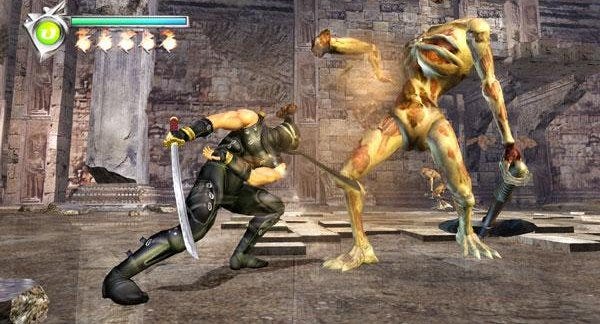
Ninja Gaiden is the sort of thing we've always wanted Tecmo to make - a dazzlingly gorgeous action game that marries a slow-burning combat system to accepted ninja design theory - running on walls, inexplicable brutality, lightning pace - and justifies its extreme difficulty level with cinematic rewards that belittle the efforts of any other developer tackling the subject matter. Anybody involved in Sega's Shinobi, for example, ought to be hanging their heads in shame by the time severed noggins start rolling a few minutes beyond the title sequence. This is how it's meant to be done, guys. Take note.
In fact, you can scratch that comment about "cinematic rewards". Even if you stripped out the cut sequences, which at times left us crawling around battered and bruised groping for superlatives on the living room floor, Ninja Gaiden would still be more than worthy of your time, because it does what every modern game really ought to aspire to do: it makes you look and feel incredibly cool a hell of a lot of the time. Within an hour of picking up the pad you'll be running around on walls, leaping from the shoulders of your enemies and tossing handfuls of shuriken at advancing reinforcements while your blade cauterises anything it touches.
An hour later you'll be getting to grips with the subtleties of the combat system, and refining your approach in the face of superior adversaries, so that you can uppercut them into the sky and then juggle them on wave after wave of fearsome blows, before pile-driving them headfirst into the ground and watching them explode in a shower of gore. It captures the essence of what every gamer wants from the word "ninja" - graceful, exhilarating, impossible violence that up until now only the big screen has been able to convey - and all without sacrificing any of the variety, challenge, longevity or addictiveness we've come to demand from the very best games. It's a gamer's game, and it looks stunning to boot.
Granted, it would be wrong to claim it's not without its flaws, and your mileage may vary where some of them are concerned, but, if you ask me (and by clicking the link you basically did), allowing them to spoil the experience would be like crying over a stolen car the day after you win the National Lottery. In the grand scheme of things, a few quid lost to joyriding hoodlums shouldn't bog you down while there's a life-altering slip of paper tucked in your wallet. Or, in this case, throbbing inside your Xbox. I'm sure you understand what I'm saying: to fall back on standard discussion thread parlance, it's "better than Halo".
The Path of the Ninja
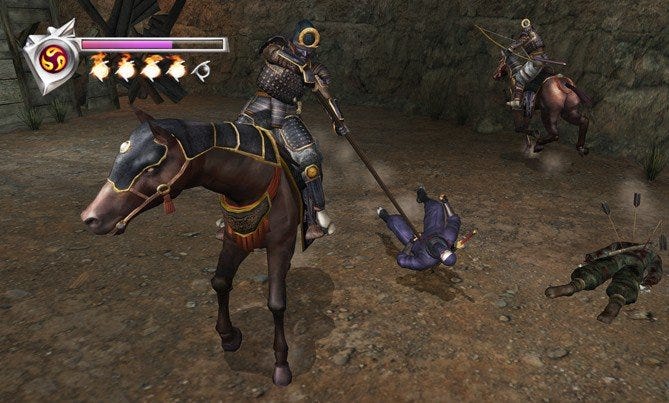
Anyway, by now you've probably grasped that I rather like this Ninja Gaiden lark, so I probably ought to get on with explaining why it's so good. Ignoring the graphics (oh we'll get back to them, don't you worry), in gameplay terms it all starts off unassumingly enough, as you steer young ninja Ryu Hayabusa through the confines of a rocky valley in third-person, learning how to run up and along walls and use the environment to your advantage as you go. It isn't long though before you're getting your first taste of the game's combat system, fashioning crude X-button-mashing sword combos out of fairly basic sword fodder enemies, and tearing around a Ninja Fortress gawping at the ease and speed with which you can spin through the air and whip your sword about like a true warrior. But these faltering swipes and thrusts are merely the tip of the iceberg in combat terms, and it isn't long before greater numbers of foes force you to cast your frenzied wall-running and ninja play-set fantasies aside and work on blocking and picking the ideal moment to strike. Only then can you start to develop and deploy truly acrobatic ninja tactics.
After a ferocious start though, in structure at least Ninja Gaiden subsequently reveals itself as a fairly conventional third-person action slash-'em-up, albeit fashioned with an adventuring mentality and level design that stands stronger than most, and obviously took its lead from the combat. You work your way through a series of 16 levels (or chapters), gradually gathering combat proficiency and learning advanced techniques, buying supplies, upgrading your arsenal and advancing the plot, which sets Ryu on a collision course with the master of the Vigor empire, who seems to have lain waste to his sacred village home in pursuit of an evil dragon sword.
The levels are much less linear than those in some other, similar titles, and you'll have to worry about maps and finding your way around just as much as the (sadly respawning) bands of enemies who await you, but on the whole the non-linearity seems to be worth the hassle of juggling a sometimes awkward map system. The chapter six boss for instance - an enormous skeletal dragon literally 20 times the size of Ryu - wouldn't be quite so effective if you didn't wander past his slumbering frame early on, and spend the rest of the level toiling around with the spectre of an impending showdown weighing heavily on your mind. That's barely a spoiler by the way - in over 20 hours of gameplay he's actually one of the weaker enemies you'll face.
Non-linearity aside, there are plenty of other elements the average action-adventure fan will be able to relate to immediately. There are secret bits scattered hither and thither, some more obvious than others; fallen enemies leave floating blobs of yellow soul juice behind - the game's currency - or life-replenishing blue orbs to unwittingly aid your progress; the game often points you in the right direction, periodically teaches you new things and offers you incentive to explore via a system of hint scrolls, which crop up here and there or whistle past your head wrapped round a throwing dart; and most levels culminate in a boss encounter that forces you to look for patterns and exploit weaknesses to avoid exotic and heavily damaging attacks. Like being shaken violently and then shot in the face at close range by a frothing handheld plasma coil.
Spiritual
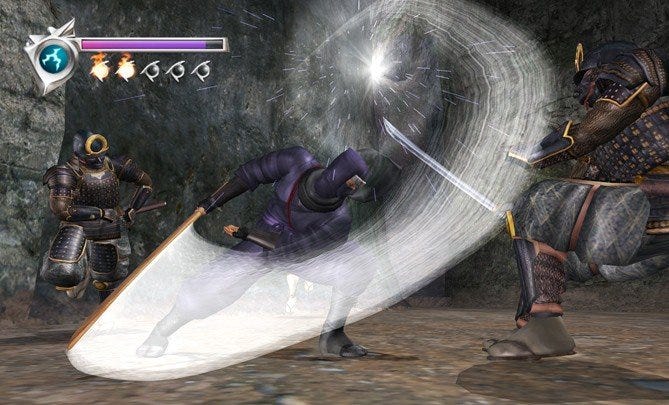
As the glowing praise at the top of the piece implies though, there are plenty of things that set Ninja Gaiden apart from the average actiony slasher. It's all miraculously accessible and responsive, for a start, even if it is harder than a concrete elephant from time to time. Your basic concerns are movement (left stick), centring the camera (right trigger), jumping (A), slashing (X), blocking (left trigger), and using your more powerful attack (Y) and projectile weapons (B).
Extensions of the basic principles of ninjadom are fairly logical - if you opt for a bow and arrow instead of shuriken, pressing B brings up a first-person aiming view, allowing you to unleash an accurate volley as quickly as your Halo-honed thumbs allow. If you want to attack the nearest enemy directly, you can call on a special jump that heads directly for them. If you want to run on the walls or leap between them, you just jump towards them and hold that direction, then spring off at an angle by jumping again and directing Ryu's flight - and not necessarily at a right angle like a certain popular Persian Prince, either. If you want to call upon 'Ninpo' magical powers and attacks, you can unleash them by pressing Y and B together. If you want to develop your combat technique, special attacks and combinations are just strings of face buttons and directions lashed together according to the secrets of the ninja (secreted rather invitingly on the pause menu). And if you find time in battle, you can also call upon Ultimate Techniques, sucking in the rising souls of enemies by holding the Y button and then letting go to have Ryu disembowel adversaries at lightning speed. Or whatever his current weapon does.
Ninja followers might be expecting a spot of stealth to offset the carnage, but Tecmo seems content to let the blood flow and leave the creeping around to the likes of Tenchu. And who can blame them? Especially when you consider how varied the combat system is. Over the 20 [Tom] hours [that's about 30 odd of mine from experience -Ed] or so of gameplay (and we can't really emphasise that bit enough; this is a long game compared to what you usually get from this genre), you'll never experience two battles that pan out in precisely the same way. To be honest, it's surprising more beat-'em-up developers don't apply their craft to the third-person genre with this level of success. The AI of your enemies grows in complexity and dynamism from chapter to chapter, and you can't simply advance by remembering how to attack individual types as you might expect - instead you'll have to improvise and react on the fly; you'll actually have to learn how to block and fight effectively; and the game will give you greater rewards for skilful combat and especially the use of Ultimate Techniques, which act as a multiplier for the soul power rising out of the remains of fallen enemies.
Even the boss fights, which ought to be more rigid and predictable than roaming enemies, often surprise you by changing in pace or ferocity from bout to bout - I only encountered the aforementioned skeleton dragon boss's bite attack on my fifth attempt to topple him, for example. In fact, the only real complaint about Ninja Gaiden's combat system - which is basically 90 per cent of the game - is that there's almost too much at your disposal by the end, with weapons like the Vigor Flail or nunchakus that you could just as well leave to rot in your inventory. Hrm. Then again, as a reviewer you know you're being forced to nitpick when you're fashioning diversity and replayability into some form of criticism...