Version tested: PlayStation 3
In the words of developer thatgamecompany, Flower is a "videogame version of a poem, exploiting the tension between urban bustle and natural serenity", and while the brief, sensuous journey through the game's six levels is worthily conceived and executed, inviting interpretation, its high-minded origins also have the potential to derail it, albeit not in the eyes of "the audience of pretentious fawning fops that have turned the PS3 into the equivalent of a f***ing beatnik poetry bar", as one of our readers put it when we previewed the game in January. However, the result is pleasantly innocent and uplifting, and perhaps unexpectedly its best qualities are those of a very good videogame.
You control the wind, using the Sixaxis motion sensor to direct a petal on the breeze, or to gust forward by holding any of the face buttons. As the petal passes over nearby flowers, they bloom and release their own petals into its wake, which follow you across hills carpeted in swaying wild grass under gorgeous oceans of summer blue. Every new petal emits a calming strum or twinkling murmur into the gentle flow of background music and pivotal events are embroidered by the audible rush of wind.
Certain flowers are held in a translucent circle, and collecting all the petals in a group of these typically has an effect on their surroundings - spreading waves of vibrancy over sun-bleached meadows, for instance, or activating wind turbines and lighting beacons at nighttime. Besides collecting petals and admiring the scenery, you also gust through gullies on occasional, sympathetic rails, sweep through caves and soar from the crests of half-buried obelisks to ascend the walls of canyons and gather far-flung petals. This is how you make progress, moving between two or three significant areas in each level and restoring them by inviting their occupants to bloom, before floating into an end-of-level vortex that transports you home to a dusty windowsill in a city apartment, where your current level's flower is revitalised by the events you've portrayed in its imagination.
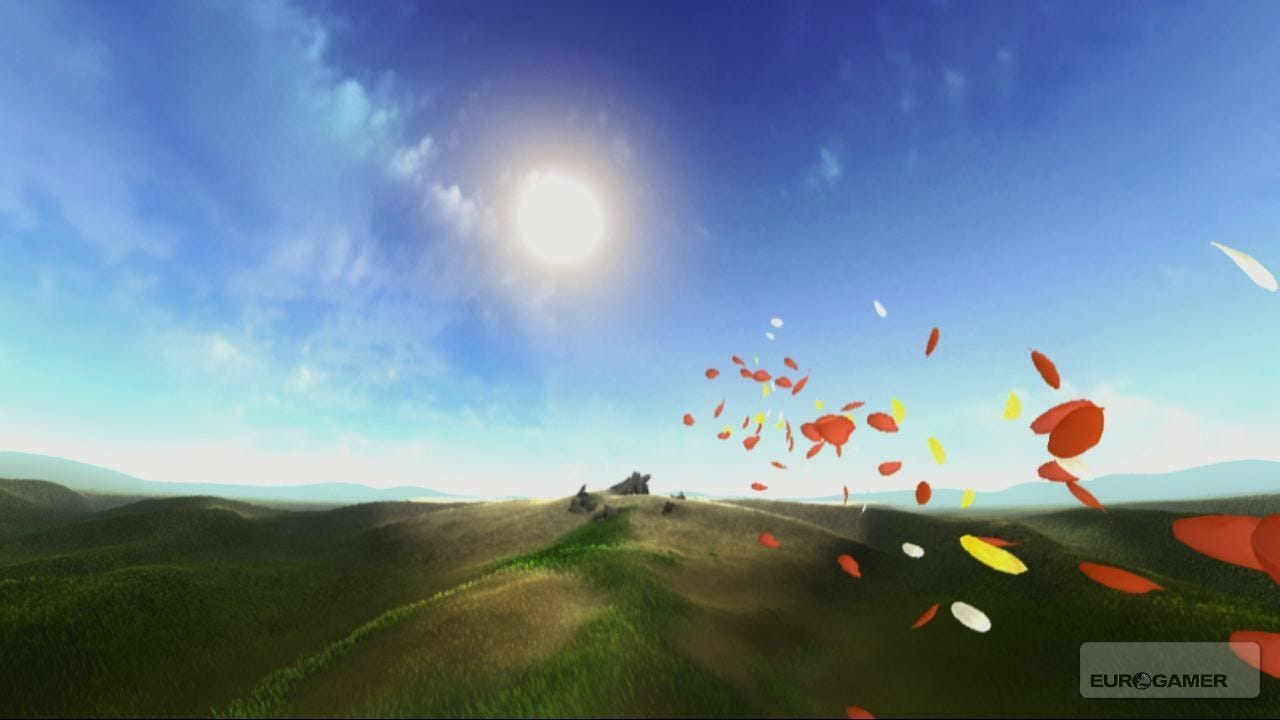
The grass animation and use of sunlight is almost without compare.
As the game darkens toward its conclusion, you encircle hay bales and sweep across pastures to sow luminescence in fields by starlight, and - in the closest thing Flower gets to conflict - flutter briefly but precisely between the rusted carcasses of fallen but electrified pylons to cleanse them, before journeying to the city itself for a conclusion it would be unfair to explain in any detail.
Each new level begins with a single petal and presents a discrete but overlapping flow of simple gameplay, and the game is never difficult. Although your stream of petals can be sizzled to ash by electricity in level five's industrial boneyard, if it's possible to fail I didn't manage it, and while the purely motion-based controls occasionally restrict precise turns over distances of a few feet, for the most part the interface is invisible.
But the absence of challenge isn't the least bit disturbing, because by the time it should become relevant Flower's gentle pace and expressive visuals have disarmed you of traditional notions of achievement. The superficially repetitive design is embellished by the game's grace and simplicity to the point that the things you do and see are the unspoken focus of your efforts. Spreading light across a field and gliding through canyons at knee height is empoweringly tactile, and the game is aesthetically coherent down to the smallest detail.
The way the petals move through the air is so convincing that it requires almost no consideration, and the silhouettes of industry that lurk in the pitch-black transition between the game's cheerful initiation and the final few levels are like shapes moving in the water. The impulse to proceed floods from these details just as it does from your first glimpse of the world outside Vault 101 in Fallout 3, or the first time you exit the hills above Damascus, Acre and Jerusalem and stare down upon Assassin's Creed's playground of minarets.
The only thing that punctures this, ironically, is the way the endgame leans too hard into tradition, inviting you to collect everything you possibly can and probe extremities to uncover green flowers, three sets of which are secreted in each level. There's almost no end to the simple pleasure of floating through the summertime but prolonged exposure to each environment weakens its grip on you until the stranglehold of immersion is broken and you're just collecting objects to make another object appear. There are many good games that are about nothing but collecting objects to make another object appear, but Flower is a good game for other reasons.
How long before we have to use the word "petal" in a review again? Answers on a kerb-stomped skull.
It is, simply, a game where you want to see what happens next, because whatever does happen next will be delicate, beautiful and pleasurable, and never so hurried as to overburden the spectacle and sense of immersion. Even viewed warily through the haughtily lyrical prism of thatgamecompany's artistic mission statement, these are the characteristics of a well-designed videogame, and the torch-wielding art police would do well to encourage them rather than arguing about the designers' motivation. Not least because in this age of overblown expectation, the developer's candour and Flower's composition are honest enough to make it clear whether or not the game will appeal to you in seconds. It certainly did to me.
With all this in mind, it seems almost horrible to have to debate the price, but GBP 6.29 is the figure Sony's gone for and, although beautiful and engaging, Flower's brief, film-length experience would be better suited to something closer to flOw's original GBP 3.49, and that ultimately counts slightly against it.
8 / 10
Flower is due out exclusively for PlayStation 3's online store on Thursday 12th February.
