Version tested: Xbox 360
BioWare is fond of saying that it takes its time tailoring its games to be the best they can be on the formats they're released on. Since its seduction by consoles - beginning with the Xbox-first release of Star Wars: Knights of the Old Republic back in 2003 - it's been as good as its word.
You can debate whether the extra time taken to adapt KOTOR, Jade Empire and Mass Effect to PC was cover for exclusivity arrangements with Microsoft or genuine format-specific perfectionism, but the end result has been the same each time. The company's long-standing, PC-gaming faithful was rewarded for its patience with excellent new versions, and sometimes new content to go with them.
That just makes this console version of Dragon Age: Origins all the more disappointing. A return to the company's Dungeons & Dragons roots (if not the D&D licence and ruleset itself), often called the spiritual successor to Baldur's Gate, Dragon Age was always a PC game at heart and by design. In fact, for the first few years of its development, it was exclusively so.
Interface and technical limitations make the voyage from PC to console - from an open book to a closed one - more difficult than the reverse. But with the simultaneous release delayed while a complete PC version of the game did the rounds - presumably to allow the Xbox 360 to catch up, with the PS3 lagging behind by a couple of weeks - we hoped the extra time would allow BioWare's multi-format standards to be upheld. It hasn't.
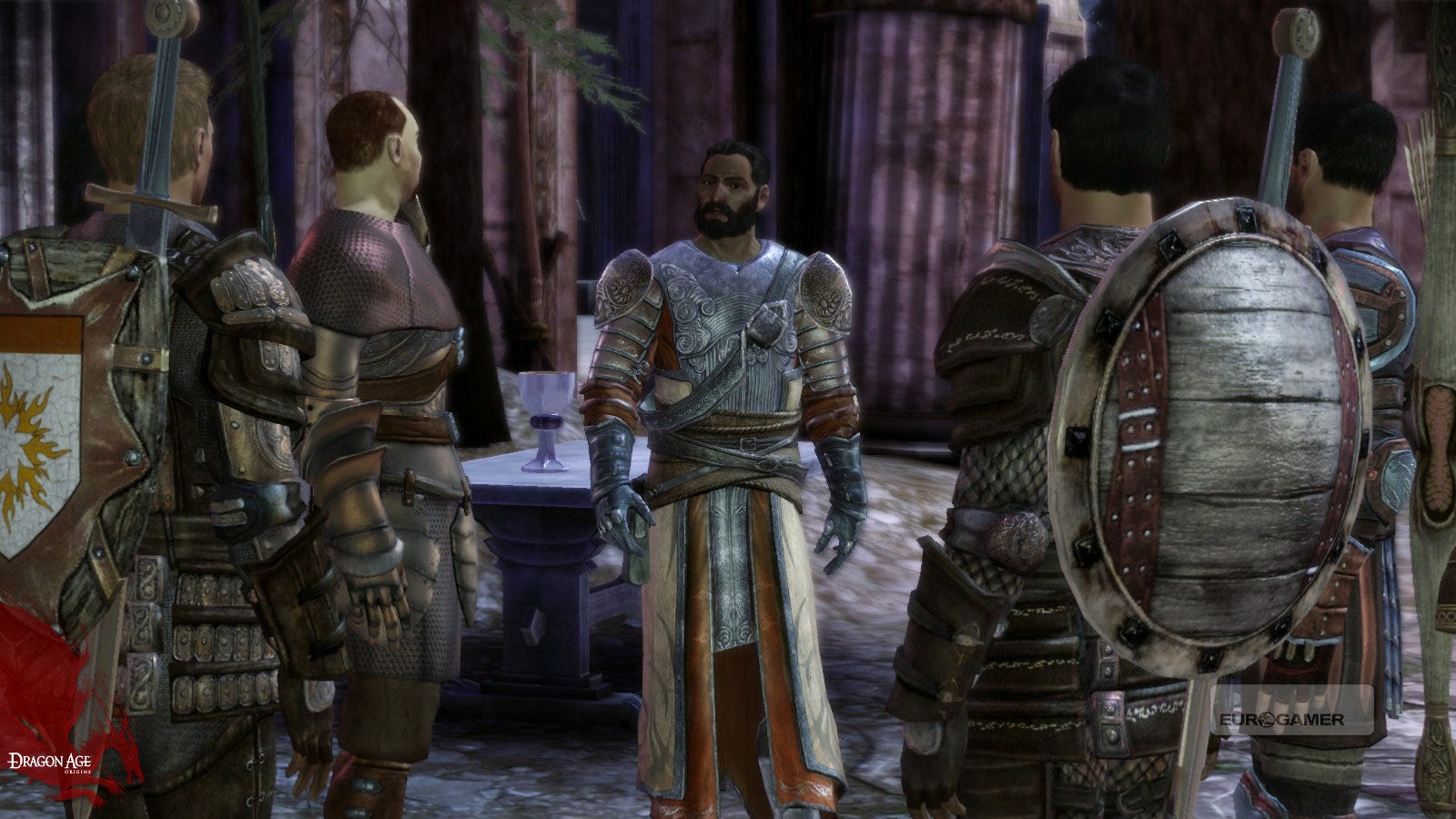
EA hasn't released any Xbox 360 screenshots...
Reviewing the PC version of this sprawling single-player RPG, I found a studious, staid and worthy epic. Dragon Age is a huge and thoughtful game, smothered in detail and founded on a flexible yet solid RPG system which boasts absorbing character progression and tactical combat challenges.
Steering your own highly individual course through it - directing the ebb and flow of its plotting and its characters' relationships through word and deed - you'll be enticed by its openness. Unfortunately, you'll also be alienated and a trifle bored by its dry setting, rote side-quests, lifeless and bloated dialogue and clumsy attempts at edginess, like a college professor trying to act cool. That it draws you in regardless is testament to its craft.
All of that remains true of the Xbox 360 version tested for this review, so I'm not going to repeat it length here. The game's raw material - the acres of stuff pumped out by BioWare's prolific content factory - is just the same, but the overall experience is dealt quite a blow. The conversion's failings make some of the game's flaws a little harder to forgive, but even worse is how badly it undermines Dragon Age's strengths.
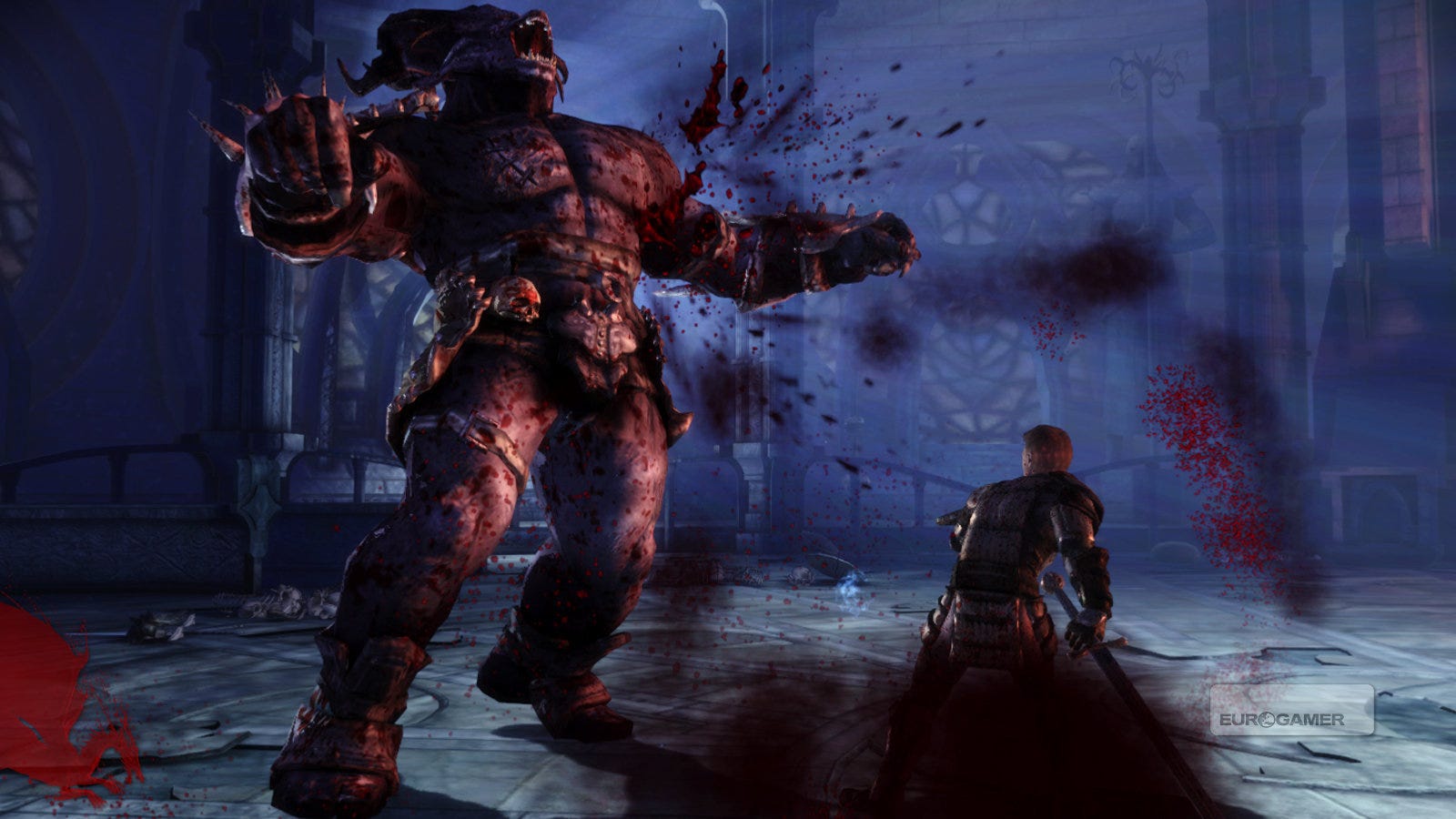
Action-game flourishes, like the slow-mo finishing moves on bosses, seem forced.
Let's be charitable and shrug off the poor-quality audio compression. There's a tinny, scrambled edge to the dialogue now, but that can only be because there's so very much of it to be accommodated without the benefit of a hard disk install. And whilst I might take issue with the script's pompous, long-winded exposition and lumpy characterisation, I'm certainly not going to complain that I have so many conversational options, supporting so many permutations and combinations of party companions and their unpredictable moods. That's what brings Dragon Age to life, sometimes in spite of itself.
The 360 game suffers visually too, however, and that's harder to let pass. On PC the game is reservedly handsome, enlivened by atmospheric lighting and a fine finish on the game's virtual actors. On the Xbox, though, Dragon Age looks just plain ugly and out-of-date. It's plastered in muddy textures, washed-out colour and bad shadowing, giving it a grimy look that doesn't suit the classical art style at all, and exposing the rough-hewn, low-detail environments in a harsh light.
But it's the people who suffer worst. You spend a lot of time watching talking heads in this game, and their smudged, pale and suddenly ugly features just draw attention to their robotic animation, rough lip-synching and stiff fantasy-speak. This version of Dragon Age fell into a creepy ditch a long time before it got anywhere near the uncanny valley. It's sad that such superficial things as texture resolution and shaders (or the lack of them) can sap your immersion in a world, but with the companions especially playing such a crucial role in your involvement in Dragon Age, it would help if looking at them didn't make your skin crawl.
Worse, though, is the game's interface. It's not that the BioWare and Edge of Reality, who assisted with this port, have done a bad job cramming all the PC game's point-and click features onto a gamepad workaround. Map, quest log, inventory and so on, accessible via the back button, are clean and well thought-out. You can map six skills to three face buttons (using the right trigger to switch between them). The radial menu, accessed with the left trigger, is a reasonably elegant and efficient route to whatever else you might need in a hurry, and some of the concessions - such as a "quick heal" button that automatically selects the most appropriate health poultice to use - would actually have been handy on PC.
But when you're in combat, there is a fundamental, unbridgeable gap between the game Dragon Age is on a console, and the game it's supposed to be. On anything but the easy setting, this is a tactical party RPG. Placement, target selection, and efficient use of the full range of your party's skills matter hugely. They're all made much more difficult by changes to the game's camera, targeting, and pause.
Dragon Age throws blood around like most RPGs dispense experience.
The game's top-down view is gone, with the camera locked to a relatively close third-person perspective on the party member you're controlling. This makes it much harder to keep track of your allies, or of the ebb and flow of a complex battle against multiple opponents. You simply can't manage placement in the same way, not least because if you want to move someone, you have to take control of them and do it manually; there's no alternative to the PC game's click-to-move orders, which are a godsend when multi-tasking (moving a healer out of trouble while manoeuvring a rogue into a backstab position, for example). Was it really impossible to implement the birds' eye view on consoles?
Target selection is infuriatingly vague, governed by the direction your character is facing and nothing else. Using the reticule in the radial menu only marginally helps. Trying to select a key foe with a ranged class across a busy battlefield is much harder than it should be, and unforgivably, there's no hard-target, so you can end up focused on someone else if they wander into your line of sight. It's a million miles from the crisp definition of the PC interface.
Finally, there's no real alternative to the PC game's pause, the iconic feature that allows BioWare's fantasy RPGs to straddle real-time and turn-based combat. Although bringing up the radial menu pauses the fray, it doesn't, crucially, allow you to set one skill for each character while the fight's suspended - select an ability, and the action resumes immediately. Micro-managers have to constantly re-pause the game for every instruction. Besides being irritating, that will cost vital seconds in the game's most intense boss battles.
If only it scaled better.
(Correction: Since this review was published, we've learned that hard-targeting and stacking orders are, in fact, both possible. You can lock on to a target by clicking the left stick, which does alleviate some of the targeting issues mentioned above, although quickly selecting distant enemies in a busy battle is still awkward. Orders for multiple party members can be queued up by holding down the left trigger to keep the radial menu open - unfortunately however, this does not work if the menu is set to "toggle", the mode in which we chose to play the game. Neither is an elegant method, but the option is there. This does not change our judgement that this is an inferior version of Dragon Age, and after discussion we believe the score below still stands. Nevertheless, it's a serious oversight for which we can only apologise.)
The result of these three changes is to impose painful limitations on the flexible, tactical and rewarding combat that is the best feature of the PC Dragon Age. The game is far from broken, but it's forced into assuming just one of its many aspects - that of the close-quarters, real-time, almost action-RPG. It's not the style that suits it best, especially when the going gets tough. Thank goodness for the Tactics system of programmable party orders, which may not work quite as well as Final Fantasy XII's Gambits under extreme duress, but certainly smoothes your path through regular encounters.
RPG fanatics without a PC will probably want to fight their way through these flaws to get to the meat of Dragon Age: Origins - which is all still hanging off the bone, and which still makes for a filling, if slightly flavourless, meal. But they won't be able to escape the knowledge that they're playing an inferior version, a game that's been squeezed into a suit that doesn't fit. PC gamers can - with a flick of the mouse-wheel - look down on them.
6 / 10
