Dragon Age: Origins Preview

Where be dragons?

The subtitle says it all - and BioWare isn't exactly trying to disguise its ambitions, either. The E3 demo of Dragon Age: Origins we saw was presented by Dan Tudge, pointedly introduced as executive producer of the franchise. Days earlier, Greg Zeschuk had confirmed the nascent series will come to consoles in some form, after this PC game. This one will run and run, if BioWare and EA get their way; we may now know that the studio's in-development MMO is no Dragon Age, but we'd be surprised if that idea wasn't already twinkling in someone's eye.

To be fair, this isn't quite the hubris that it seems to be. Despite being an all-new game in an all-new universe, Dragon Age has a long and distinguished history: that of Baldur's Gate, the series of role-playing games that made BioWare's name, to which Dragon Age is a "spiritual successor". The title looks back as well as forward: Origins refers to the game's "origin stories" system that will "change the way the world perceives you, and how you perceive the world" - in other words, you'll define your character and the story by your words, actions and moral choices, choosing to be a "hero, martyr, or tyrant". Vintage BioWare, then.

In fact, Dragon Age: Origins is such a straight-down-the-line fantasy RPG - it finds BioWare in such a respectful and conservative mood - that despite filling a small cinema screen with insanely high-resolution images of massed eldritch combat, the demo barely raises an eyebrow. It is all exactly as you expected the first time you heard about it.
1

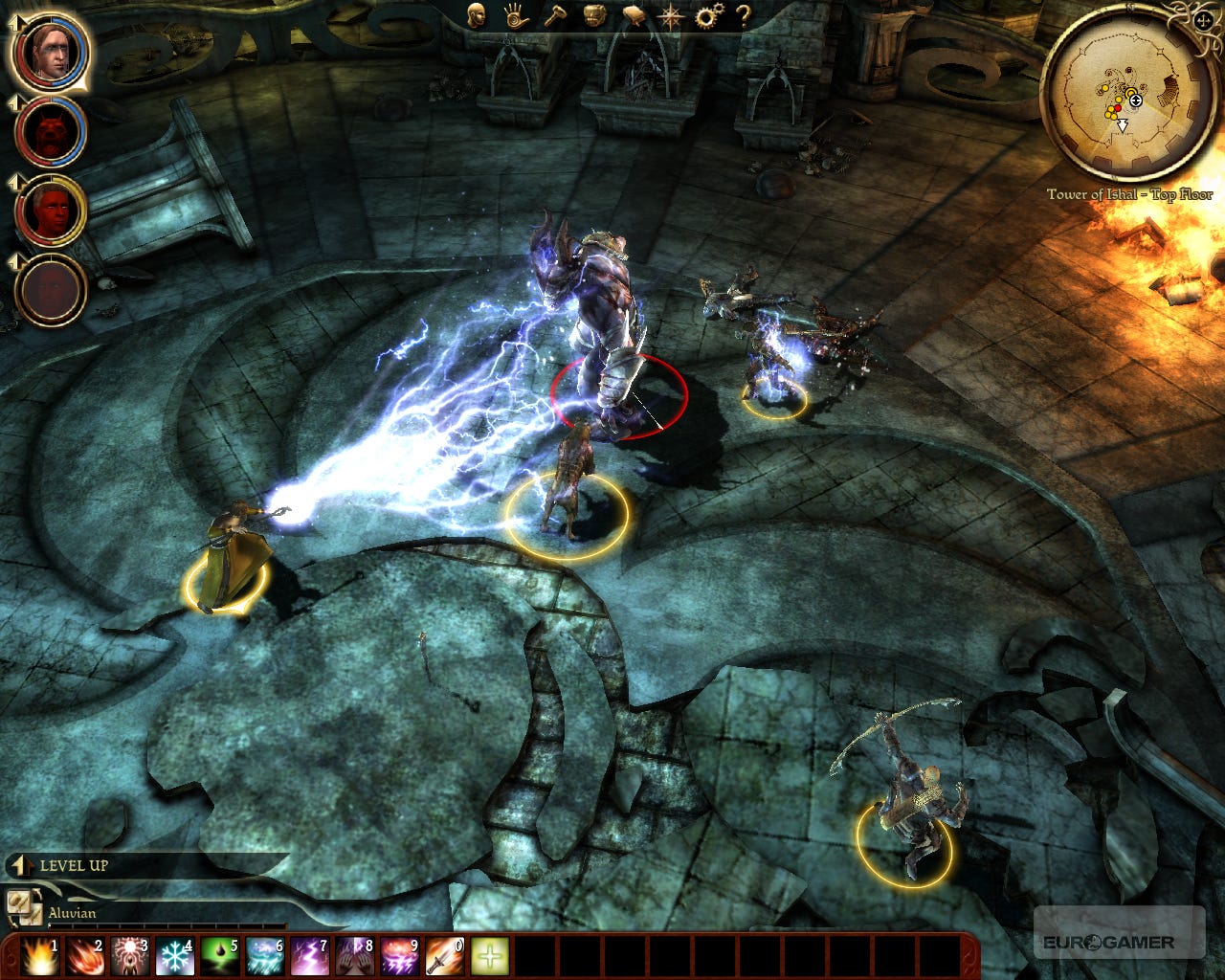
Red circle = bad. Yellow circle = good.

Warriors and mages? Check. Fire and ice schools of magic? Check. Ogre boss? Check. Charging, roaring army of fang-faced orc-a- likes? Check. Trios of conversational options, neatly split between obsequious, wary and rude? Check. Raven-ringed spires? Ponderous council-of-war cut-scenes? "Will you kill the prisoner or set him free?" Check, check, check. Dragons? Actually no, we didn't see one. What a gyp.

This, however, is a "realistic" dark-fantasy setting distinct from the high-fantasy of Baldur's Gate, so we wouldn't expect them to be swarming all over the shop. The game focuses on the war with the Darkspawn, that numberless mutant horde. We're introduced to the game as a human warrior who belongs to the Grey Wardens, a neutral order of wise men dedicated to the eradication of Darkspawn, which inspires equal amounts of reverence and mistrust in the more politically-minded characters that we meet. It's not clear if all players will join the Grey Wardens, however; play later switched to a female elven mage, and one cut-scene did show a council of mages opposing the Grey Wardens' advice.

You'll choose between three basic archetypes - warrior, wizard and rogue - and presumably specialise within these, though there were no details on that. Dragon Age is an entirely single-player game, but you'll often be leading a party of four. This party is neither entirely pre-ordained nor left to you to select from a pool; events and conversations will often give you the option to add certain non-player characters to your party, like the fresh-faced tower guard seen in the demo.

Combat happens in real time, with skills selected from a time-honoured action bar and the character manipulated with WASD controls. You'd be tempted to say the game played like an offline World of Warcraft, if it wasn't for the optional "pause and play" system. Once paused, you can cue up series of commands and switch between members of your party, and this is where we suspect the real meat of Dragon Age's combat lies.

NPC party-members are controlled by autonomous AI in real-time, but once controlled offer up their own limited action bars, providing some variety and tactical flexibility. Pause also allows you to string together combos neatly, across single or multiple enemies, and BioWare is clearly working to provide skills that play off each other within combos - such as the warrior's shield bash being used to open up enemy defences for more direct strikes, or the mage casting a slick of oil before setting alight with a fire spell.

Much is made of the fact the combat will be "scalable", but although the engine can throw vast numbers of characters around in the live cut-scenes - as evidenced by the Darkspawn charge that introduces the grand battle in the demo - we don't see much evidence of this in gameplay, with the most spectacular action happening tellingly off-camera. Instead, encounters with small groups of mobs culminate in a conventional four-on-one boss battle with an ogre.

2

Flying Buttress and Free-Standing Arch Age, more like.

There is a least some impressive physicality on display here, with the ogre picking up, shaking and tossing ragdoll party members around, rather than simply gesturing large red negative numbers into existence above their heads. It's no Diablo III - it's slower by several treacle-vats than Blizzard's forthcoming monster-mash - but Dragon Age does see BioWare willing to allow a soupçon of action into its hallowed RPG template.

Visually, Origins is technically impressive and flows smoothly, if not rapidly, from story to combat to exploration to conversation, within an elegantly restrained interface. It rarely excites, though. Its looks are as coolly handsome and restrained and hedge-betting as the characters who never say anything with feeling, because they have to deliver three responses the same way. There's grace and detached splendour here, but not much imagination, or guts, or glory. Dragon Age: Origins looks and sounds like a war in a library.

There will be a great many fans who are overjoyed to see the effective return of Baldur's Gate, and we certainly wouldn't suggest that they're wrong. As scant as gameplay details are - considering the game is due out in "early 2009", BioWare is playing its cards close - we are prepared to bet that Dragon Age: Origins will be as luxurious and welcoming a PC RPG as you could wish for, a real leather-armchair game. As the foundation of a franchise though - as the keystone, the origin, of a new fantasy universe - we can't help but wish it was a bit more fantastical.

Dragon Age: Origins is due out on PC in early 2009.

Comments (39)

Comments for this article are now closed, but please feel free to continue chatting on the forum!

  • Loading...hold tight!