Dante's Inferno

Suffer the little children.

I've just killed King Minos, the Cretan ruler who, until quite recently, sat at the entrance to the first circle of hell proper, judging the fallen and assigning them to their particular circle of torment according to their sins. A little unfair, you may think, as he was really just doing his job, but the bastard started it.

Playing through the first level of EA's adaptation of the legendary epic poem at the Eurogamer Expo this week, it's hard to argue that Hell is rendered with spectacular ferocity, and that nearly every possible detail represents some aspect of eternal woe and torment. In the background, torrents of flailing, screaming damned tumble from the gaping mouths of demons into the fiery pits below as Dante carves his way towards his goal.

Walls of shrieking, grasping souls clamour desperately for the succour of the living, providing convenient handholds for Dante to scale the cliffs and precipices of the funnel of damnation leading down to the eternal city of Dis. Even the doors in Hell are personified by the harrowed lost, their barriers only surmountable with a quick thrust of Death's scythe and a jagged upward sawing, rending them asunder with a throaty howl. It is quite the grim experience. And, as mentioned, people keep starting on you.

For a game which has you killing Death himself in the opening tutorial, ambition of scale was always going to be high on the agenda. This is Hell by Hollywood, with the howling undead exploding from the ground in plumes of fire and brimstone, Dante's swings and swipes dismembering their cadavers like so many grouse on the Glorious 12th. These common-or-garden condemned are soon dwarfed, however, by spiral-horned fiends who put up much more of a fight with their flaming blades, breaking Dante's blocks with charged attacks and knocking him down for the lesser beasts to pounce upon.
1

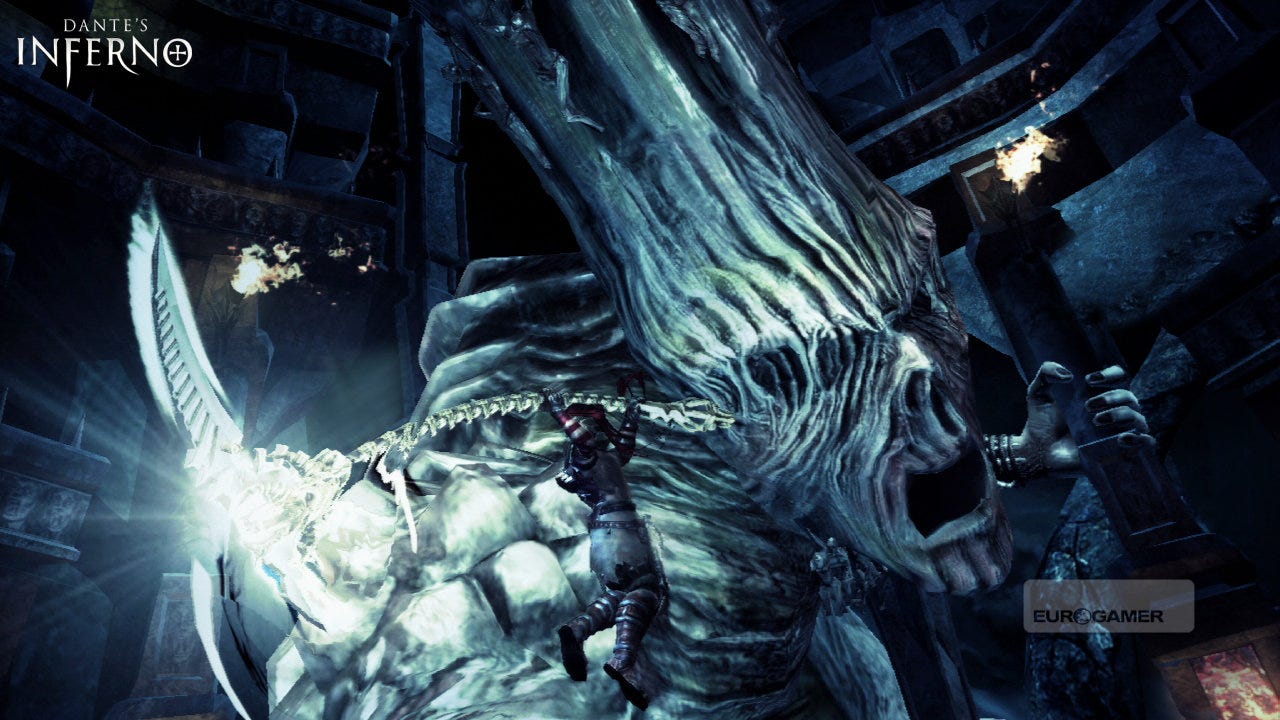
This is Minos, who meets a particularly grisly end.

These larger enemies can be bested by hammering away with combinations of blows from the scythe and the stunning power of Dante's mystically imbued cross, but a far more satisfying method of dispatch is to weaken them until a helpful button icon appears above their heads. Replying with the correct input slings out the scythe, latching onto the neck of the monster and swinging Dante around to put him on its shoulders, blade at its throat. Then you pummel the circle button to perform a quick decapitation manoeuvre, and revel in the accompanying fountain of diabolical ichor.

Quick-time fuelled physical abuse punctuates the gameplay, both in the general carnage and the suitably epic boss fights. When I gouge my way through Limbo to confront the huge, grotesque edifice of Minos, the action is divided between freeform slashing and button prompts - very much in the vein of a certain other divinely-themed action slasher you can also play at the Eurogamer Expo. The denouement to this confrontation is a spectacular one, which I won't spoil for you. Suffice to say that it's not for the faint-hearted.

Probably the height of the macabre grotesquery are the scampering, blade-handed unblessed infants. These miserable unfortunates are the souls of children who died before they were baptised, traditionally banished to purgatory in the delightful Old Testament interpretation. The first time you encounter one of these proto-Chuckies he's writhing in a crucible of flame, bracketed by statuary depicting the agony of childbirth with the gaping, swollen bellies of women in labour.

It's quite a disturbing sight, and, of all the horrors I bear witness to, that which seems most likely to agitate the scissors of the censors. These infants soon beset you from all sides - the charred stumps of their tiny arms tipped with curved and rusty sickles which double as extra legs for their scuttling gait. Luckily, essentially being babies, they're pretty easy to dispatch with the six-foot instrument of Death that Dante wields so fluently.

And fluent it is. Combos grow increasingly ludicrous and destructive as they progress, quickly escalating from simple sweeps and stabs to devastating spins and power slams. Whilst initially complex, these patterns are actually easy to pick up - the time-honoured tradition of light and heavy blows gelling fluidly into flurries of metal. Using these effectively for crowd management alongside blocks and the chargeable cross-stuns (during which I fight off a powerful urge to shout "The power of Christ compels you!") is essential to avoid being overrun and overcome, which happens to me rather a lot until I ramp down the difficulty from hard to normal.

2

These flying beasts can be hooked with the scythe and slammed earthwards.

Because taking a shoeing from the denizens of Hell is an occupational hazard for our hero, EA has helpfully scattered a few mana and health wells around the shattered environments, which must be latched onto with a bumper and tapped with presses of a face button. Because this takes a few seconds, enemies must be cleared from an area first, heightening the tension when the health bar drains.

As you'd expect from a game which depicts a man's descent to the seat of the very Devil himself, Dante's Inferno rattles the nerves and challenges at every turn. It's not a relaxing experience, rather a strangely invigorating one - the haunting screams of sinners will grit your teeth and run their fingernails down the blackboard of your mind, but this feels appropriately like a real crusade, a heroic fight against almost insurmountable odds. I'm reminded of a quotation from John Steinbeck, talking about his masterful Grapes of Wrath - "I've done my damnedest to rip a reader's nerves to rags, I don't want him satisfied." Except, of course, that a great deal of what you'll be doing in Inferno is really very satisfying indeed.

Dante's Inferno is due out for PS3 and Xbox 360 on 12th February 2010.

Comments (40)

Comments for this article are now closed, but please feel free to continue chatting on the forum!

  • Loading...hold tight!