Version tested: PC
Let's start with the bad news, because there isn't really very much of it. Crysis Warhead is not a particularly long game - in fact, if you're playing on normal settings, and you're familiar with the first entry in the series, you can probably clock this at somewhere between five and seven hours.
But is that really bad news? Because although Warhead isn't the most time-consuming initial playthrough - it's a side-story rather than a true sequel, after all - it manages to throw in a surprising amount of variety, and, with that, a considerable degree of replayability. It may not take days of your life to complete, but it never asks you to do the same thing twice, and the chances are that, as with the original, each subsequent playthrough will reveal an unexpected side to most of the set-pieces.
The basic mechanics remain unchanged. Taking place within the original Crysis' timeline, your suit powers are still the same - cloak, strength, speed, and the standard armour setting - and it's still you against the North Korean Army, battling through the same beautifully rendered jungle and waiting for those floaty Matrix-style aliens to show up and turn everything into ice.
But despite these seemingly impossible constraints, Warhead manages to address practically every issue players had with the original game. It may fit inside the same story, but as it follows a different character ("Psycho" Sykes, the original game's Statham-alike, and a man specifically designed, in the words of the developers, "to make you want to blow s*** up") through different encounters, the pacing has been radically altered for the better, with the big freeze arriving far earlier, and a far more satisfying finale than the slightly hurried and abrupt conclusion of the first Crysis.
Warhead's story may not be Faulkner, but it has at least one surprisingly emotionally powerful cut-scene.
Both human and alien AI have been improved, too - the NKA are better than ever at flanking intelligently, deciding when to hold back and when to try and take you out from a distance, and they're now much more willing to use cover. Equally, they no longer have that strange habit of standing around looking like they're trying to recall the name of the actor from Q: The Winged Serpent, while you pump bullets into them from close up, either. (It was Michael Moriarty, by the way, but I sincerely hope you already knew that.) And the aliens - a real weak point in the first game - aren't half bad themselves. In fact, if anything, they're now a little more human in their intelligence, hiding, lurking, blasting you with freeze rays from just out of range, and far more eager to take you down with them via their post-death explosions. And without spoiling things too much, expect them to ramp up in force much earlier on this time, with certain old enemies making surprisingly snappy appearances.
Crysis had a lot of great moments, of course - moments of real drama where the AI and environment came together to create brilliantly fraught set-pieces that looked as good as they felt. But it also had a fair amount of downtime in-between, sections when the pacing was less inspired, and enemies dribbled out at you more from a sense of politeness rather than any clever staging on the part of the designers. And at its worst, when the game promised its most interesting encounters, Crysis suddenly curtailed all of your expansive freedoms, locking you into a moving vehicle and turning into an (extremely pretty) light-gun shooter. Warhead, though shorter, is far tighter, following each encounter with one that's radically different, mixing driving sections with grinding shoot-outs, and making sure that, even when you're behind the wheel of a vehicle, you can still get out and play it on foot if you want, and if you're surrounded by heavily-armed enemies in a situation built for gunplay, there's still a solid option to stealth your way through if that's your kind of game.
On the inevitable occasions when Warhead shunts you into corridors, there's a reason for it - generally to break up the pace of a gruelling openworld section, or create a claustrophobic tone before shoving you out into another giant vista. And even these more controlled environments still have options everywhere - a smattering of lightly branching paths, fights going on above and below you, and a constant stream of physics toys for you to attack with if you get tired of shooting or run out of bullets.
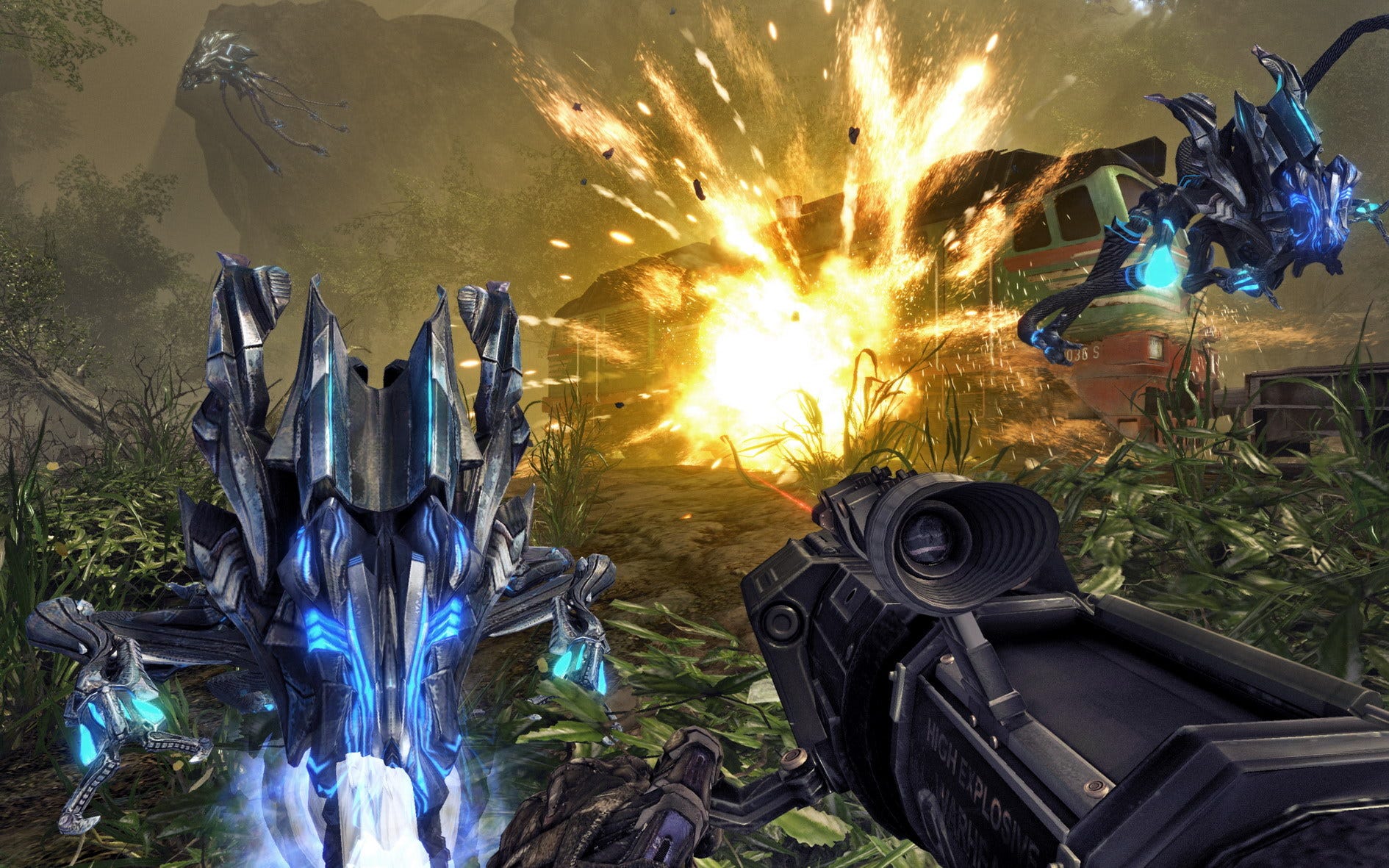
One of the strangest things about Warhead is that, while at times it practically beats you over the head with creaky old FPS conventions, more often than not it manages to make them feel fresh, or at the very least, intelligently crafted. Ideally, I'd rather not play another game with a mine section or a train section, or a set-piece where I have to defend an area against waves of enemies while a colleague does something clever and time-consuming with explosives behind me. But even though Warhead offers all these moments up, it puts its own spin on them - the mines are an on-foot rollercoaster, with beautifully gloomy shadows in which enemies can lurk, and fights erupting when you least expect it; the train section allows you to get on and off at will, running across the carriages and using the mounted guns, or racing off into the jungle to tackle enemies from an unexpected position before clambering back on. Even the defensive sections have an interesting twist, with the static turret turning out to be a red herring as often as not, and every nearby hiding space far more destructible than you might have expected.
And it's still surprising how good this game looks - and, more specifically, just how it manages to look that good. Because the original Crysis has such a reputation for technological brilliance in the graphics department, it's perhaps been unfairly underrated in terms of raw art direction. Warhead is not just packed with brilliant shaders and filters, it's often beautiful in terms of sheer composition. From the initial midnight insertion point down a flare-lit river, picking your way between rubble and flames under a deep blue starry sky, to the first appearance of the alien freeze, with beautifully sculpted half-pipes of frozen wave and an entire warship permanently paused mid-roll, this is a game which really cares about the environments it offers up.
Vehicles are present but by no means mandatory, except for one brilliant hovercraft section.
And even if the single-player's short, with few new gadgets, enemies, or settings, there's always the multiplayer, with a rebalanced version of Power Struggle, and a new Instant Action mode, allowing for easy team death-matches across a smattering of old and new maps.
In the interests of full disclosure, I should point out that I was a pathetic, cringeful failure in all of these modes, dying comically at the hands of both fellow journalists and Crytek Budapest's shockingly effective QA department for the best part of a long, sad afternoon that I shall not soon forget. It's a testament to how good the multiplayer is that I still managed to enjoy my humiliation. In any case, I look forward to your kind, kind words on the subject in the comments section below.
But of course, this being Crysis, a single question remains. Will your hardware allow you to play the game this time around? Will it run on anything less powerful than the WOPR from WarGames? This issue has possibly been slightly over-stated, as a significant chunk of the PC audience were actually perfectly capable of running the original Crysis on some manner of settings the first time out. The difference here is that the game has been optimised for a lower spec machine, and a slightly sheepish Crytek have made it clear that they sounded off on the tech-melting requirements of the first game a little too loudly last year. The official specs for Warhead are:
The nano-suit may be a lovely piece of kit, but if I had to dress up like that to enjoy its capabilities, I'd probably rather risk a bullet in the pancreas instead.
- OS: Windows Vista / XP with SP2;
- Processor: 3.2 GHz for Vista 2.8 GHz for XP;
- Memory: 1.5 GB for Vista 1.0 GB for XP;
- Video Card: NVIDIA GeForce 6800 GT or greater; ATI Radeon 9800 Pro (Radeon X800 Pro for Vista ) or greater.
To put that in context, Crytek has built a machine from online parts capable of running Warhead on the second-highest graphics settings for USD 600.
To end on a tenuous analogy, Crysis Warhead is probably the Back to the Future II of videogames: rather than totally transform the story and setting, it returns to the original narrative, exploring it from a different angle; once again, the results are sharper, meaner, and have a lot more for you to think about (although, thankfully, there are no dodgy CGI sharks or Elisabeth Shue performances). The original Crysis may have given you the basic tools, but Warhead allows you to really use them, and while its previous titles made it clear that Crytek knew technology like few others, it's this strange off-shoot Warhead that proves it's no slouch when it comes to level design and set-pieces either.
9 / 10
Crysis Warhead is due out for PC on 19th September.
