Bayonetta Review

Angel May Cry.

Version tested: Xbox 360

The best two Japanese action games of the year are diametrically opposed in approach. Demon's Souls is a brooding traipse through the corridors of purgatory, fair but relentlessly unforgiving. It teaches that modern videogames have made us weak and stupid, that our gaming muscles have atrophied through the efforts of so many mollycoddling developers. Every sword strike must be carefully considered, and button-mashers are not so much ridiculed as downright abused for their lack of sophistication. The result is a tense but ponderous experience, one that demands supreme trepidation before each step taken, careful contemplation before every input made.

In Bayonetta, meanwhile, you press a button and your television implodes.

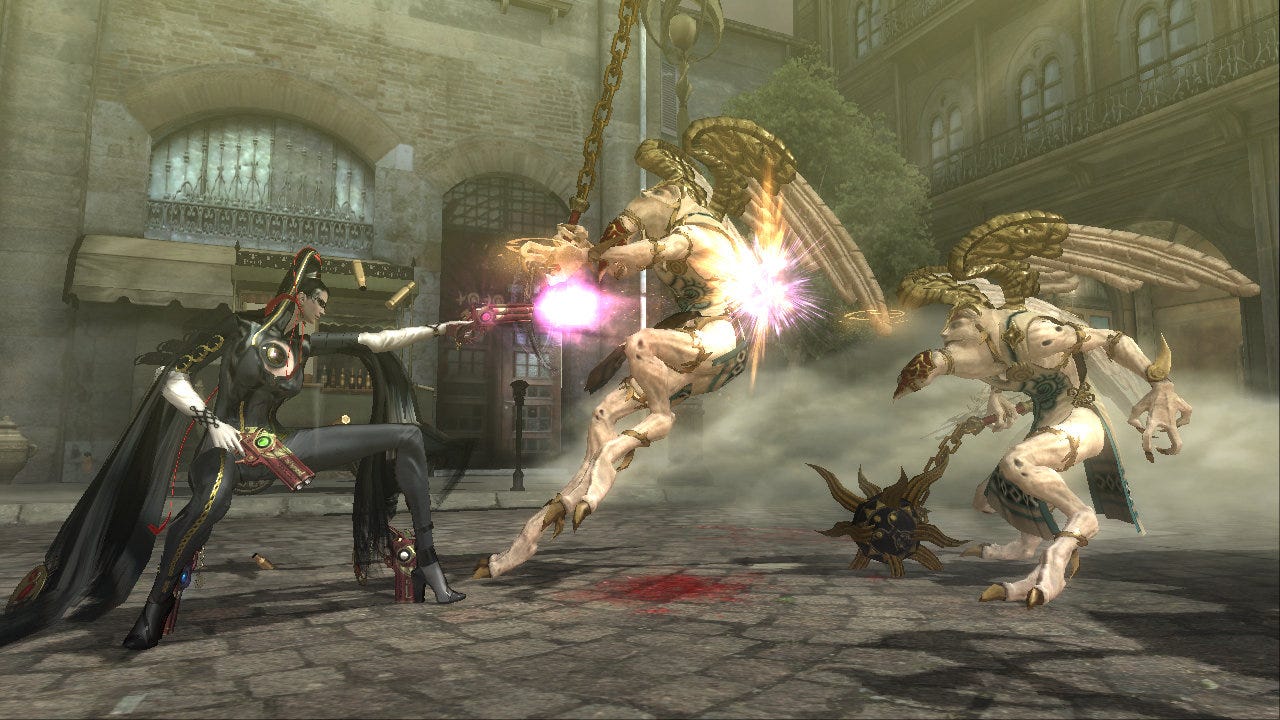
Beloved is a celestial giant with the face of a three-year-old cherub and the body of a weightlifting Buddha, who falls from heaven to cobblestone with a squelchy thwack. Standing just 20 feet from this sudden epiphany, Bayonetta smirks to the cameraman, who's angled our viewpoint on the scene from ground level in order to fully celebrate the titular anti-heroine's ninja Barbie physique and secretary-cum-sex-worker attire. Her wink to lens is the starter pistol for interactivity.

You rotate the left analogue stick and hit the X button on cue, and Bayonetta cartwheels into a handstand, firing the twin pistols attached to her stilettos into Beloved's rolls of fat by clicking her heels in rapid succession. You break the sequence short with a triple jump through the air, esoteric purple wings momentarily sprouting from her arched back as you do so, before landing on Beloved's shoulders. The camera wheels and dives around, matching the kinetic assault of Bayonetta's body blows with dazzling movements of its own.

Finish him: an invitation to execute a Climax Attack on your wearied angelic opponent stamps onto screen. As you make the input, Bayonetta plants her feet square on the ground. Her black latex suit is absorbed into her skin, inexplicably extending the strands of her hair as it's drawn up through her body.
1

In between levels you play a lightgun-style arcade mini-game, in which you're given a limited set of golden bullets with which to shoot down some angelic beings. Points can be converted into cash or performance-enhancing lollipops.

Shielding what's left of her modesty with her arms, Bayonetta flings her head backwards and her new 30-foot hair extensions assume the form of a black dragon: follicular shape shifting. It bares shadowy tooth shapes before lurching forward and down onto the cherub's torso. You madly hammer X to fill a Megaton bonus-point gauge, each mash encouraging the beast to chew a little harder. Then, in the final moment of climax, it rips Beloved's torso in two, dropping a crimson waterfall onto the cobblestones below like a dead weight.

Bayonetta's hair retracts itself back into her scalp. Her clothes re-envelop her body. She pops a lollipop into her mouth and sucks twice. Lara Croft shivers. Airport massacre levels, be damned. Bayonetta eats angels with her hairdo. Let's have a discussion about that on the Today programme.

For director Hideki Kamiya, Bayonetta is the final destination of a stream of flamboyant creative endeavour he first tapped eight years ago. With Devil May Cry, Kamiya invented his own sub-genre: a scrolling beat-'em-up that combined kung-fu wire combat with near endless combo strings and wrapped it all up in a camp gothic aesthetic. Rather than attempting to merely recreate Devil May Cry's successes in Bayonetta, Kamiya's bravely stripped away all of the dead weight from his initial template, ruthlessly streamlining the form and function to deliver something at once fresh and familiar. It's also, unquestionably, the greatest game yet to spill from this niche.

Developer Platinum Games' influence is clear from the off. Bayonetta discards the dark and dry anime tone of Kamiya's earlier work for something more tongue-in-cheek and irreverent. The story is delivered in bite-size, snappy cut-scenes, with slightly ropey albeit effective cutaway stylisation and camp voice-acting that soon wins you over. The approach suits the game style well, allowing for humorous quips and wry visual gags to be interspersed with the action, revelling in the silliness of its scenario in a way Devil May Cry never quite dared.

While the presentation teeters on the edge of objectification, with long, lingering shots of anatomically perplexing females, the characterisation does much to counterbalance the sexist overtones, and Bayonetta emerges as one of the strongest Japanese leads in recent memory. Discarding a grand gothic soundtrack, the game instead settles upon an incongruous but irresistible mix of J-pop and jazz. The thrill of batting away celestial bodies to a poorly enunciated lounge version of "Fly Me To the Moon" is unforgettable.

However, it's in combat that Bayonetta's splendour is fully revealed. The emphasis is on stringing together attacks, both ranged and melee, into giant, unbroken chains. Strip away the fury and spectacle and it works a little like Batman: Arkham Asylum's combo system, in that it's entirely possible for a skilled player to clear an area of opponents without taking damage or dropping the combo. Where the two games diverge is in Bayonetta's gigantic library of potential moves, the majority of which are unlocked to you right from the off. With four slots for weaponry (a piece in each hand and one tied to each foot), and separate move-lists for each type, the scope for unique play styles is dizzying.

To help you find your way through the labyrinthine move lists, Platinum delivers one of the smartest loading screens yet. While the next level's assets are loading in, you take control of the bespectacled witch in an abstract training space, free to pull off any move in her unlocked repertoire. On the right side of the screen a shopping list of Bayonetta's moves is displayed, each with a number next to it indicating how many times you have executed that move.

This plays on our natural inclination to catch 'em all, turning the very act of practicing into a mini-game. Moreover, as you string together different balletic moves, you absorb new techniques and approaches into your style. The next level automatically begins when loaded in, but by pressing the 'back' button you can choose to delay progression and simply play around in this space for a while. It's ingenious.

Bullets are the glue that links together your melee combos, every close encounter with an angel or seraphim strung together by a hail of pistol fire to keep the numbers rising. Dodge an enemy attack at the last moment and the game will temporarily slip into Witch Time, the screen doused in purple and all enemies reduced to extreme slow motion. Chain enough enemies together during the course of a battle and you earn magic points that can be used to summon forth torture equipment, such as giant chainsaws and opaque guillotines, devices that can be inserted into combos for additional points and exhibition. As fodder for YouTube showboating, few games rival Bayonetta.

2

The game's occasional key/lock puzzles are well-executed, requiring you to, for example, find an egg timer item in order to turn back time and restore broken down parts of the environment in order to progress.

For all this visual excitement, this is a game driven primarily by its narrative. Exploration has been reduced to a lean minimum, and puzzles are generally simple reaction-based challenges, requiring you to, for example, dodge a bolt of lightening to trigger Witch Time, in order to run through spurts of lava.

More often, each short cut-scene is followed by an encounter with multiple enemies in a locked-off area. These micro-fights are each scored and graded, the ultimate prize being a 'Pure Platinum' medal for those who manage an unbroken combo without taking a single hit. This rolling rhythm can be interrupted by trips to the Gates of Hell, Bayonetta's local bar, where she can upgrade weapons and purchase new moves, but generally every building block of the experience is sized and segued to prevent boredom and promote pace.

With two tiers of 'easy' level to play at, Bayonetta is welcoming to newcomers, who will be able to perform impressive strings of attacks simply by mixing up button inputs. Play the game at Normal difficulty or higher, however, and every move will need to be carefully timed, especially during the protracted boss fights, some of which make up entire chapters of the game. With scored leaderboards for almost every level, the firm emphasis is on competition, and at high-level play, Bayonetta demands mastery before victory.

The result is a game that exemplifies so much of what commentators claim has died in the Japanese game industry. A blast of creative brilliance, both technically accomplished, strategically deep and infused with rare imagination, Bayonetta represents the pinnacle of its chosen niche.

9 / 10

This is a review of the Japanese Xbox 360 version of Bayonetta, which is out now. The PS3 version is a port, and Digital Foundry will be looking at the differences soon. Bayonetta is due out in Europe on 8th January for both formats.

Read the Eurogamer.net scoring policy

Comments (141)

Comments for this article are now closed, but please feel free to continue chatting on the forum!

  • Loading...hold tight!