Robert Bowling talks Modern Warfare 3

Plus COD Elite, Battlefield 3 and Black Ops.

It may have been nearly two years since the last Modern Warfare game, but Infinity Ward can't seem to get out of the headlines. First there was the infamous sacking of studio heads Jason West and Vince Zampella, then earlier this year Kotaku released a huge stack of leaked campaign materials for Modern Warfare 3, and more recently some wag started redirecting modernwarfare3.com to the website of EA's competing Battlefield 3. It must be something of a relief for Infinity Ward's Robert Bowling that he gets to talk about the game nowadays rather than hijinx.

Not that Bowling is shy. He's a rare thing for a blockbuster game studio - an accessible spokesperson - and through his @fourzerotwo account on Twitter he spends hours every week responding to fan feedback and answering questions. Rather than tweet him though, we caught up with Bowling in London recently to talk about the challenges of multi-studio development, an iffy start for Call of Duty: Elite, and the looming challenge from those noisy folks at Electronic Arts.

Eurogamer: You're a very visible presence online and seem to maintain personal connections with a lot of Infinity Ward's fans on Twitter. What's the advantage to doing that?

Robert Bowling: I often say that joining Twitter was the best thing I ever did. It's very easy to sit back and look at the sales numbers or how many people are playing or critical response to a game and think, "We're done!" But then you're able to go online every day and hear from people in your community and get a gut check on, "There's still a lot of work to do, there's still a lot of polish we can put into this, this feature didn't work, what can we learn from that?"

I think it's always important to surround yourself with people who have different opinions of you. Regardless of how good your product is, it can always be better, and having that personal engagement allows us to do that.

On the other hand, it also allows us to be aware what the sentiment of the community is immediately. We're not disconnected from our audience – we know exactly what they want and we can be listening to that and seeing how we can use that feedback and incorporate it into the game.
1

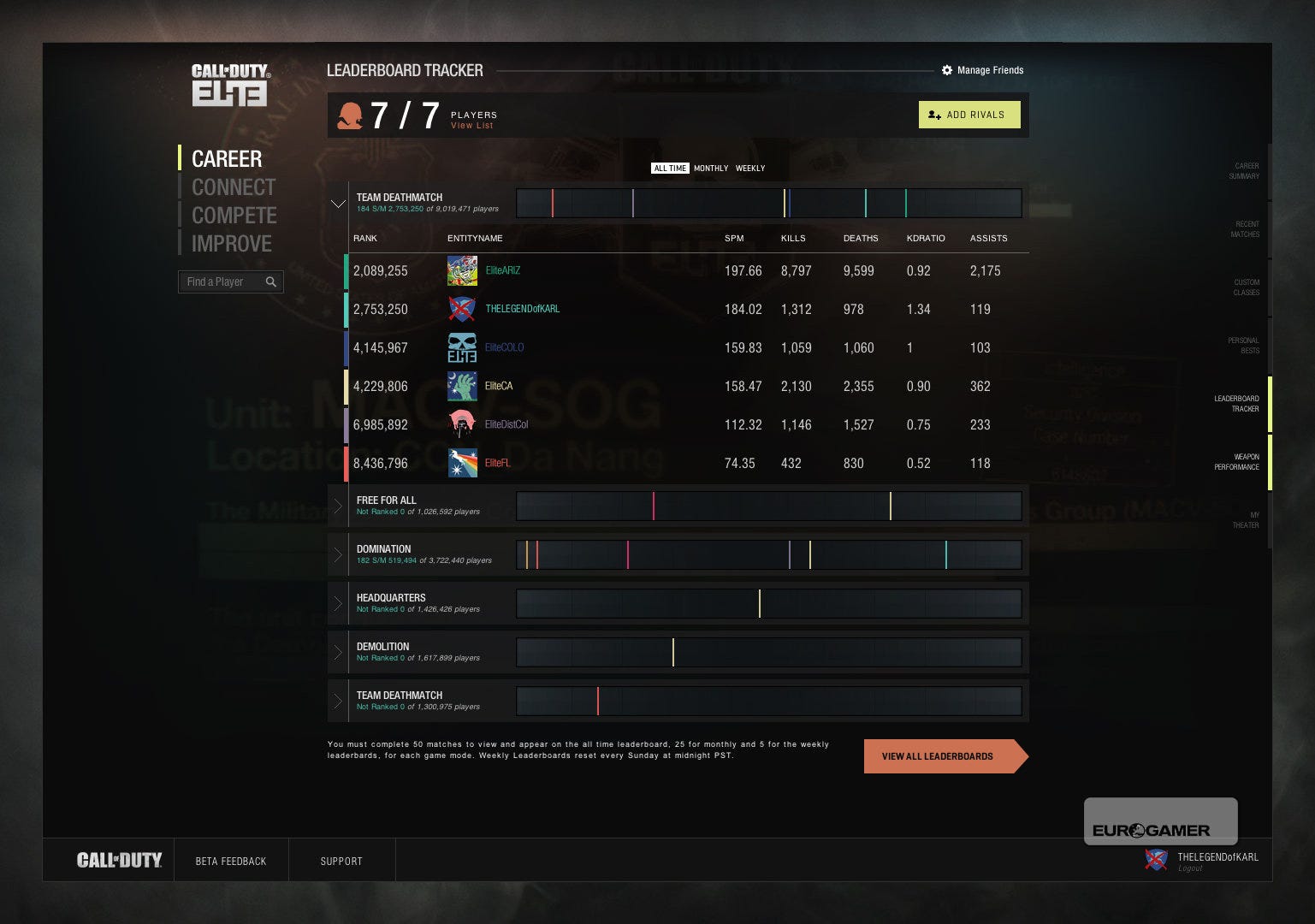
Call of Duty: Elite wasn't a popular notion when it was first announced, but Bowling says it's a great free tool first and foremost.

Eurogamer: Do you ever feel creatively constrained by the game's popularity? Does the broad userbase ever make you second-guess yourselves about the kinds of features you want to include?

Robert Bowling: I wouldn't say we're constrained. It's challenging because you have 30 million people who have a wide spectrum of tastes and definitions of what fun is, and that is the challenge of developing a Call of Duty, and it's a unique challenge and not one a lot of developers have – to have such a wide and varied userbase.

I think that's part of the challenge of taking all that feedback and putting it into the filter of, "OK, where does this person come from? Is he a hardcore competitive player? Is he a casual just-for-fun player? Is he Objective-only? Is he somewhere in-between?" And putting it through that filter then putting it through the filter of your core design philosophy of, "We know the game we want to make. How can we incorporate this feedback to enhance that experience we're looking for?"

It's useful because it allows us to spawn new features, new modes, new goals, that maybe we wouldn't have thought of before. Survival Mode in Spec Ops is a direct result of that.

Eurogamer: You mentioned your design philosophy. How did you set about preserving the core of Modern Warfare given how much upheaval there was in your team last year? Was that even an objective, or were you just happy with the influx of new thinking from studios like Sledgehammer?

Robert Bowling: Well, you know, a lot of our core team remained who have been working on the Modern Warfare franchise since its beginning, but it was also great to have a team like Sledgehammer come in with that fresh set of eyes and mentality and the way they did things, and to bounce off each other.

I think it's been great because it's allowed us to take the core game mechanics that make COD what it is - the smooth, super-fast gunplay and controls and big cinematic moments in the story - and then build up in a new way.

A lot of it was looking back and identifying that core gameplay we wanted to do, and in a lot of ways we've been building up from Call of Duty 4 rather than MW2. We're bringing in the stuff we love from MW2 - the advances in tech, the advances in gameplay - but also focusing much more on that gun-on-gun gameplay from COD4 and then building with the new inspirations from everyone on the team.

Bowling says Sledgehammer's assistance in storytelling has been invaluable.

Eurogamer: What's an example of something the Sledgehammer guys brought to the game? Maybe something that originated entirely with them?

Robert Bowling: I would never say anything ever originates entirely from any one group...

Eurogamer: I guess I mean: how did they freshen your perspective?

Robert Bowling: Yeah - it was great to have them come in simply from a storytelling standpoint, because these guys, their background is they have great storytelling ability, so to have them come in and work with us on the story and crafting it really allowed us and them to work together to deliver on this payoff. Because this is a big moment in terms of the momentum and characters of this conflict that have been built since Call of Duty 4, so that's been extremely great.

Plus, they have individuals on their team who are amazing at every aspect. They have some amazing world builders. You've seen some of their work in some of the demos you've seen today, and working with our guys and our lighters and artists all together on the same levels has been fantastic.

Eurogamer: As a studio you seem quite protective of your message, so how did it feel when the Kotaku story broke a few months ago with all those campaign details?

Robert Bowling: At first it's a little shocking, because you want to know where it's coming from and all that, and is there more to come, but the big thing is we never want the game to be seen out of context.

The reason for that is that user feedback is extremely valuable in the development of our games, so when a user is giving uninformed feedback and they see something out of context or misinformed and then that leads to this conclusion and this conclusion, and then that leads to a question based on this conclusion, then they're giving us feedback and might be asking about something that's not even true, which if we're not realising that could cause us to go in a direction they don't want us to go.

So that's the biggest thing - I want to make sure our fans are informed and know what Modern Warfare is so they can give us informed feedback. So that was the biggest challenge with it - making sure we start the conversation about Modern Warfare 3 so we can have an honest conversation with our fans of what to expect so you can tell us what you want more of.

Eurogamer: On that note, looking back on the Call of Duty: Elite announcement and the confusion around that, what would you have done differently if you could go back and redo it?

Robert Bowling: COD Elite isn't ours, so I wasn't in control of how it rolled out, but I was happy with our response once it rolled out - of being very boots-on-the-ground, answering individual questions, making sure we're clearing up any miscommunication.

To answer your question as a whole, I would have loved for it to be... It's such a vast and detailed service that could very easily be confused, so I wish that from the get-go there could have been more transparency on everything that there was to know, rather than just the high points or just the points that were based around the premium structure, considering that it's a free service first and foremost.

So I would never introduce a free service as a premium service. I would say, "Here's what everyone gets. Completely optional. If you want more, then we'll talk about that later, but most importantly this is what we're adding to the game for everyone."

The E3 demo at Microsoft's conference was set just hours after the end of MW2.

Eurogamer: Does the baiting from Electronic Arts over Battlefield 3 ever get to you or is it just water off a duck's back?

Robert Bowling: Yeah, it doesn't really get to us. I'm very aware that we have two very different audiences and we're delivering two very good and very different experiences, so I think the baiting is built up more of these two really passionate communities - and they should be really passionate about their individual games - getting at each other, and that's been happening forever.

Eurogamer: Does the fact they're coming at you so directly suggest there isn't room for more than one of these games on this scale?

Robert Bowling: I think that would be a misconception. I think there is definitely room. If you are a shooter fan, you should be getting both, because they're both going to be excellent experiences. But more importantly they're going to be very different experiences. The kind of gameplay you get from Call of Duty is very different from what you get anywhere else and I think that's important. I think any shooter fan would be extremely disappointed if you only got one.

4

Take that, ground!

Eurogamer: Are you going to buy Battlefield 3?

Robert Bowling: I am.

Eurogamer: Last question and it's about Black Ops, a game I really liked. You're not talking about multiplayer much today, but I wondered whether innovations like Wager Matches were influencing you at all and how you felt about the game overall?

Robert Bowling: I felt Black Ops was great. What I love about where we are as a franchise right now is that we have teams that are taking their own twist on the franchise each year, and I think that's great because we are clearly going in two different directions and it's not as black and white as good and bad - it's two very distinct flavours of what Call of Duty can be that are both great in their own way.

I really like that because it allows us to stick to our core Modern Warfare philosophies but we can be inspired off each other, so we can look at things that they're doing and features they're doing and think, "How can we put the Modern Warfare twist on what they're doing?" and they can look at us and vice versa.

A clear example of that is how well they do Zombies, and that's something we will never do, but we have our Spec Ops mode that we started in MW2 and we've been building up on that and incorporating little things from their stuff, but then taking it in a whole new direction.

Robert Bowling is creative strategist at Infinity Ward.

Comments (38)

Comments for this article are now closed, but please feel free to continue chatting on the forum!

  • Loading...hold tight!