In the run-up to the release of Splash Damage's team-based shooter Brink, there has been an odd reluctance to state plainly what, at heart, the game is about.
Perhaps it's because Brink's heritage lies in the mod scene, where its fundamental ideas were beaten into shape by amateurs. Or maybe it's because Splash Damage's Enemy Territory: Quake Wars, with which Brink shares its basic approach, sold only modestly. Or has it been fear on the part of publisher Bethesda that the team-based shooter at its core isn't quite enough to raise blockbuster expectations on its own?
Instead, there has been much talk of parkour, with videos of free-running experts launching themselves over virtual crates, in the hope of lending an air of street chic to the hype. There have been tourist guides to the setting: the futuristic floating city The Ark, a final refuge for mankind whose offices and corridors furnish the game's maps.
There's been the focus on the divisive and unique character designs: Gears of War marines redrawn by a 19th-century Punch cartoonist, with an exaggerated gauntness and muscle. Most recently, there have been the in-depth tutorial videos discussing high-level tactics and the intricacies of Brink's strategic game.
But what has somehow been missed in the marketing bluster is that Brink is a game of cops vs. robbers.
Yes, the S.M.A.R.T. system used to move your character through the environment is fluid and fascinating, allowing you to climb up and over obstacles in search of the quickest route to your objective. Yes, the Ark provides some interesting locations. There's no denying that Splash Damage has refined the genre by way of a host of fine-level design details here.
But it's important to be fully aware that Brink is Reds vs. Blues, Cowboys vs. Indians, Resistance vs. Security. There are eight men on each side, whether you're playing online or alone – and it's not quite as complicated as it's been made out to be.

The Ark's factions are little more than jerseys to distinguish one side from the other.
The game does its best to convince you otherwise. Lured by the promise of a bonus 1000 experience points, you start by watching a long, overly technical set of videos which seek to introduce Brink's class system, free-running model and objective-based play.
The developer seems concerned that the learning curve is going to be too steep for most, or that all of its ideas need to be communicated in the first five minutes. But a non-interactive film makes a poor opening, and has the opposite of the intended effect, introducing mild panic and a sense of confusion from the off.
What should have been Brink's inaugural tutorial is tucked away inside the first Challenge Room, a smart, straightforward micro-mission that introduces you to the four character classes, their abilities and the kind of objectives you'll encounter as you try to defeat the opposing team in the 12 missions that comprise the main campaign.
Brink doesn't distinguish between single-player and multiplayer, or co-op and competitive play; it's all part of this campaign. You join seven others (players, bots or a mixture, depending on your preference) working to complete a set of linear objectives (breaching doors, stealing data and escorting valuable cargo) while the opposing team attempts to thwart your plans. You can choose whether your opponents are human or AI, too.
Brink's tutorial-filled first 15 minutes.
The four classes are the Soldier, able to rig explosives to blow up doors; the Engineer, who can deploy turrets, defuse explosives and fix vehicles; the Medic, who can revive fallen team-mates and increase the maximum health of those around him; and the Operative, able to disguise himself as an enemy and hack terminals.
During the course of a mission each class type may be required to complete a primary objective. An effective team will enjoy a balance of classes to benefit from each unit's buffs, but weapon choice and offensive shooting capability is consistent across them all.
It's a smart decision, since it means that you can slip seamlessly between Medic, Solider, Engineer and Operative without any change to your preferred style of gunplay. Command Posts enable you to switch class on the ground, especially useful when playing alongside AI - you'll want to take the primary objectives into your own, more capable hands. The AI's performance is mixed; you won't want to trust it with these, but it does provide decent enough back-up to finish the campaign solely alongside bots if you want to.
It's always clear where your current primary objective is, and you can move through the (primarily indoor) environments either by taking the corridors and staircases or, if you hold down the L-bumper, free-running up columns and hauling yourself onto ledges. Holding up on the d-pad brings up a radial interface listing your current objectives, and you can pick the one you want the chase, your character shouting your intention to team-mates without anyone needing to use the mic.
It is, rather obviously, imperative that you work as a team. In a match between two teams of eight humans, the side that moves as a team rather than a loose collection of individuals will effortlessly overpower its rival.
One core difference to the majority of squad shooters is Brink's RPG character development. Every positive action in the game is rewarded with experience points. On levelling up, you're awarded credits, which can be spent on a variety of performance-enhancing abilities.
The majority of these enhancements are modest or specialised, such as shooting a grenade while it's in the air, or scavenging equipment from downed enemies. Where there's a more serious upgrade, it comes with a counterbalance; learning to fire your secondary weapon while incapacitated reduces the amount of 'downed' health you have, for example. A few abilities, like the Engineer's capacity to erect auto-targeting defence turrets, are critical upgrades that can turn the course of a match. But on the whole, the RPG metagame has been skilfully designed so as not to upset balance.
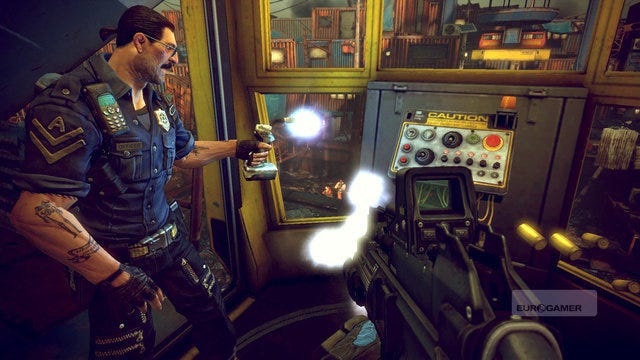
As you complete stages you unlock new guns and attachments, and the customisation options for each rival those seen in Modern Warfare.
The campaign tells two stories: that of the Ark's Security forces trying to bring order to the city and that of the Resistance, a group of disgruntled residents hoping to flee it. There's no room for narrative flourish within the missions themselves, which are so intently focused on game mechanics that cut-scenes would irritate rather than enrich. Instead, the story is told entirely through optional intro scenes and fails to gain much of a foothold in the mind.
The campaign is a slim package, with just six missions assigned to each faction and two bonus 'What If?' missions for each side. In many cases, the missions on each side mirror one another, which can leave you feeling somewhat short-changed when both sets are complete.
You get additional content in the form of four challenge rooms. Each of these introduces a different aspect of the game: one for objectives, one for free-running, one in which you must escort and protect a repair robot, and a tower defence stage in which you play as the engineer laying turrets to fend off waves of attackers. Each challenge has three levels of difficulty. It's a strong area of the game that feels a little under-developed, and a more comprehensive set of challenges would have been welcome.
Likewise, there's some concern that Brink will fail to provide ongoing incentives over the long haul. It's telling that the achievement for developing a character to Rank 5 is titled "Time to start a new character". It won't take too long to max out one character's abilities, leaving you with the sense that you've 'won' everything the game has to offer.
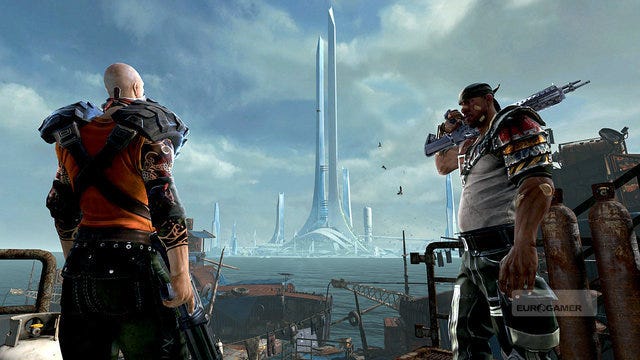
Complete a primary objective as the attacking team and you’ll be shown a mid-level cinematic during which time you can change class.
Of course, the idea is that you continue to play the game competitively online for its own sake as the months roll past. But any title that introduces an XP system as its core economy sets up the expectation that there is an eventual endgame, and Brink's extrinsic rewards dry up too soon.
A free play mode allows you to set up your own bespoke matches across any of the eight maps in the game, playing objective or time-based games with a variety of options to tailor the set-up to your own taste. Online, you can only ever play against players of your own rank or higher, so the focus is always on improving yourself - but it would have been nice to have a little more flexibility with skill-based matchmaking.
Nonetheless, Brink is an exceptional team shooter, smart, supremely well balanced and with a unique, exciting art style. Splash Damage struggles to ease the player into its workings – evidence, perhaps, of the studio's background creating free mods for hardcore Quake players, who never needed much hand-holding.
But the clean menus and HUD have a slickness and simplicity of interaction that elevate the squad-shooter genre to a new level of style and polish. Likewise, in moment-to-moment play, this is often a more engaging, tighter experience than Valve's Team Fortress 2. For those who can leap that first hurdle, Brink should run and run.
8 / 10
