Now, where did we leave things? Last time on Deus Ex Street, poor Adam had been beaten senseless then strapped to an operating table to have most of his internal organs and limbs replaced, nice Dr Megan had gone missing and those naughty geezers from the other side of town had been causing all kinds of problems for friendly neighbourhood science genius David Sarif.
Six months later. Jensen's back on his feet (though they're probably not his original feet) and so, apparently, is Sarif Industries. Conspicuously absent, however, is Jensen's erstwhile love Dr Megan Reed. She was killed during the attack, we're told. We didn't see it happen, which at least to me raises a conspiracy flag, but Jensen, Sarif et al seem pretty sure she's corked it. Also missing is the air of well-natured optimism that our first experience of this new age of humanity had offered.
Surliness and paranoia are the orders of the day, with the freshly-augmented Jensen greeted by a mixture of awe and horror by his colleagues. Awe, because they'd heard the rumours of what he'd been through, the sheer extent of his injuries and mechanical alternations, and the miracle that he stands glowering before them today. Horror, because, well, the same reasons.
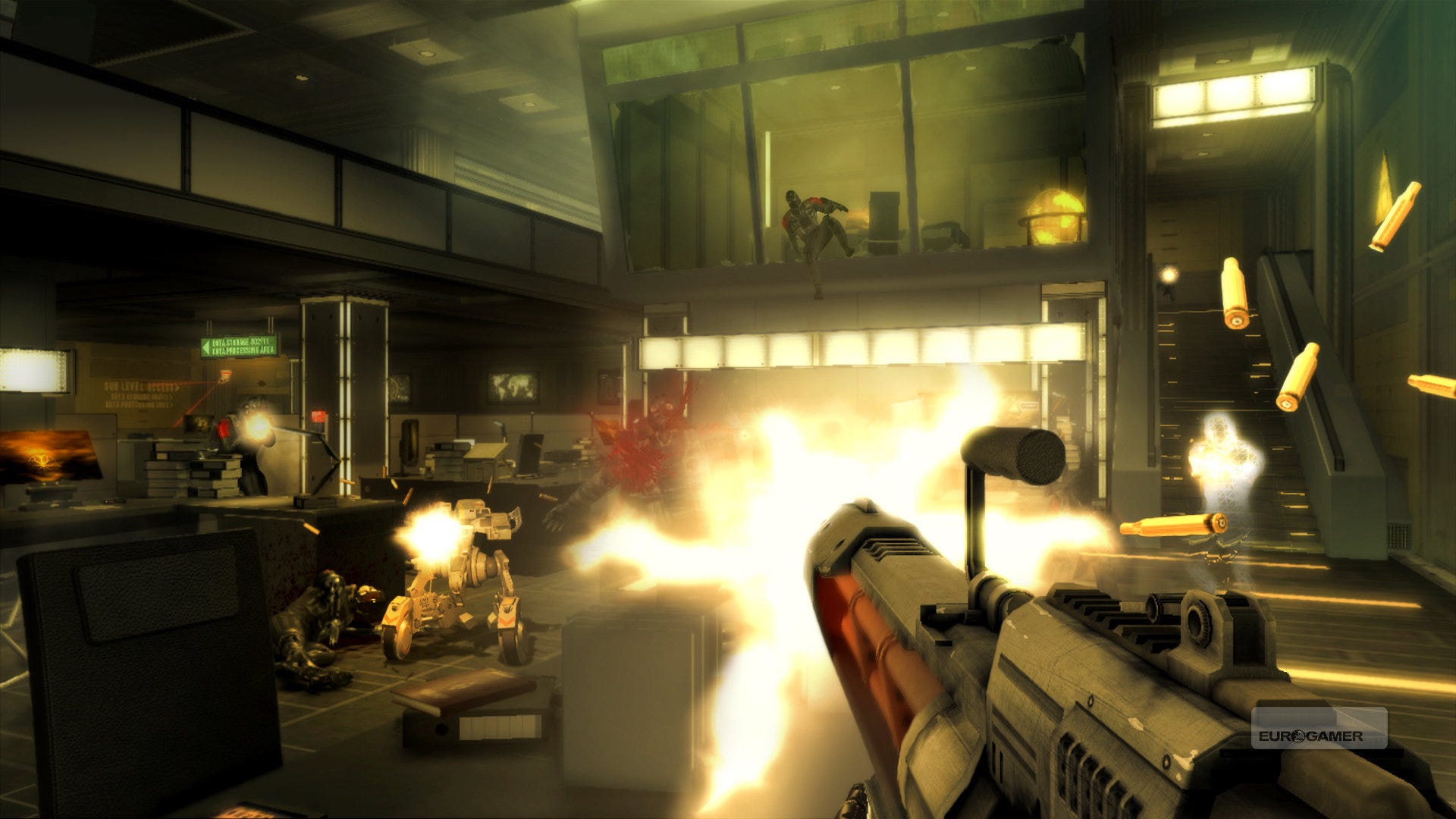
Complete your mission via stealth or hi-action. Hint: this is not stealth.
This is, it seems, a key element of this new Deus Ex. Augmented humans are not enviable superhumans: they're mechanical Frankensteins who raise frightening questions about what 'human' means. Jensen is, in a lot of eyes, a monster.
But what a monster. A first peek at the abilities his augs offer suggests a far more elaborate skill tree than either of the prior DXes. His skills are divided roughly by body part - cranium, torso, arms, legs and skin. Within each of these categories are a clutch of sub-powers, which essentially allow you to build Jensen into the action hero you want him to be. An invisible, silent spy? A juggernaut able to move and kill at incredible speeds, even able to fire explosives from his chest? A hacker, a sniper, an athlete, an explorer, a double-hard bastard with radars for eyes? It's gratifyingly elaborate, a grand hit of the tactical thinking that lies ahead.
Nu-Jensen's first mission is to tackle a group of Pro-Human Purists, who've broken into another of Sarif's factories. Sarif is simultaneously Christ and Satan in this universe - the bright hope of curing disease and fixing any injury, and the terrible mutilation of replacing limbs, organs, even brains with machinery. That his business is a target for fanatics is scarcely any surprise. That he sends his own personal Terminator to go fix the problem is no less of one.
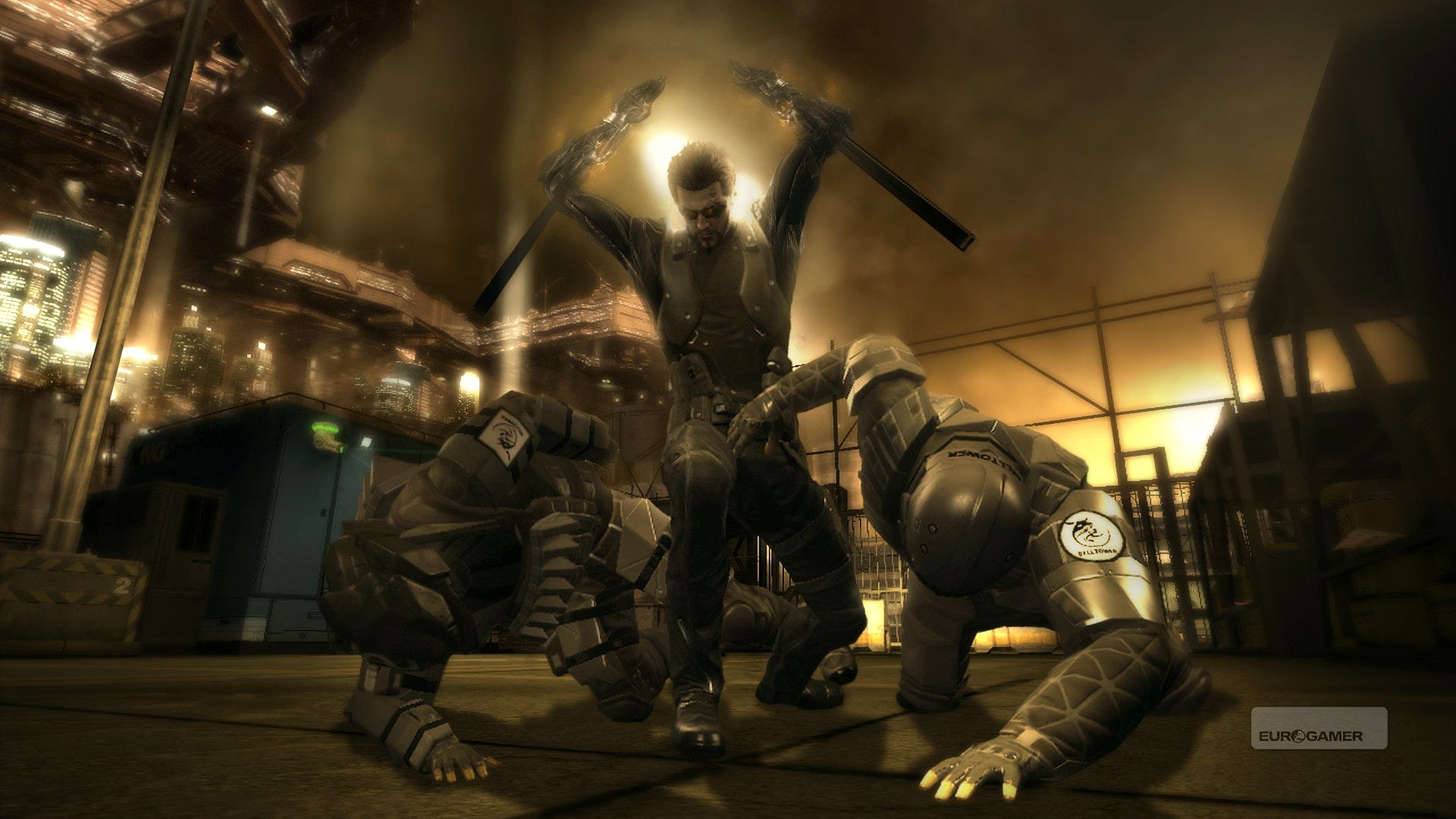
Deus Ex: Morris Dancing Revolution.
That said, in a direct nod to the original Deus Ex's first mission, Jensen is given a raft of choices as to just how much of a Terminator he wants to be. Lethal or non-lethal takedowns, ranged or close combat? I go non-lethal, and for the stun gun rather than the long-range tranquilliser rifle. I want to be in the middle of things, but I don't want blood on my hands. No-one appears to judge me for my choices at this stage, but the levelling and achievement notifications reveal I'm racking up rewards for maintaining certain approaches. This, in turn, grants me more aug upgrades. For now, my choices are limited - I pick a raft of stealth powers, primarily temporary invisibility and dampening movement noise.
I can't yet speak for how well it works as a straight-up shooter, had I chosen the more bloodthirsty options, but as a stealth game it seems to be shaping up phenomenally. While there's a cover system, which involves a fan-outraging but genuinely non-disruptive switch to a third-person perspective in order to get a better sense of what's around Jensen, where the stealth really shines is when it's simply about not being seen. Run, duck, hide - breathlessly behave as would were you trying to avoid detection. It's about gut instinct and observation, and even the stealth-orientated augs don't replace that.
What they do do is - hey! - augment it. The base-level Cloak, a sub-dermal enhancement that permits invisibility, lasts just a couple of seconds before draining Jensen's battery. This doesn't render it useless - instead, it ensures it's a genuinely tactical tool rather than a superpowered cheat. I found myself gauging guarded gaps between crates and pillars, trying to do the maths on whether I could make it from cover to cover before my Cloak flickered away and left me in plain sight of three angry fanatics. Deep breath, activate, leg it! When it worked, it felt fantastic: the heart-pounding tension of knowing that the difference between life and death was a matter of milliseconds. When it didn't work... well, Jensen sure doesn't last long if you've not riddled his tortured frame with armour and health augs.
Tackling this mission, this factory full of heavily-armed mercenaries and elaborate security systems, was beautifully organic. While there was a point A and a point B to be traversed/blundered between, the actual route is relatively open. I made it through a frankly cack-handed hodge-podge of running, tasering, hacking, panicked EMP-grenade lobbing and, mostly, hiding. I made a terrible mess of things, ultimately - a bunch of hostages were murdered, I got spotted about six times a minute and the so-called terrorists' leader escaped, killing another hostage en route.
More, much more than that, I did it my way. I made those choices, I made those blunders and - happily - I didn't kill a single soul myself. Sure, I hadn't exactly been subtle: the maze-like factory/office/lab building was littered with slumbering Pro-Human nutters and deactivated robo-turrets, but no blood was spilt. Not by me, at least. I could clearly see how I could have been far more discreet - telltale ventilation hatches here and there, security terminals I hadn't found the password for or was too busy being chased to hack, and a warren of ignored staircases, doors and gangways.
Still under wraps: what Augmentations are activated by Jensen's pointy goatee.
While the details of Deus Ex may be different, the fundamentals are not. The scope of Human Revolution's moral dilemmas and tangled conspiracies remains to be seen, but in terms of being a free-form action game it's very much in the spirit of the original - not neutered and 'streamlined' for a perceived more impatient audience. The systems are modernised, made to look and feel slicker, and the result is a game that evokes Deus Ex as you remember it, rather than Deus Ex as the remarkably progressive but now somewhat lumbering game it is by today's standards. I'm a little wary about growly, guarded Jensen himself, who I haven't found a sure reason to like as yet, but then there might be a good reason for his relative lack of personality - and one that's the single most astonishing thing I've seen in the game so far.
This first major mission ends, in grand old gaming tradition, with a boss fight. No daft glowing weakspots or feckless quicktime events here, however - instead Jensen's climactic conflict with the one-eyed leader of these Pro-Human purists is purely a mental one. Zeke Sanders, a man so outraged by augmentation that he's ripped out his own ones (including that telltale missing eye), knows that the gig is up. His men are dead or sleeping, and he's faced with his own living nightmare - someone who completely blurs the line between human and machine. That's why he's taken a terrified hostage, to whose head he holds a gun. The spit'n'polished Tomb Raider engine behind Human Revolution flexes its best muscles here, with Sanders convincingly betraying his desperation via body language and facial expressions. He's a man on the edge. Watchoo gonna do, Jensen?
What should we call a game that's both a prequel and a sequel, anyway? Sprequel. Yes, that's elegant.
The challenge at hand is reading and predicting Sanders' reactions and mental state, whether it's to talk him down from killing the hostage or to get him off guard enough that you can take him out. There is, I'm told by a nearby dev, no one fixed path, a golden route of conversation options that leaves everything sweet as peaches. I need to listen to what Sanders says and watch his body language. If he's getting hysterical, perhaps I should appeal to his reason. If he's puffed up with pride, the smartest thing to do might be to humble him, make him realise he's not top dog here. If he's visibly afraid and torn, perhaps I should emphasise with him.
Apparently, his initial reactions are randomly chosen from a small pool; it's my job to keep up with them, get him closer and closer to calming down and doing the right thing or leaving himself open to a takedown. I almost get there, but stick too doggedly to rationality, which eventually headbutts against his rage and passion for his cause. He makes off with the hostage, whose corpse I find in the next room when I try to follow him. Sigh. Blown it.
He's gone, and I've made a right pig's ear of my mission, but maybe I got through to Sanders a bit. I showed that Jensen was no cyborg killing machine, and I made the pro-human zealot aware that he was being used by someone else - that his invasion of Sarif's lab had been used to mask a hacking attempt by an augmented man. A remote-controlled augmented man in fact, made to take his own life by forces unknown when I discovered him. There's a much bigger picture here than the debate between natural and man-made humans: someone, somewhere, is trying to control the destiny of both. Ah, the sweet, sweet smell of conspiracy. The game's afoot. The Deus Ex game's afoot.
