DC Universe Online Review

Clicky boom boom down.

Version tested: PC

As the first MMO to attempt to bridge the gap between console and PC since Final Fantasy XI in 2002 – and the first to ever do so simultaneously at launch – DC Universe Online raises a lot of questions. Will the PC game be limited by the necessity of designing around a controller? Are PS3 owners willing to embrace a subscription model?

We'll come to these and other questions later, but let's put them aside for a moment and consider the game at face value.

Your arrival in the DC Comics universe, home of Superman and Batman, marks a call for a new breed of superhero to rise against the forces of Brainiac, who's intent on taking control of Earth. This starts, of course, with the creation of your force for good or evil, depending on whether you choose to play as a Hero or a Villain.

You can either create a purely custom class or take inspiration from a selection of DC characters such as Wonder Woman, The Flash and The Joker. There's a reasonably generous selection of combat styles and roles on offer, whether your heroic dreams involve controlling the will of others or more dramatic sorcery. You'll also choose your mode of travel here, with options to fly, sprint or grapple your way around the world.

Though the cosmetic customisation is a shadow of DCUO's contemporaries, there are just about enough options to leave you feeling unique. With enough imagination, you're unlikely to run into carbon copies of your super-self once you complete the tutorial section, escape from Brainiac's ship and enter the world proper.

And it's a breathtaking world. The sensation of darting deftly around the neon-streaked city of Gotham beneath a brooding sky is a triumph in art direction. Combined with the brighter, sun-kissed avenues of Metropolis, the world is by turns rich in colour and grimly intimidating. The sight of Batman's signal imprinted on the sky will elicit a sigh from even the most casual DC fan, and the atmosphere that permeates the game's visuals is truly magical.
1

Exploration is the best thing about the game.

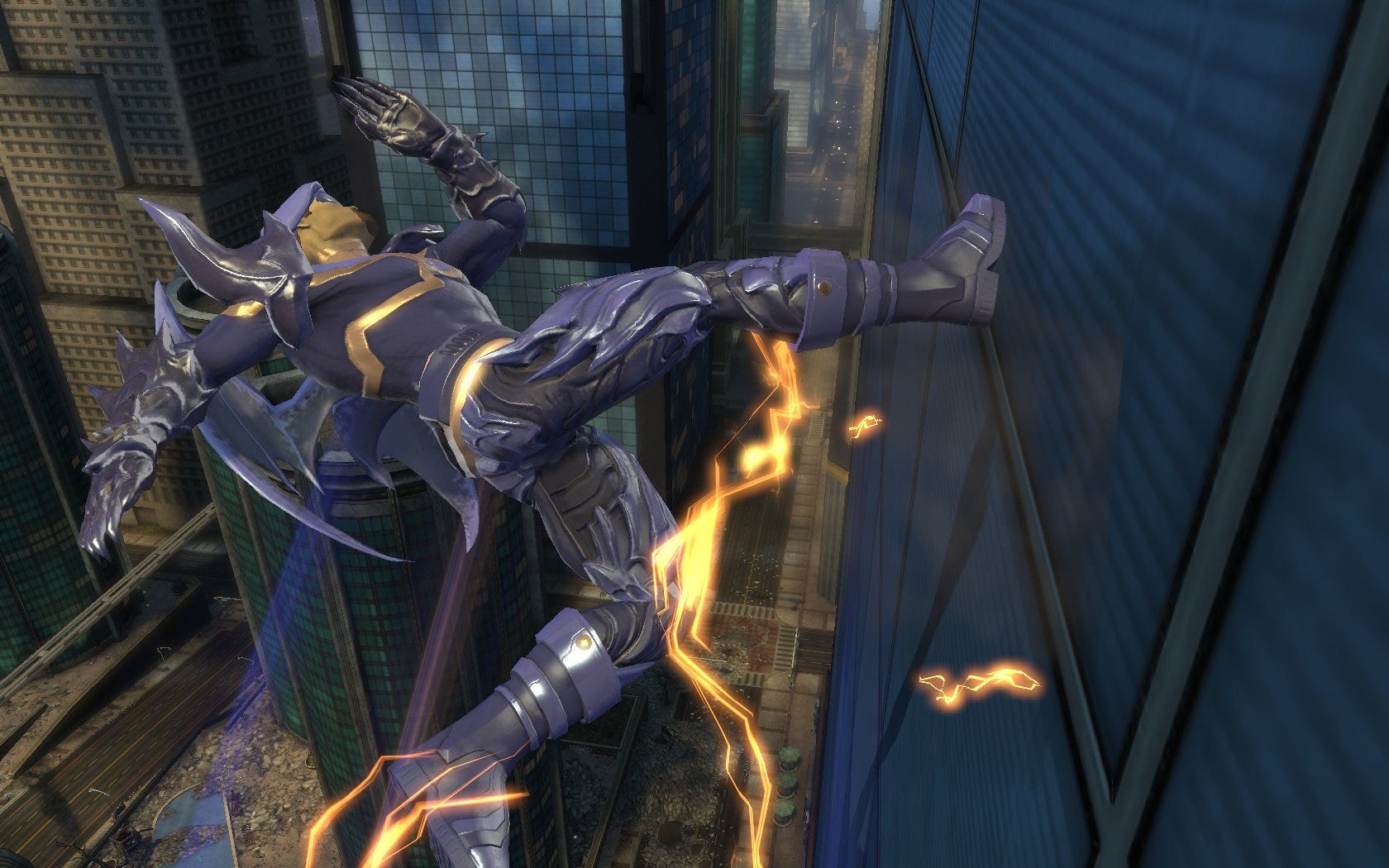
Whether you choose to soar like a bird, race through the streets with an electrifying glow or spring from building to building, the freedom of exploration offered by DCUO is a true breath of fresh air among the traditionally flatter planes of MMO worlds. For the most part, the world is also pleasantly open and seamless, save for significant character fights, which are instanced.

But the beauty and freedom of the world have come at a cost. A sense of emptiness abounds, save for traffic on the horizon and crudely animated characters in the distance. Population is limited to specific quest locations and the streets are deserted, more often than not. As you look around at the magnificent buildings, it's hard to imagine that there's a world of wants, hopes and dreams worth saving behind these windows.

Much has been made of the game being without grind, and there's a refreshingly brief road to be travelled to the game's current level cap of 30. Alt-aholics will no doubt rejoice in this, as they have the freedom to experiment in different roles and see a new side of the game without having to climb a mountain to reach the view.

Less welcome in this context, though, is that the quests themselves are so deeply rooted in the grind mentality of yesteryear, discouraging extra play-throughs. You'll kill 15 henchmen in order to obtain 10 devices, only to find yourself returning to do it all again. The locations, art and names change, but the mechanics remain the same and there's little in the way of variety.

While this process is broken up with some wonderful set-pieces featuring a diverse array of characters from the DC universe, it's all too soon before you're back on the treadmill, waiting for the next thrill. Around halfway through the levelling there comes a point where you begin to feel less like a harbinger of justice and more like an errand-boy for Superman, whom you imagine to be enjoying a cup of tea in the Watchtower with his feet up, taking all the glory while you undertake the less glamorous work.

Even though the Alert system, which allows you to participate in instanced events with a group of heroes, adds a little more bite to the proceedings, the challenging boss-fight pay-off comes only after you've fulfilled a series of similarly generic objectives – kill ten of these, gather and return six of something else. Now have some fun.

Beyond the mission design, the most divisive issue – for PC players, anyway – will be the combat itself. Sony Online Entertainment promised an exhilarating action game set within a fully-fledged MMO, and it has certainly delivered a meaty, tactile experience that delights. Building combos of basic attacks interspersed with superpowers is tremendously satisfying and that all-important sense of connection is there.

But though the fast-paced battle system works tremendously well on the PS3 gamepad, all the coaxing and fiddling in the world wouldn't bring DCUO to recognise my 360 controller when playing the PC version; forum discussions suggest I'm far from alone. Certain controllers which allow turbo modes or macro-ing are also sat firmly on the naughty step, and you'd be wise to check your brand of controller before buying. Mouse control, meanwhile, fast becomes a painful experience.

2

Gotham has a striking atmosphere.

Wonderfully frantic and visceral though the combat is, the target-lock system has a tendency to pick the one enemy you wouldn't want to engage. It sends you lunging not towards the remaining mob in your pack, but whizzing and slicing into one fresh group after another. More often than not you feel cheated into death. For a frantic action-MMO that rewards nimble fingers and combo work, it's a system that either works flawlessly, or not at all.

Levelling sees you accumulate skill points to invest in improvements to your travel, alternative weapons or your superpowers. Up to six of these can be made available on your action bar at any one time. Far from dumbing down the game accommodate the limitations of the PS3 controller, this actually adds a more strategic depth to combat, forcing you to select the skills you need for the job at hand. This variation helps prevent DCUO from stagnating into button-mashing.

This freedom to experiment doesn't quite extend into the player-versus-player areas, where knockbacks, stuns and crowd-control currently dominate. For the most part, your objective is to enable and hold onto resources as team points count down to zero. Tactically, it's often more sensible to stand your ground and hope that your enemies repeatedly rush lemming-like into your knockbacks. More often than not, they do; either the players in general will need to up their game or some revisions will need to be made to this system.

3

One toon and his moon.

In the absence of any crafting professions, gear beyond quest rewards is either bought from vendors or earned as renown rewards. Choosing stats is often a case of trade-offs: it certainly serves to put more meat on the bones of a comparatively simple character development process.

Camaraderie and social interaction are the glue that binds a player to an MMO, and the most basic tool for this is the chat system. Unfortunately, in DCUO, it's a cumbersome affair that discourages use, adding further to the feeling of emptiness and isolation. Combined with an interface which – most noticeably on the PS3 – lurches between screens, your engagement with the game and other players feels broken.

The chat also suffers from what is politely known as the Scunthorpe problem. With no option to disable the filter, anyone wishing to discuss topics such as 'analog controls', errant 'assumptions' or extol their 'amusement' with the game will find their chat rendered as asterisked nonsense.

A word of warning, too, on your microphone: you would be wise to know in advance that push-to-talk is not enabled by default. Change your settings, unless you want your domestic life to be broadcast to your new friends. A Saturday spent in the company of someone else's screaming baby led me to disable voice-chat altogether.

As for the voice acting, performances range from the extraordinary to the abysmal. Mark Hammill's reprisal of his role as The Joker is superb, although it's disappointing that your first encounter with him as a Hero takes place in The Vault, a shallow event that sees you invited to his madhouse in order to rush around, smash presents for rewards and then walk out when you tire of it. It feels needlessly shoe-horned into the game to maximise exposure to his involvement.

But even allowing for the more pantomime theatrics of the comic-book narrative, something has gone terribly awry in audio production. During the beta, certain NPCs carried developer-read placeholder dialogue. While it's impossible to verify now, so awkwardly flat is some of the delivery that I suspect some of these lines have persisted into the final release. Furthermore, switching your mission mid-narrative or accepting a new mission immediately after handing one in often leads to a muddling, schizophrenic rambling of voices talking over each other.

4

There's something off about Legend PVP.

There are certainly great achievements in DC Universe Online that raise it above the median: the gloriously rendered cities, the freedom of movement and exploration – not to mention a refreshing approach to combat in a genre dominated by spell-casting and global cooldowns. Despite the significant kinks that need to be ironed out, these are all welcome additions, and server-wise it's been a remarkably stable affair – no mean feat at launch.

While there's likely more long-term appeal here for devoted fans of DC, let's also be clear in saying that 'niche' is not a dirty word. It may be that, in the passage of time, DCUO becomes to its fans what EVE Online is to System Architects: a little slice of heaven, and profitable for the publisher to boot.

But the game currently suffers from a fundamental crisis of identity. Interface issues notwithstanding, is it deep enough to provide a satisfying experience for the PC audience, should console owners find themselves turned off by a subscription of £9.99 (€12.00) per month? Equally, is it accessible enough to a player community less familiar with the subtle allures of the MMO?

5

Where the streets have no... people.

If it's a casual experience designed to be enjoyed in short, thrilling bursts, then the pricing structure is misguided. In trying to be all things to all people, while at the same time attempting to bridge the gulf created by the subscription model, this hedging of bets may be the game's undoing. Only time – and the promised monthly content updates – will tell.

As a standalone online action game – albeit one with improved missions and realistic content pricing – DCUO would almost certainly fare better in the final analysis. But this is a subscription MMO. As such, it needs to be compelling enough to draw you into the world for months – if not years – to come, and reward the significant investment of your time and money. Without changes to some fundamental aspects of the game, it's hard to imagine that the potential for that longevity exists.

PC gamers accustomed to feasts of content and polish will likely feel short-changed from their subscription fee once the initial 30 day rush is over. And while it may be the best implementation of a console MMO to date, PS3 owners should still ask for more.

6 / 10

Read the Eurogamer.net scoring policy

Comments (119)

Comments for this article are now closed, but please feel free to continue chatting on the forum!

  • Loading...hold tight!