The Fall of Realtime Worlds
An insider speaks out.
"APB has been a fantastic journey, but unfortunately that journey has come to a premature end. Today we are sad to announce that despite everyone's best efforts to keep the service running, APB is coming to a close."
With those words, community officer Ben Bateman announced the death of the massively multiplayer shooter APB and the studio that created it, Realtime Worlds. The revelation, which came via the game's official website, marked the climax of one of the industry's most spectacular failures. Despite a team of hundreds, a development period of five years and tens of millions of investment dollars, APB stayed online for just 86 days.
Prior to release, all the indications were that APB would be a success. The Dundee-based studio behind it was headed up by Dave Jones, the creative force behind Lemmings and the Grand Theft Auto series. The core of the same development team had been responsible for the success of Crackdown.
In short, APB had a fantastic pedigree. And a self-published, independent MMO shooter offering unprecedented customisation options, capable of handling up to 10,000 concurrent players per city, had huge potential. So why, on 23rd September 2010, were the plugs pulled on APB? What was it that forced Realtime Worlds to close its doors for the last time?
In the weeks and months that followed, much rumour and anger seeped out from former employees and sources close to the studio. Tales of excess and arrogance, mistreatment and mismanagement abounded. But Ben Bateman tells a different story. The 26 year-old, who hails from Norfolk, paints a picture of an idyllic working environment.
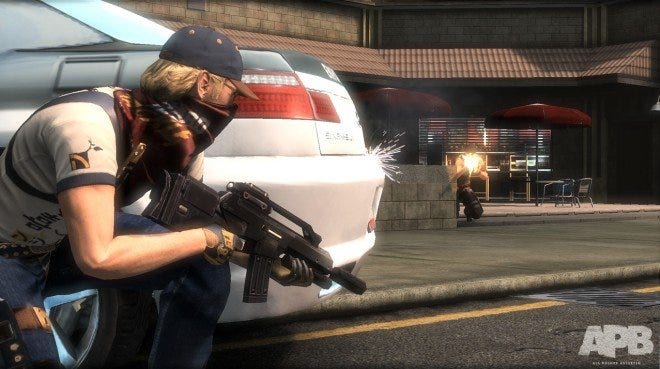
Despite some impressive underpinning tech, APB's shooting and driving was heavily criticised.
On joining Realtime Worlds from SEGA in January 2009, Bateman took up the role of QA tester. It's an entry level job requiring the endless identification of development bugs. QA jobs are seen as a foot in the door for those eager to make a career for themselves in the games industry.
They're also known to be poorly paid. Testers are often badly treated, regularly employed on "zero hour" contracts that could mean unemployment at a moment's notice. Not so at RTW, according to Bateman.
"One of the brilliant things about working at Realtime Worlds was getting the opportunity to see how radically different everything was," he says. "I was at SEGA before and, this sounds stupid, but they locked up the fruit. It was that kind of environment, where it was like, 'Oh, it's the QA - only one piece of fruit a day!'
"But at Realtime it was like, 'Wow, they've got a pool table!' And the building itself was impressive. And they were really good to us. Even the QA positions were six month contracts. I was talking to family who warned me that it was still a little bit unstable, but it beat the zero hour contracts by a mile."
The studio's treatment of its staff also extended to generous relocation packages for those employees making the journey up to Scotland. They could either take a lump cash sum or accept temporary housing in one the studio's company flats. In addition, RTW offered overtime across the board - unremarkable elsewhere but a rare luxury in the world of videogame development.

The Realtime Worlds dream, say insiders, slowly turned into a nightmare.
Realtime Worlds' working conditions are a reflection of the once buoyant financial state of the company. The studio was a massively attractive prospect to investors. Indeed, Companies House records reveal that by May 2010, RTW had secured a huge $101 million in venture capital.
Though such financial matters were rarely discussed with the lower echelons of the development team, Bateman insists there was "a degree of openness" from the management. He says that from top to bottom, the culture was one of inclusion.
Every Friday the entire staff, including Dave Jones and executive producer Joshua Howard, would gather in the cafeteria for a company-wide meeting. The word cafeteria may suggest an austere room with plastic chairs lined up against fold-up Formica tables, but that wasn't Realtime Worlds style. Their cafeteria was resplendent with concept art-festooned banners, comfy sofas, plasma screens, consoles and a full Beatles Rock Band set-up.
In those weekly meetings, everybody was encouraged to speak up and air their concerns or thoughts. Bateman makes constant references to the company "family," a close-knit group of people with a real love of both the game and the studio. The sense was that everyone was in it together.
Bateman flourished in this environment. Just four months into his contract he was promoted to the role of community officer and tasked with engaging APB's burgeoning fanbase, beginning with the participants of the game's first closed beta.
It was at this stage the first rumblings of discontent began. The beta testers pointed to a number of issues. Poor car handling, unresponsive weapons, a lack of headshots - all were identified and lamented alongside persistent lag. But the mood at Realtime Worlds remained optimistic and Bateman assured the community that the problems would be addressed. It was a beta, after all; there was time to iterate and improve.
However many of the problems identified in the early betas survived until APB's eventual release, and despite the continual release of patches. As a QA tester Bateman had brought the issues to the attention of his superiors. As community officer he had relayed them directly from the beta testers. So wasn't he frustrated at being ignored?
"Not at all. At the end of the day, the feedback was there, it was recognised," says Bateman. "But whether it was due to management, time, money, whatever it was, they just didn't get implemented.
"People forget how ambitious and difficult an MMO is. You have to remember that Realtime Worlds went from being a medium-sized company that made Crackdown to trying to make an MMO, which entails becoming an online publisher, having customer support, supporting several different languages - people forget the scale of it.
"So where people have said we should have been fixing this problem about the game, maybe there was more time being spent on things like the online shop, or improving our customer support. There's so much involved."
At its peak, RTW employed around 350 people.
Neglecting some of the game's core problems resulted in a mauling at the hands of reviewers. While the technology behind the game was roundly praised, the gameplay itself fell flat. Eurogamer's review identified APB as "a game about shooting and driving" in which the shooting was "weak" and the driving "a reasonable facsimile of attempting to sail a bathtub down a canal". It scored 6 out of 10.
The review was representative of the general consensus. APB received a Metacritic rating of 58 - damaging for a modest console title, but deadly for an online game in need of constant, costly support. Critically, APB was a flop.
At the company-wide meeting the following Friday, Realtime Worlds' management did their best to remain upbeat. "I don't want to say they spun it but... Obviously it's about keeping your team enthusiastic and focusing on the future," says Bateman.
"We had hit a major hurdle. We'd launched a title, an MMO, that was a big deal. It wasn't easy. So we concentrated on the positives."
But the writing was on the wall. Each of RTW's many offices boasted monitors streaming live player figures direct from the servers. At any time, the company's employees could glance up and see APB's failure written in cold, dispassionate numbers on a graph. It was a constant reminder that simply not enough people were buying and playing the game.
Still, within the bubble of Realtime Worlds, there was a belief that the studio could update and patch its way out of the problem. Life would go on.
But RTW was in trouble. The investment cash had gone and the company had begun running up debts.
The first public indication of this came when the company announced it would be laying off staff. The revelation was covered up by assertions that redundancies were inevitable as the game had launched and some staff were no longer needed. But the truth is that the lay-offs were far more widespread than expected.
Project MyWorld, Realtime World's innovative social media game, took the brunt of it. Announced early in a bid to pull in some much needed cash, the title failed to find a publisher. As a result the team's 60-strong staff were let go. Bateman says they never saw it coming; the studio was in shock.
It was the beginning of the end. Just days later, Realtime Worlds went into administration.
As they had been so many times before, the remaining staff were asked to gather in the plush cafeteria. But this time the meeting would be chaired by the administrators, Begbies Traynor. Though reports emerged at the time that "the staff were sacked over the PA system" the truth is a little more prosaic. A microphone was used simply so those at the back of the packed room could hear.
In total, 157 staff were to be made redundant. "They essentially said, 'Here are the 50 people that we want to keep on. Please go to room X,'" recalls Bateman. "It was tough."
One by one the names of the survivors were announced. Those that didn't make the cut were to leave. This would be their last day. But despite the horrific nature of what was unfolding, there was still good will.
"Like I said, because there was such a sense of friends and family within Realtime Worlds, there were a few people that you knew should stay on because they were excellent at their job. When their name was read out they got claps and whoops, people were congratulating them, there were cheers.
"There were moments of silence, of course, where everybody was just looking at the floor. It wasn't all nice obviously. But yeah, that sense of family survived."
It wasn't nice at all. The layoffs ripped a hole in both the town of Dundee and the lives of those affected. Over 60 per cent of RTW staff had relocated to Scotland. Suddenly cut adrift, families and individuals were left without work and had little hope of receiving either wages or redundancy pay. For them, it was catastrophic.
For Bateman and his friends the only answer was to drink. A lot. So that's exactly what they did, drowning their sorrows until the early hours. "It's what we all needed to do, to consolidate, recover. We got absolutely twatted."
The next week, as many of Bateman's friends and colleagues signed on or tried to find their way back home, the reality of life under the administrators revealed itself. According to the terms of the deal, RTW had just six weeks to find a buyer for APB. Failure to do so would spell the definitive end of both the studio and the game.
In the meantime, all the company's assets were to be painstakingly raked through in order to calculate their material worth. As Bateman and the rest of the 50 survivors ploughed on, the administrators counted fire extinguishers.
The next six weeks slipped by as a procession of publishers, businessmen and potential buyers padded through the RTW offices. Rumours circulated in the press. Epic Games was linked with a buyout, among others. But no buyer came forward. The six week stay of execution was up.
Dave Jones, the man that had created the studio in 2002, made his way around the building to deliver the bad news. Bateman recalls, "Dave came around and apologised to everybody individually, informing us that APB didn't have a buyer. He laid down the simple facts that he could, saying, 'At some point today, the servers will be shut down.' He was so emotionally invested, you could see that it hurt to say it. He was gutted.
"So I went and made a cup of tea and thought, 'F*** me, this is a bad day.'"
Some reacted badly, pointing the finger at Jones as the culprit. Emotions ran high as people looked for someone to blame. But it was wasted energy. Bateman drafted one final post for the website: "APB is coming to a close." It was over.
More on APB
-
Interview: Defending APB
Realtime Worlds' Dave Jones hits back.
Review: APB
Any cop?
Hands On: APB
Bulletin points.
-
Screenshots: APB
After receiving the news, most of the former employees left for the pub straight away. But a core of the now jobless staff remained at the studio well into the night. Though the studio was finished and APB was effectively dead they didn't want to say goodbye, to each other or the game.
"We stayed on, even though we knew we were fired," say Bateman. "We were running the servers, trying to get contingency plans in place, so we could try to do stuff from home. It was like the Titanic was sinking but people were trying to patch it up just in case.
"Let's say if the login server went down, nobody would be able to login. So if we could secure and support just one login server, then as long as the districts were on another server then everything would be fine. We were trying to support the service, but no-one really had the resources."
In the space of 86 days APB had launched, almost immediately gone onto life support, then passed away quietly - taking an award-studded, multi-million dollar studio and hundreds of jobs with it. The scale and speed of the APB's failure is unparalleled in the history of the industry.
"I was a youngster at the company," says Bateman. "I was only there for 12 months, some people were there for five, six years. It was our heart and soul. In the year I was there I ran a closed beta, an open beta, launched an MMO and closed it. I experienced everything there was to experience, good and bad."
Rather than any resentment or anger towards the fate of the game and his employers, Bateman is filled only with regret. "There's no need for finger-pointing," he says. "It was a multitude of things that contributed to Realtime Worlds failing and APB failing.
"But we made such massive progress in that last year. If we had that kind of drive for maybe two years, then we would have had the most phenomenal game. We could of made the game that everybody wanted.
"Regardless of everything that happened, I still maintain that I had the best job in the world. I loved APB. Still do. I just wish that it could have gone on a little longer."
You may also like...
-
Ghost Recon: Future Soldier Review 80
-
Face-Off: Max Payne 3 114
-
Diablo 3 Review 235
-
Diablo 3 accounts hacked, gold and items stolen 121
-
Dragon's Dogma Review 121
-
Blizzard addresses Diablo 3 account hacks, outlines security measures 101
-
Company of Heroes 2 Preview: Russian Attack 14
-
Bungie's MMO style sci-fi FPS Destiny out 2013 as an Xbox 360, next Xbox timed exclusive 88
-
App of the Day: The Sandbox 7
-
Uncharted 2 DLC free from today for everybody 21
-
Silicon Knights vs Epic lawsuit only worth $1 26
-
Castlevania: Lords of Shadow 2 to launch on Wii U, PS3, Vita and Xbox 360 48
-
Sony announces F2P shooter Bullet Run 13
-
PlayStation All-Stars Battle Royale confirmed for Vita 27
-
XCOM: Enemy Unknown release date 26


Comments (80) Latest comment 2 years ago
Comments for this article are now closed, but please feel free to continue chatting on the forum!
Comment below viewing threshold Show
Love that at the end.
Comment below viewing threshold Show
I can understand why the felt they had to launch the game when they did but what I can't understand is how they managed to make such a fundamentally broken game when they had such a big budget to make it.
Comment below viewing threshold Show
Shame it was about a companies demise. Hope they all find decent jobs for the future.
Comment below viewing threshold Show
The truth is they made a terrible game based on a terrible business model and the greed of the upper management had them batting way above their average. They tried to be one of the big boys when they were nowhere near ready for it. It might sound harsh but these things only happen to companies that absolutely deserve it.
That isn't to say that Johnny B. Goode working on the Physics engine deserved to lose his job, but it is a cold fact of life unfortunately.
Next week on the BBC: A Caretaker at Enron says it wasn't all bad!
Comment below viewing threshold Show
Mind you, they didn't have paid overtime when I was there either, so perhaps I'm not best placed to say.
An unusual article, not what I was expecting. Nothing to do with what went wrong, just what happened when it went wrong. For the former, Luke Halliwell's opinion is probably as good as you'd get (although I'd dispute his views on the development progress of Crackdown).
Comment below viewing threshold Show
Would have been improved by more critical commentary, maybe? Comparing what was said by the source, to the testimony of other sources that had since broke silence, but there was none of that.
Comment below viewing threshold Show
I think some people are too eager for articles about "what went wrong and why", but as Mentalist(air), this was an interview about what happened when it went wrong. If that isn't what you are looking for then faor enough, but its hardly the fault of the interview.
People also seem to want to fall into camps on issues like this too. Either one story is right, or the other story is right. Either it was terrible misfortune, or it was mismanagement and greed. The truth is really that in situations like this, there will be people that suffered as a result of bad decisions who feel bitter, and there will also be people that realise people are fallible and just feel quietly disappointed about how things played out.
The only thing you can really be sure of is that when something this significant happens in the working lives of a whole company, nobody is really capable of being an objective witness for quite some time after. We should also not forget that people are all different, and you will get a different picture of events depending on whether the person you ask is glass half empty or glass half full - some people like bitching and "knowing it all", and others stay ridiculously generous and positive in the face of plain incompetance.
Anyway, a good article. A personal pespective. Not some investigative journalism witch hunt to track down "those responsible", but then I don't suppose that it was intended to be, and I'm quite certain that it is still very valid reading.
Comment below viewing threshold Show
id still be interested to hear more about the real-world implications of being faced with undeniable gameplay problems but deciding to pass them over and concentrate on other stuff because theres simply no time to do anything else, which is obviously what happened. thats got to be a difficult decision to make and to live with.
Comment below viewing threshold Show
Still, I look at APB, and it amazes me that a game that *looked* that good could have failed on such a fundamental level. I've never played it nor even seen video, but it absolutely shines in screen shots. Shame.
Comment below viewing threshold Show
What Happened on The Day Some People Were Sacked
An insider tells me
Might have lowered my expectations a little. That aside, a lot of the content of the article was still rather vomit inducingly flattering to RTW.
Comment below viewing threshold Show
You see this again and again, though. I'm always amazed by the obvious flaws that make their way all the way through production, testing, beta cycles... sometimes even to sequels after professional critics/ journalists have had their say. If you were a developer with a AAA budget, wouldn't it be something of a no-brainer to hire an objective, professional games critic on contract, ask them to tear your game a new one, and fix anything that catches their attention well-early in the development cycle, and well-before your investment is on the line? But instead so many companies flat ignore legitimate complaints at their own peril.
Comment below viewing threshold Show
I was actually amazed how BAD (bland) the game looked considering their budget and how great the illustrations were.
Comment below viewing threshold Show
"Our team of QA ninjas trained night and day so as to be able to act out the same scripted combat scenario on demand (they were actually pretty impressive to watch doing this!)."
Wow. The QA had gone over to the dark side.
Comment below viewing threshold Show
"We wouldn’t even set up small, regular user tests to observe people playing our game. We couldn’t show anything to anyone until it was ABSOLUTELY PERFECT. The irony, of course, is that by not showing your work, you never get to perfect it."
Sums up my failed life as a rock star LOL.
Comment below viewing threshold Show
The *game* or the screenshots? Again, I've never seen the game itself. But the screenshots in this very article are impressive to me, esp. when you consider we're talking about MMO tech.
Comment below viewing threshold Show
Read the article again.
He concedes there were problems. He concedes they weren't fixed. He offers his opinion on why that might have been. Basically, you have based your opinion, for example 'upper management greed', on hearsay from people tenuously attached to RTW or angrily reacting to the news.
This piece is not at all sycophantic. It's balanced the opinions of a former employee with the cold hard facts.
Your closing comment is just plain disrespectful and goes to show how little you know of the industry or how important someone in Ben's role is to a community focused game. The fact people are approving your comment highlights a general ignorance all round.
Comment below viewing threshold Show
Words can't express how unpleasant that sentence is.
Comment below viewing threshold Show
What I think you also overlook is that there are well organised companies out there, making hood games on time and to budget, that are hell to work for. And there are also companies out there, somewhat out of their depth, knocking out sub-par products, that are great to work for while it lasts. Which is better, I don't know. Losing your job sucks, but so does hating every day that you have it.
This here article was simply an account that appears to be from the latter situation. Sure there are other points of view, but we are reading just one point of view. Nothing wrong with that.
What I don't understand is why some people on this thread are so damn angry. You (I don't mean you personally Shikasama) wanted a with hunt, because you wanted someone to be held to account for the dashing of your high hopes (as if not having a game turn out as well as you had hoped is somehow you being personally let down by someone). I mean, Jesus, let me find my tiny violin and I'll bang out of a tune for you.
All this article was was the personal account of someone who worked at a company that had some organisation issues, and went under as a result. And the personal account says the person in question had a great time working there, because they were treated very well as an employee. Why WOULDN'T someone have fond memories of a place that treated them well as an employee? He isn't really defending the company as a whole, or the end result of APB's failure. He is just saying "this is what it was like for me". I find that interesting personally.
Whatever else some posters would have liked this article to be, it isn't that. Move on with dignity
Comment below viewing threshold Show
Personal accounts are always one sided.
Almost all articles about game are in essence pointless.
I found it interesting.
Comment below viewing threshold Show
I've seen what wen't wrong at the company in blogs with far more detail and enthusiasm than presented here, what i haven't seen is anyone coming out that worked on the game and actually deconstructing it's faults. The guy mentions that there is so much they had to work on, a shop, customer support etc, but he doesnt have any input as to why these decisions were made, what the design docs stated or what the overall goal was. An MMO needs to be more than a shop and some support, there actually needs to be a playable game with an amount of content worth investing in, was this always a secondary notion? Was the plan all along to create a framework with a crappy tacked on game component and try to milk it?
Comment below viewing threshold Show
So many times mmo companies make bad games which sell enough to get a profit (or even sell extremely good) and then they make another bad game and so on.
Seems here the right thing happened; mmo company makes bad game, company goes under.
Let's hope this will become a trend so the mmo market can get back on track.
Comment below viewing threshold Show
I wonder what their loss was in the end.
Comment below viewing threshold Show
So...as a company who have recently released an MMO with a worse metacritic score than APB, namely Final Fantasy XIV, you think Square Enix should go bust?
Comment below viewing threshold Show
As for how important people in the interviewees position are, well, they don't mean squat if their feedback isn't taken on board and acted on. That's not a slight against this guy in particular, but his job doesn't actually mean anything unless his feedback is dealt with. Talk to the guys who made those decisions. It also doesn't balance anything, its simply a list of how great it was for employees. The superficial crap like sofas in the kitchen doesn't mean anything, the best thing you can do for your eployees is make sure they are in continued employment.
guernican - Unfortunately it's true. The final product wasn't an accident and neither was the decline of the company. Companies that are run well and effictively simply don't go into administration, likewise companies that work within their means and recognise their limits don't get themselves into the position where they have to release a product that is essentially broken.
aaaaand Kanga - I agree, I just assumed by the title, subtitle and first couple of paragraphs that it was going to have a bit more of a critical analysis. Essentially you have one guy saying 'and then this happened, and then this happened'. I agree that might be interesting to some, but it is even interesting that in the same comments thread you have people lambasting others for referring to 'hearsay' and 'one sided arguments' whislt treating this as surefire truth (not you of course).
Also, my comments about the slurpy tone of the article referred to the author rather than the guy being interviewed.
Annnnywho, I'm not going to argue about this all day with you wonderful people. It was an article that was vaguely interesting to me but ultimately devoid of any real content in my opinion. I hope the deserving people of RTW get to work on a more worthwhile project in the future.
Comment below viewing threshold Show
Ben Bateman didn't write this article.
Why would game articles be inherently pointless? You mean because they're toys and don't need to be taken seriously by adults am I right? Tell that to this guy who lost his job. No, what I meant was pointless was that this article didn't really say anything else than it sucks to lose your job which I'm pretty sure was not the intent. But since we only get to see things from the point of view of a low-level employee who frankly doesn't really have interesting insight of this whole debacle then yes, the article seem to miss its point.
And why some people are angry? I can only suppose it's because they saw a massive amount of money and resources going down the drain and hundreds of people losing their jobs.
Comment below viewing threshold Show
No, Square Enix makes other games besides MMO's.
And a metacritic score doesn't say all, from I've read FF is not crap like APB was, just not suitable for most average gamers.
I wouldn't mind if Square Enix went down since I never have and probably never will play any of their games but I don't think they deserve it.
Funcom and Cryptic on the other hand..
Comment below viewing threshold Show
The article didn't just say "it sucks to lose your job". It also served as a window into what it can be like at a games company that goes under. The people can have a good time, for a long time, and when the end comes its quite jarring. For me the article was interesting for that reason. As I said at the start, its purely human interest. Such articles exist for a reason. They don't have to achieve to have a point, anything other than be interesting to read.
And I also touched on why I think some people are angry. Some posters aren't so selfless as to be angry because people lost their jobs. They are angry because they feel personally afronted when any game turns out badly. And some people are just angry for whatever reason you care to give them.
@Shikasama
The tone of the article was kind of woeful (I think sycophantic is a bit strong), but there is clearly a tone of "everyone lost their jobs, and that sucked" in the source material, so I'm not surprised that came across in the editorial as well. Based on this one source, it sounds as if RTW was quite a nice place to work. Even if that isn't the rule, the dude in question clearly thought so. I've personally had a great old time at companies that in hindsight were only going to release sub-par products and end badly, and I understand the feeling of loss (overly dramatic as that makes it sound), even if the result was inevitable.
Comment below viewing threshold Show
You're referring to accounts which followed on from the events at RTW rather quickly. No time for retrospect, no time for calm, no time for a balanced argument. It was however totally justifiable for these people to rant on the internet given their respective sitautions. Does that provide an accurate story of what happened though? No. You can't slate one article for being sycophantic while totally buying into a bunch of other, more negative articles and taking their opinions as gospel. People are much more likely to rant online than tell you how great something is...I thought everyone knew that?
Every ex-employee I know from RTW had positive things to say about their experiences there and were disappointed by the company's demise. They just didn't get on the internet and air the company's dirty washing in public.
As for your employment opinion, tell that to the Romanian kids in the Malvern field. Employment doesn't mean anything if you hate your job. If it was shortlived but fun then at least you can take something positive away from the experience. To say that no feedback was ever acted on ever at the request of the community, via people like Ben is naive and frankly inaccurate.
Comment below viewing threshold Show
However true - or not - your point is, your original remark was an insensitive, thoughtless sneer about the nature of redundancy. I just hope you're lucky enough never to discover that all sorts and sizes of company can go down for all sorts of reasons, and how easy it is for lots of people to lose their livelihoods because of it.
Sorry to everyone else if that sounded a little sanctimonious.
Comment below viewing threshold Show
This is absolute lies. I once attempted to apply for QA testing at Realtime Worlds under an application that I was willing to relocate and I was denied because they argued I would have been unable to do so. They offered no incetives or anything to perform said task, and when I asked them via a further inquiry whether any help could be administered I received no reply.
Frankly after that I had no time whasoever for Realtime.
Comment below viewing threshold Show
I've been on the end of company closures/relocations/redundancies before.
No matter the time of year, it is a cold & harsh time.
Best wishes to all at the ex- RTW and hope you can find a new job soon.
Comment below viewing threshold Show
You do know that saying "the XYZ brigade" makes you sound like a middle class housewife.
Comment below viewing threshold Show
Yes I have and that's a good point.
I'm still glad a company wasting millions and millions of money to make a crap game went bust.
That's how it should be.
Comment below viewing threshold Show
Cute, you're being hyperbolic. In fact, not implementing feedback seems to be Ben's biggest (only?) complaint in the whole article.
Comment below viewing threshold Show
Really? Please point these good reviews out to me. Everything, and I mean EVERYTHING I have read about FFXIV has been negative. Massively negative. Broken combat, lack of content, broken mechanics, unbalanced, unfinished and practically unplayable.
Realtime World failed because they foolishly, and perhaps arrogantly, pinned all their hopes on one game in a genre they had no experience in. If they had developed Crackdown 2 alongside APB, then perhaps they would still be here today.
Comment below viewing threshold Show
Cute, you're being pedantic. Clearly the important issues were never ironed out. I don't see how pointing out other fixes were made at the request of the community, via the community team, is in any way hyperbolic though.
Comment below viewing threshold Show
Kane and Lynch for stonking poor aiming, unbelievably hard to kill enemies with apparent immunity to single full clip of machine gun, twice should do the trick! Oh the shortness of the game too.
I digress, but how is SquareEnix is no more deserving of going out of business?!
NO one should be going out of business in the first place, should have been better managed and yes because there were too many mistakes. Concerned that seem to be an awful amount of serious mistakes that are still being foolishly made, SquareEnix or others today, as if lessons are never learnt.
CONSUMERS will not afford to waste our money on shoddy products and DONT dare try and hope that we won't notice!
Comment below viewing threshold Show
My heart goes out to the lads and ladies that lost everything.
Comment below viewing threshold Show
APB, or any other GTA style game, attracts gamers that are way more casual than normal MMO-players. MMO's are all about the long term investment of time, the social aspect (working in groups), commiting yourself to a character you build, a quest he's on... It's a type of game that you play for long stretches of time.
Now, GTA style games, altough there's plenty of similarities with MMO's (they're..uhuh..big too..uhuh), is more about short bursts of action, screwing around, acting anti-social and on impulse. There's a lot to do, a lot of variety, none of it deep enough to keep you occupied a long time. It's almost about explicitly not commiting yourself and just doing whatever...
It's a different audience, that games differently, and APB didn't do anything to attract either. It didn't have the variety and craziness to draw in open world gamers or the longevity and depth that MMO players look for.
That is where they went wrong, making a game for an audience that doesn't exist, or at least not in the numbers they expected. That's like Tom Waits and Justin Bieber doing an album together because they're both succesful singers and boy, wouldn't it be great to combine their audiences... yeah.. you'd get a room full of grumpy drunk old guys ogling cute n clean high school chicks
Comment below viewing threshold Show
Thanks, Captain Hindsight.
Comment below viewing threshold Show
Maybe immigration rules or something? I relocated from North-west england to work in QA there and got the relocation money and an offer of company accomodation.
Comment below viewing threshold Show
But my new job has better apples!
Comment below viewing threshold Show
We already know they could of done crackdown 2 but decided to put all resources into the MMO, they may very well been around now if they hadn't put all the eggs into the mmo basket
Comment below viewing threshold Show
Give them a full dev cycle and I think we'll see something special from them.
Comment below viewing threshold Show
I am literally only about 40-50 miles away from Dundee. I was fully qualified for the role, but nobody seemed to bother themselves. Not happy I was given that they were a good option for QA and industry experience, which would have helped immensely for job prospects today.
Comment below viewing threshold Show
This is a large part of WHY some projects end up being such expensive disasters. Making a game look really good, especially just in screenshots, is more a matter of spending money than anything. It's comparatively easy (and I say this as a former game industry artist myself) to find talented people just out of school who can do high-quality art, and art is very easy to schedule compared to things like game design that are more about solving open-ended creative problems. So it's no surprise to me that the studio, whose most headline-grabbing quality is how much investment money they'd raised, is able to serve up a lot of pretty screenshots giving the impression of progress and quality.
Making a game that A) plays well, B) does something truly innovative, or even C) looks good without the expense of playing poorly, now those are tougher. You need super smart people at both the high and low levels of a project to attain those goals.
I wish gamers and press would stop being impressed by the pure expensiveness of games; it would decrease the future likelihood of over-funded disasters.
Comment below viewing threshold Show
The ambition, the exhilaration of working at RTW, the more progressively corporate structure they adopted post investment... the simple fact they were offering contracts to QA testers proves they had more money than sense. I'm surprised so many people find the rosiness of Bateman's hindsight distasteful.
If I worked at a company for 12 months, on better pay than I'd had before, and received a promotion in that time AND they had Rock Band in the canteen, I'd be delirious in my praise. It may be gloss, but it's nice gloss, particularly in an industry which rarely provides any.
His position is irrelevant to an extent - even an entry level employee can have accurate misgivings about a company and, indeed, even an entry level employee is preferable to some of the know-nothing supposition being espoused in these comments, but a proper article would surely speak to a range of people, including those who were there for a bit longer. Bateman really only caught the end of APB's development cycle. It means he can literally go over the detail of how people were fired but, for an insider, provide very little insight. The distinct lack of analysis is woeful. RTW's carcass needs to be picked over a little more thoroughly than this.
Comment below viewing threshold Show
Well clearly the relocation package does exist, so even if it wasn't offered in your case its not "absolute lies" is it?
And "fully qualified" isn't the only consideration. If a company interviews just you, then whether you are qualified or not is perhaps the only factor. But if they interview lots of applicants, you have to be more suitable then everyone else. Harsh, but that is how it works, and you must know that.
I don't really know anything about your specific situation, and I don't want to cast any doubt on your abilities, but what we seem to have here is someone who applied for a job, was turned down for whatever reason, and is now telling everyone how bad the company is. Its understandable, but its hardly objective. And its a little strong to describe the account of someone who did infact work at the company as "absolute lies", when you really don't know for sure why you didn't get offered a relocation package or position.
Comment below viewing threshold Show
No wonder it was ****.
jks
Comment below viewing threshold Show
Honestly though, jobs today are worth more than ten bags of gold dust. The absolute disappointment of not being employed/being made redudant/being denied a job/people inviting you to interviews for the fun of it (it's happened to me twice) is soul-crushingly terrible. I'm in exactly the same position as a lot of those ex-employees and it's horrible, especially with there being no jobs out there, unless you have "experience".
Those that have "experience"? Great. To those who left university last year and have no real "experience"? Not so great. At all.
Comment below viewing threshold Show
Sets the rose tinted tone for this article. There were some nice people at Realtime but the place was a fuck up as a game studio.
Comment below viewing threshold Show
As reported by Eurogamer to much public outcry. Even though EG commenters who were actually there made it plain this wasn't the case.
Shit reporting of unsubstantiated stories like that is why I hardly ever read this website any more.
Comment below viewing threshold Show
What indications? Everything pointed it to being a disappointing launch. The only people who believed it was going to be a success were the higher ups at RTW
Comment below viewing threshold Show
Talent alone is not enough if you dont have good management to co-ordinate your efforts you just get a mess.