Might as well get it over with. Yes, Uncharted: Drake's Fortune is a bit like Tomb Raider. But then Tomb Raider nicked a load of ideas off Indiana Jones. Which was inspired by '50s TV adventure serials, which were inspired by films like Gunga Din, which was inspired by a poem written in the previous century, which was... There's probably a cave painting somewhere of a stick figure being chased by a giant boulder into a pit of spikes, trying to make sure they don't lose their hat or puncture their breasts.
There's being lazy and derivative, then there's taking old ideas and making them fresh. It's about remaining true to what makes the original concept work, adding your own input to create something new, improved and unique. The film of Gunga Din is a lot more exciting than the boring old poem. The Indiana Jones films are funnier than the '50s TV adventure serials. Lara Croft has a better chest than Harrison Ford, and so it goes on.
Or does it? Has Naughty Dog got what it takes to move the action-adventure genre forward? The studio certainly did great things for platforming with Crash Bandicoot trilogy. It was followed with the superb Jak and Daxter games. Later instalments saw Daxter's name dropped from the title, GTA elements added and the series going in a darker direction. However, Naughty Dog's trademark cartoon style remained throughout.
Getting real
A much more sensible outfit for adventuring than glorified hotpants and a six-year-old's vest.
Uncharted: Drake's Fortune is different. You won't find any wumpa fruit, furry friends or double jumps here. The characters are human. The environments are realistic. The weapons are sniper rifles, grenades and AK-47s, not chunky laser beam blasters. But, as game director Amy Hennig explains, there are similarities with Crash and Jak.
"Uncharted is very much in the same spirit as those games," she says. "Larger than life action-adventure has been part of the Naughty Dog tradition from the beginning. It's about the power of the hardware now being able to express that realism. It doesn't feel like a big sea-change, but it was a new challenge."
There's certainly been a big shift in visual design. Hennig says they're calling it "stylised reality", explaining, "We're not going for photo-real, because we find that creepy ourselves. In a game development environment where so many people are going for this de-saturated, grim reality, we wanted to get the feel of a pulp adventure. There's a saturated, romantic quality to the whole thing."
This ties in with the other concept Naughty Dog has developed for Uncharted: "emotional realism". The idea is you care about the characters because you believe in them. That includes the game's hero, a modern-day treasure seeker called Nathan Drake. During his adventures he meets many allies and enemies who play key roles in the storyline.
Isn't it iconic?
Oh no, pirates! Contemporary ones! Who wear sunglasses instead of eyepatches! How disappointing.
"Emotional realism is about creating characters you can buy into as real, down-to-earth, authentic people. They're not over-drawn, over-the-top cartoon characters," says Hennig.
"The characters aren't photo-real, but they're still pretty believable. We wanted to find that mark between too iconic, too cartoony and too photo-realistic, and we're really happy with where we ended up."
Emotional realism is about how the characters behave along with how they look. If Nathan mistimes a jump, he stumbles. If guns are being fired at him, he recoils. If a bullet ricochets off the wall next to him, he flinches. According to Hennig, the very human aspect of Uncharted's main character is one of the key distinctions between this game and Tomb Raider. But surely there are some similarities...
"Oh, sure. They're both drawing on the same inspirations, way back to Prince of Persia. But the main difference is the characters," she says.
"Lara, to me, is a James Bond type of character. She's larger than life, possessing perfect acrobatic skills, graceful... All the things Nate isn't. He's more a Bruce Willis or a Harrison Ford, somebody who's flat-out at the edge of their ability but perseveres. That doesn't mean one is a better choice than the other, but it's very different... Nate is extraordinary because he's ordinary. That's unusual in videogames."
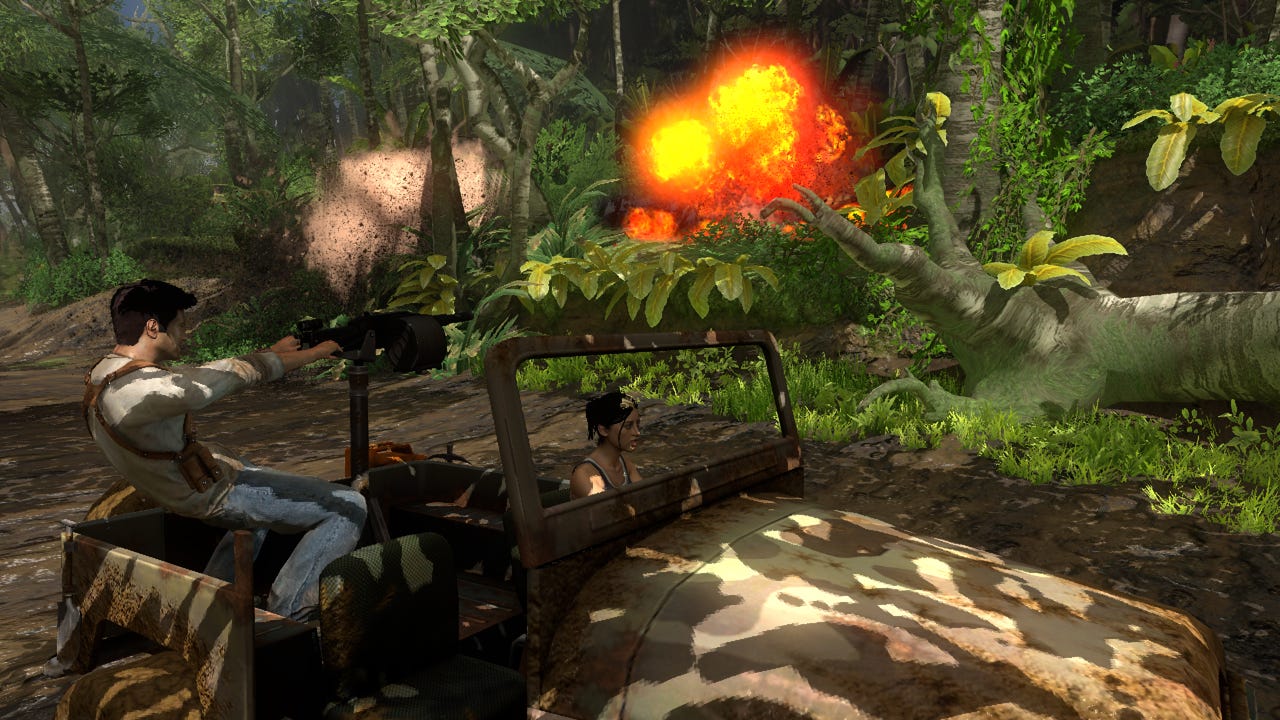
Some levels see you in charge of firearms while your chum keeps an eye on the TomTom.
Nathan Drake isn't completely without acrobatic skills. He can jump long distances, hang off ledges and dive-roll behind cover. He's a skilled fighter, albeit one who trained on the streets rather than by frolicking around a country pile. "It's a down and dirty fighting style, with big, wild, off-balance haymakers, uppercuts, crosses, scissor-kicks... This is dirty fighting, and you've got to do what you've got to do," says Hennig.
Despite the range of moves at Nathan's disposal, the combat system isn't complex. Hands-on, the moves you pull off depend on the context you're in rather than the buttons you press. Approach an enemy from the front and press the square button and he'll unleash a volley of punches. Approach from behind and press the same button, and he'll snap their neck. It's not likely to satisfy beat-'em-up fans, but this is an action-adventure game after all.
Howdy, cowboy
The gunfighting is also pretty straightforward, and Hennig says this is deliberate. "Most games have a very tactical style of gunplay, there's a lot of precision. When you look at the movies we draw our inspiration from the hero is not a super-soldier. He can get into a panic, he can get overwhelmed, he's overmanned and outgunned. We wanted the gunplay to have a Wild West feel rather than a military feel."
It's not all about running and gunning. You'll still need to make good use of cover if you want to survive for very long. This doesn't mean crouching down and waiting for enemies to come to you, however. You'll need to keep moving, dashing across open clearings and dive-rolling from one cover position to another.
And while all that's going on, you'll need to keep an eye out for snipers; they can kill you with one shot. This isn't as unforgiving as it might sound, because you can see the lasers on their scope as they track you. This gives you a couple of seconds to either move into safety or take them out. It's still tricky, mind.
Hennig explains that gunplay and combat are two "key pillars" of Uncharted, but this is still a Naughty Dog game and an action-adventure game. So the third pillar, and a hugely important one, is exploration. "One of the most inspiring things about this genre is the urge to explore, which I think we all share. It's a human urge," she observes.
H2Oh
The new Eurogamer offices. We're getting a pool table put in and everything.
During the demo we see three of the environments you get to run around. There's the interior of a fort, beautifully lit with blue-green tones and complete with spectacular water effects. Next up is an open area where you're surrounded by moss-covered ruins - Lara would feel right at home. And finally a monks' library, where you must solve a puzzle by turning statues in different directions.
Before you can get cracking on the puzzle, you need to deal with a load of gentlemen firing guns at your head. In fact, after we've played through each one a couple of times, a pattern emerges. You start off by taking out the snipers, then the enemies on the ground, and then you can do the puzzle-solving. We ask Hennig if this is how all the levels in the game play out.
"No, that's such a small sample," she replies. "There is an aspect of that as you can't very well solve a puzzle while someone's shooting at you. You need to clear the area then deal with the problem at hand."
The enemies are clever buggers, at least when they're at a distance. They take cover convincingly, observing your movements and changing their strategy. But walk straight up to them and they don't always know how to react, leaving you free to punch their heads in. They're also a bit deaf, so it's easy to creep up on them. A few are visually impaired and won't turn around if you walk straight past them. Still, this is pre-beta code, so there's time to iron out the niggles.
Hourly rate
Time could be an issue in a different context, however. Another journalist in our interview session asks how many hours of gameplay Uncharted offers. "It's hard to estimate. It depends on the player and how they play," Hennig replies. "I think we're looking at something like a 10-hour experience, but it's such a subjective thing."
Just recently, Heavenly Sword fell under heavy fire for lasting around 6 to 8 hours. There's a growing debate about game length, with many questions being raised about value for money and next-gen expectations. So what does Hennig think?
'So when it comes to sun and fun and goodness in the jungle, they all prefer the sunny funny one they call...'
"I don't know what we should do these days. People go out and buy DVDs of two-hour movies, and it's over. You've got something five times that long... It's not a bad price for the value, I think.
"It's getting harder and harder to make these games, there's a lot that goes into it," she continues. "We have to worry about how his eyes refract light the way Pixar does, but it still has to be interactive and run in real time. Sometimes that density of detail means you can only do so much. But I think if the experience is compelling enough, that's okay."
She's got a point. Just the other day we reviewed a game that can be completed in under an hour, and we gave it 9 out of 10. Mind you, that game costs GBP 4.25, not GBP 42.50. Uncharted is bound to take flack from those who like their adventures long lasting.
Let's just hope any such flack doesn't completely overshadow what Naughty Dog achieves with Uncharted. They're clearly working hard to push the action-adventure genre forward, and to make the most of what the PS3 has to offer. The question is whether this game has that Naughty Dog magic, or whether it has been left behind along with the fantasy elements and the cartoon visuals of previous games. Only one thing is clear: it is a bit like Tomb Raider.