Super Street Fighter IV Review

Ken out of 10.

Version tested: PlayStation 3

This is not the comeback story. No, we had that last year: the old champion brought out of retirement for one last, historic bout, fighting against the odds to a victory so glorious it revitalised the sport itself. And Street Fighter IV soared along that narrative arc like no other game before it, confounding even Capcom's expectations to rekindle the dulled passions of fighting fans and introduce an entire new generation to the old ways of pixel pugilism.

The game may not have taken the arcades by storm, particularly, but it was precisely the fact that it wasn't interested in taking the arcades that led to its success. Street Fighter IV went where the players are: to the consoles.

Then, in combining some of gaming's richest iconography with a rediscovery of that precious DNA that made Street Fighter II appeal to such a broad range of players, it delivered the entire genre a shot in the arm. It had its detractors, as any champ does. But none could deny the game's significance or the mainstream, Rocky-esque comeback it spearheaded, not just for its series, but for fighting games in general. Street Fighter IV: the comeback kid.

So how to bill Super Street Fighter IV, then? Bright hero turned cash cow, merchandising and endless appearances diluting his vim and appeal with each outing? Or a fighter who, having found rare form, is now moving from strength to strength? 10 minutes in to what will almost certainly be known as Capcom's defining work of the generation, there can be no doubt: Super Street Fighter IV, allegedly the final update for the series' fourth instalment, goes down in a blaze of glory.
1

"See? The strongest fighter always wins. As easy to understand as a flowchart." Capcom joins in with its fanbase's jibes.

In the 11 months since work began on the update, all of the data pulled from a million battles across the world has been distilled into a generous clutch of changes that improve the original in almost every tangible way. If Street Fighter IV reinterpreted the successes of the past for a modern audience, then Super Street Fighter IV lives up to its name, making that reinterpretation superlative.

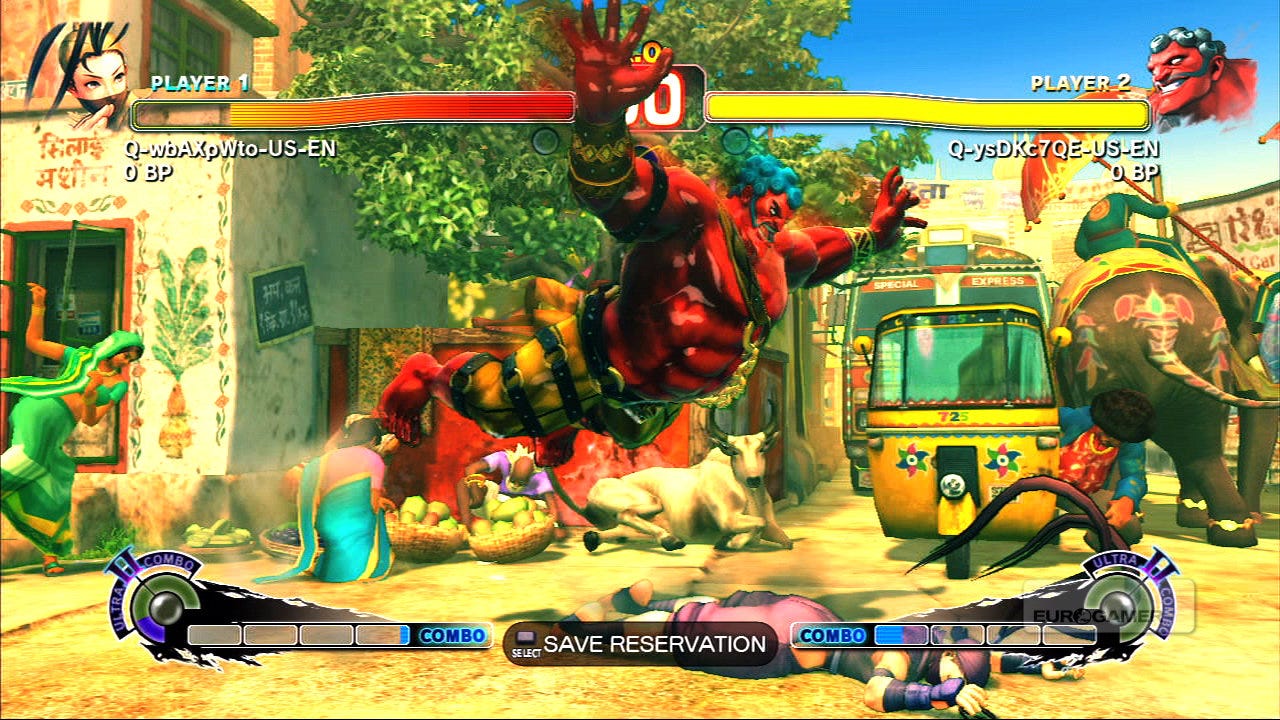
10 new characters bolster the original roster of 25. Two of these, Turkish oil wrestler Hakan and sex-crazed Korean Tae-Kwon-Do practitioner Juri, are new to the series, the rest pulled from across Street Fighter's rich heritage. Crucially, not one of the new characters repeats or imitates what was already in the game.

Each fighter offers an entirely new feel in the hands, requiring fresh strategy and careful learning - and, most importantly, bringing yet more diversity and vibrancy to the cast. Makoto darts with whip-crack speed to land karate thwacks. Dudley, the aristocratic British boxer who taunts with a thrown rose and drinks tea with his gloves still on, is like Balrog following a weight loss programme, all coiled-spring power. Juri's armour-breaking dive kick punishes Focus Attacks from practically anywhere on screen, while ninja kid Ibuki's fearsome mix-up game is lightning fast.

The distinction between characters is outstanding, and the new fighters bed seamlessly with the existing roster. Moreover, for those who complained the first game favoured defensive play over risk-taking, each is primarily based around offensive play. All the characters are unlocked from the start, answering those critics who bemoaned slogging through arcade mode to unlock the character they wanted. Likewise, new costume colours and taunts are won simply by playing as a character in any mode, one per game.

However, most of the game's value to experienced players lies in the wholesale rebalancing of the existing cast. Many moves in the game have had their damage reduced (far more than have had it increased), particularly with regard to the Ultras, those spectacular finishing moves available to any character when they've taken a certain amount of damage from their opponent. Now it's entirely possible to eat two Ultras from a weaker character and still go on to win the match, something far less likely in the first game. The reduction in Ultra damage, combined with the more offensive new characters, encourages risk-taking where Street Fighter IV often punished it.

Aside from new characters and balancing, the area of the game to undergo the biggest overhaul is online. Three core battle modes are available. The first, Ranked, has you play one-on-one matches of one, three or five rounds. Here you earn two types of currency: Player Points, which increase with a win or decrease with a loss, and Battle Points, which can only increase and are tied to the particular character you've chosen. Each character in the roster has its own individual Battle Point tally, increasing in Rank as you pass set thresholds.

These two stats work well together, as they indicate both the general skill level of the player you're facing, as well as their proficiency and experience with the character they've chosen. It also adds an RPG-style meta-game in the unspoken challenge that you raise the level of all of the characters by winning matches online.

2

There's a welcome option to play character music, usually reserved for Rival Battles, in the Arcade mode.

Endless Mode allows up to eight fighters to play winner-stays-on in a lobby together. Those players not engaged in battle get to watch the fight and talk about it together, while the next player in the order can reserve their spot to fight next by pressing the back or select button. Endless Mode also allows you to limit the number of players in a lobby all the way down to two, replacing Player Matches from the vanilla game.

Finally, Team battle works like a tournament system, allowing 2 vs. 2, 3 vs. 3 or 4 vs. 4 matches, with a cup for the overall winning team. You can choose the order you fight in (there's no Marvel vs. Capcom-style tagging in here) so there's additional strategy in attempting to deploy your best players and most favourable match-ups to the opposition's.

Outside of the combative online modes, Super Street Fighter IV boasts an impressive Replay Channel, allowing every player to save, name and rate 150 matches to watch back at any time. You can view replays in slow-motion and invite friends into your own Channel to view your best fights. While replay channels are an unnecessary addition to many games, here they provide an invaluable resource in allowing you to view and evaluate your own battles, discerning where the weaknesses in your game lie, as well as seeing how the best players in the world do it.

The other additions to the game are of mixed success. The car-smashing interstitial first seen in Street Fighter II makes a return along with a barrel-breaking mini-game. Fun for a few turns, you'll soon be reaching for the option to switch these arcade mode interruptions off, as they're little more than nostalgic diversions.

While the Time Trial and Survival modes have been lost from the first game, the Character Trials, which offer 24 increasingly taxing moves and combos to master across each of the 35 characters, are now better-pitched and more expansive. As you pass certain completion thresholds, you unlock new icons and titles to attach to your gamertag in order to intimidate (or mislead) your opponents online, but their true value is in giving you a basic understanding of how each character behaves.

For those players who want to enjoy the arcade experience at home, once again Mad Catz is offering a range of controllers designed in consultation with Capcom. In the main, these are simply re-skinned versions of last year's range (reviewed extensively already). However, the top-grade stick, the £150 Tournament Edition, has undergone a more major overhaul, losing the sloped Viewlix-style edging of the original stick. The sharper edges can irritate your wrists after extensive play and, while the stick still feels weighty and responsive, we prefer last year's version for this reason.

3

The option to select Japanese or English voice acting on a per-character basis remains, and is something we'd like to see introduced into many more games.

Hori, Japan's most famous stick-maker, also has a new mid-range stick out to coincide with the game's release, the Real Arcade Pro EX, although sadly we were unable to test at time of writing. Plenty of top-level players play Street Fighter with a standard Xbox pad, but the layout of inputs in the game is explicitly tailored to stick play (with throws, Focus Attacks and taunts all mapped for easy execution on a stick, but awkward on a standard pad), so if you're coming to the genre fresh, we'd recommend investing in a mid-range stick and learning the ropes on that: you'll likely play better in the long run for it.

For the Street Fighter devotee, Super is an exemplary update, tweaking the original in logical, balanced ways that few would contest improve the experience. For newcomers, this is an excellent point to get involved in Street Fighter. However, be warned that, unlike, say, Modern Warfare 2, this is not a game you can expect to walk into with some level of competence if you're unfamiliar with fighting games. The path to proficiency is long and winding, but also one of gaming's most enjoyable to master.

Super may lack the impact of its immediate forebear, which grabbed headlines with its heady combination of brilliance and novelty. But this is the very best sort of evolution, a perfection of detail, one that diminishes its faults and amplifies its successes. If Super is, as producer Yoshinori Ono claims, to be the final iteration of Street Fighter IV (besides the inevitable DLC), then fittingly it goes out in its prime, a game at the very top of its game.

10 / 10

Read the Eurogamer.net scoring policy

Comments (144)

Comments for this article are now closed, but please feel free to continue chatting on the forum!

  • Loading...hold tight!