Super Smash Bros. Brawl Review

Fantastic.

Version tested: Wii

The other week we joked that if OutRun 2 was fan service, SEGA Superstars Tennis was dinner, dancing, cocktails and fellatio. We'd lose our jobs if we tried to put Super Smash Bros. Brawl on that scale. It's so completely, bonkersly in love with Nintendo that it's hard to imagine how it will be topped. Perhaps if the next Mario game prints money out of the disc slot every time you find a star. And Princess Peach turns out to be Scarlett Johansson, who lives in the box, and needs a backrub.

Like the other Smash Bros. games, this is a side-on beat-'em-up with platform game elements, where the object is to knock the other player (or players) off the side of the arena. Doing lots of damage to the enemy - as indicated by a percentage - means they will be blasted further away, until it's impossible for them to jump back to safety. Depending on the game rules, players are rewarded for knockdowns and penalised for their own trips into the abyss, with the winner usually a logical synthesis of the two. And the winner is always a character from a Nintendo game, or a welcome intruder from a friendly competitor.

The cast is massive to begin with - Kirby, Mario, Link from Zelda, Zelda from Zelda, and lots of other much less obvious ones - but gradually deepens as you progress through the single-player adventure mode, Subspace Emissary, where you meet Ike from Fire Emblem, Pikachu, Solid Snake from Metal Gear Solid and others. It's even got Sonic the Hedgehog, who has been welcomed into this orgiastic, Return of the Jedi Endor campfire scene of a game like Darth Vader pulled lovingly from the crumbling Death Star of the broken old-days SEGA, his past attempts to destroy Mario ignored as he dances gaily with Admiral Ackbar and the Ewoks.
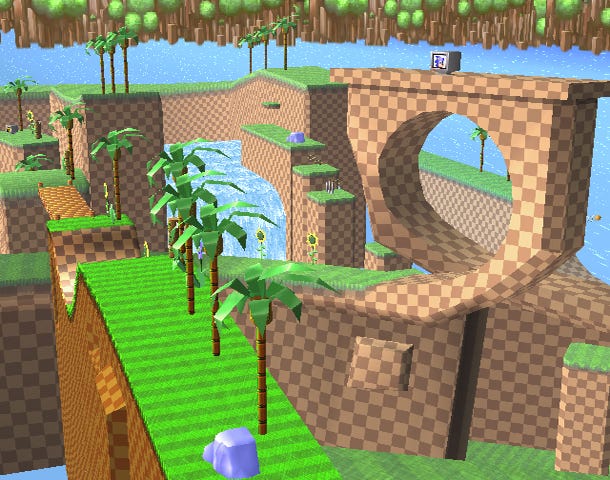
1

Sonic gets his own stage. It would be unfair to point out that it's better than half the actual 3D Sonic games.

That single-player mode encapsulates the fan service. You navigate side-scrolling platform game levels having fights with Game-And-Watch squiggles and armies of ROB the Robot, among dozens of others, as disparate Nintendo properties from incomprehensible alliances in the face of pantomime evil. So you have Link retrieving his sword, Excalibur-like from a rock in the forest before wandering past a sleeping Yoshi and getting into a fight with the Ancient Minister, while miles away Fox McCloud partners up reluctantly with Diddy Kong and Lucas from Earthbound inches through the ruins of a zoo with a bit of help from a Pokmon Trainer.

This is all summarised in occasionally brilliant dialogue-free cut-sequences that almost justify playing through Subspace Emissary alone, but the real incentives are unlocking all the characters you meet for use in competitive multiplayer. The option to play co-operatively with a friend adds a bit more depth, although there are some mild camera issues, and there's a neat sticker-based power-up system that lets you buff your characters between levels using collectibles derived from increasingly obscure Nintendo-related sources, like Electroplankton and Ouendan 2.

And yet Subspace Emissary is basically just extra hugs. Once you've cuddled enough, you can concentrate on the fighting modes, which is where Smash Bros. is strongest. Sometimes dismissed as a bit random and disorientating, it only really is for the first little while, after which the emphasis on special moves, power-ups, environmental awareness and smart movement around platforms establishes itself. KGB-speed reactions to twitching enemy biceps and combo memory aren't the necessities they typically are in beat-'em-ups, although there is room for advanced attack and defence. So it's more accessible than, say, Virtua Fighter, but there's also enough of a hook there if you're a bit hardcore, providing you can put up with all the hopping around.

Doing so, and double-jumping, are two basic but important actions, and you can also block, grab, attack and execute specials once you've found your way around the controls. Specials are usually derived from familiar traits, so Mario's uppercut bounces an enemy for coins, Link can throw bombs and shoot arrows, Pikachu electrocutes and Yoshi can throw eggs. New characters are the same - Pit from Kid Icarus can take off and flap around, for instance, and the Pokmon Trainer can switch between a trio of Pokmon - Charizard, Ivysaur and Squirtle. Olimar is particularly eye-catching, using an army of pikmin to engage.

Also prevalent in combat are power-ups, including the SNES Superscope, which can be fired like a gun, and more functional alternatives like baseball bats and health tomatoes. Others allow you to breathe fire, swing laser-swords, or run around madly with a hammer, and then there are assist-trophies that reinforce you with other non-playable characters like Tingle. Most potentially divisive of the new ones is the Smash Ball, which is basically a finishing move, called a Final Smash, wrapped up in a floating rainbow bubble. Everybody makes for this when it appears, and for good reason. Fox McCloud turns into a Landmaster tank and starts steamrollering everyone, Bowser turns into Giga Bowser, and Pikachu evolves into a floating ball of electric energy. Olimar's Final Smash is my favourite, and hence I won't spoil.

All of this Nintendonanism takes place on stages just as frequently engineered to compliment their source material: there's a WarioWare level where your surroundings rotate through configurations derived from the original game's short, sharp bursts of quirky and diverse gameplay; a PictoChat level where the platforms beneath your feet are ever-changing illustrations (oddly not a nest of penises); a volcanic Metroid level where you have to hide in shelters that pop up on random platforms so an occasional screen-filling wave of lava doesn't murder you; an F-Zero racetrack where you get knocked around by hovercars; and many others, including a few from the Cube Smash Bros. game, Melee.

2

Not exactly an unusual sight, this sort of thing.

Moving platforms and stage-specific gimmicks are fewer than they were there, but initially the complexity and dynamism of all this still adds to that feeling of disorientation, especially for newcomers. But just as the strengths of the fight mechanics emerge after an hour of play, so like a good racing game you improve in your response to each stage as you learn its behaviour. This is particularly important in a game where keeping the ground beneath your feet is second only to separating the other players from the ground beneath theirs.

Balance is pretty much everything, and for the developers, too. Watching Ike perform an uppercut, release his sword, leap into the air and then grab it to slam back down into his still-dazed enemy's head surely has little place in a game where Lucas responds by directing a lightning ball around the level with the analogue stick, as Princess Peach floats by overhead and Meta Knight buzzes around, cute as a button, flapping his cape and trying to catch people in it. Except somehow it all fits. It's not the perfect blend, but it works consistently enough to produce fair battles in most cases. Indeed, if there's a flaw it's perhaps that there's a bit of uniformity among certain characters, although not many. Even Final Smashes are double-edged - Fox's Landmaster may be powerful, but it's also rather difficult to save if it tumbles off the edge, forcing caution, and other moves, like Meta Knight's, are only effective if they're used in specific ways.

Sheltering all this functionality and balance together like heart-patterned umbrellas are more than enough modes. There's Brawl, the basic two- to four-player fight mode; Special Brawl, the less basic alternative where you can apply various modifiers (speed, gravity, permanent hats, etc.); Tourney, an elimination-based tournament, startlingly; Rotation, where up to 16 people can fight in sequence; and the option to fight as teams within them. That's before we get on to the single-player/co-op stuff. Subspace Emissary may be the dominant bit, but Classic mode still lets you fight a sequence of enemies, punctuated by mini-games and culminating in the usual encounter with series badguy Master Hand; Events mode tasks you with completing specific goals, like collecting dragon pieces and fighting a metal Dedede; and Stadium mode lets you tackle the throwaway mini-games like Home-Run Contest individually.

What else? There's a Stage Builder, where you can design levels out of simple components, save them and share via WiiConnect24; the Vault, where all your trophies and unlockable objects (music! stickers! etc!) reside; and online multiplayer.

This is a first for Smash Bros., obviously. You can play against randomers, waiting for them in a warm-up room where you can mash Sandbag around; you can input Friends codes to play with people you actually know; and Spectator mode allows you to watch other people on the Internet and bet gold coins on the match outcome. With no contextual information, like performance records and names, it's basically guesswork, so you usually go for the guy with the character buried deepest in the game, but its inclusion - while ultimately pointless - does at least save you turning the game off while you eat your supper. We had no lag in any of this, playing on a usually robust DSL connection, and only the typical Wi-Fi Connection caveats apply: communication is limited to stock phrases and built-in d-pad taunts, and Friends codes are cumbersome.

3

Zero Suit Samus (bottom-left) and regular Samus can switch to the other form with a Final Smash. Sexy.

There are other complaints. Subspace Emissary is longer than ideal, meaning you won't get to play as some of the biggest novelties for a good while, and the quality of the cut-scenes and level designs here is inconsistent - there are a few clever conceits, but levels also drag on unnecessarily, with doors as red herrings and other minor frustrations. Control is also a little imprecise overall - there are four schemes available, taking in Wiimote, Wiimote and nunchuk, Cube pad and Classic controller, but none is without minor grievances - and particularly in single-player, where performing big leaps and landing them is fine but small positional movements from standstill are fiddly.

However, control and structural quirks will struggle to compromise your long-term entertainment - and Brawl really does offer that. It's consistently satisfying over long periods, fulfilling its usual role of dominating a willing crowd's evening into the early hours, and now allowing you to sustain that after everyone's gone home using the Internet. Really the only reason you wouldn't feel that way would be if you didn't stick with it past the dizzying first quarter of an hour, or if you don't like Nintendo characters - and if you don't in either case then you probably aren't reading this anyway, and the prospect of Triforce-smashing your friends to death won't mean anything. Otherwise, persist, and enrich yourself, and wonder where on earth it all goes next.

9 / 10

Read the Eurogamer.net scoring policy

Comments (200)

Comments for this article are now closed, but please feel free to continue chatting on the forum!

  • Loading...hold tight!