It's amazing how far Star Trek Online gets just by having the right sound effects. The high-pitched warble of scanners and transponders, the hiss of phasers, the shimmering harmonics of the transporter: these sounds beam you directly to a universe which, you find, you already know by heart. It works even if you're not a particularly big fan, Gene Roddenberry's benign science-fiction now being so ubiquitous that everyone has absorbed it by a kind of cultural osmosis, whether they wanted to or not.
So, from the moment you hear that unmistakeable French horn fanfare on the character-select screen, Cryptic's Star Trek MMO is winning the immersion war without even having to try. It's just as well - the Champions Online developer needs all the help it can get. Not because of any shortfall in talent or ideas, but because this game has clearly been put together on a fairly limited budget and schedule by MMO standards - it is, after all, only 18 months since Cryptic announced it had the Star Trek licence, and four months since it launched Champions, with four weeks to go to Star Trek's release. The Californian developer hasn't got time for world-building on the scale of Azeroth or the Old Republic, but the Star Trek licence has raised interest and expectations for this game far beyond the niche. It's great news that it sounds right - and, as we reported from the Eurogamer Expo, feels right - but what's next?
Playing through the early stages on the beta, you're confronted with a game that's being assembled, almost before your eyes, out of multiple discrete parts - like a flat-pack MMO. Star Trek Online is essentially a series of short bursts of instanced action - either ship combat, or planet-side runabouts with the away team - hung on a framework of massively-multiplayer socialisation and novel, flexible RPG progression. It's a little rough, surprisingly simple, immediate and accessible - and it hangs together surprisingly well, despite having so many disjointed one-click jumps between starbases, sector space, space combat and beam-me-down rucks.
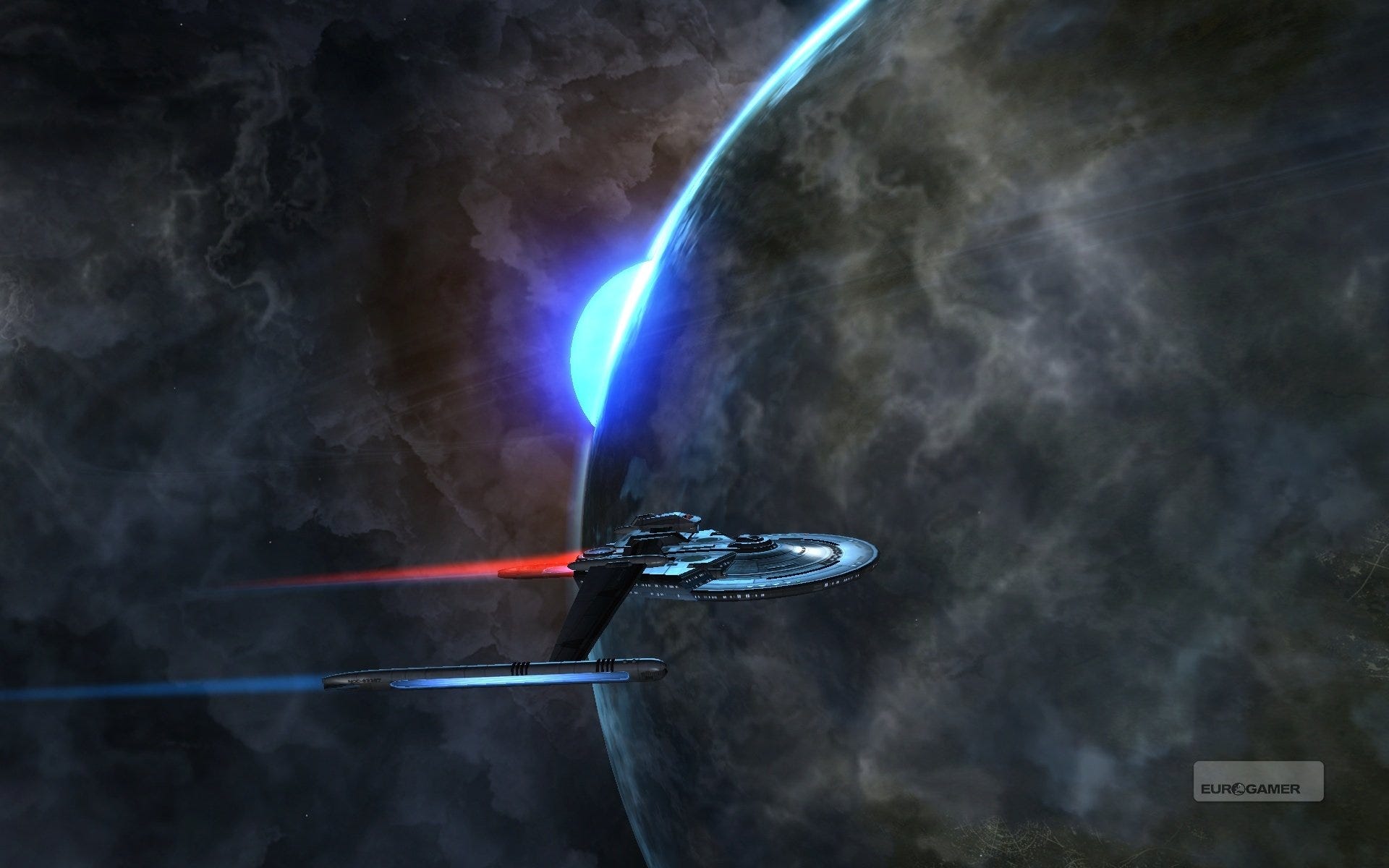
Hit the "randomise" button on the ship customisation screen to be amazed at how many variants Cryptic has coaxed out of the class Trek design.
Character creation is more straightforward than Champions'. You can knock together an archetype for your Federation officer very simply and quickly, choosing from most of the famous (and some not-so-famous) Star Trek humanoid races. Inveterate slider-tweakers will enjoy creating their own race though, with Cryptic's peerless experience in character customisation allowing you to conjure up all kinds of unique, yet somehow inimitably Trek, blue-skinned and ridge-browed freaks. Otherwise, it's a simple matter of choosing your career specialisation: science, engineering and tactical.
Broadly speaking, science is a buffing and healing class, engineering provides gadgets and crowd-control abilities, while tactical is straight combat and stealth. All three classes can be further specialised later on. But as with many things in Star Trek Online, Cryptic is clearly thinking about Star Trek first and MMO convention second. Your main combat abilities are dictated by your weapon, not your career, and any class is effective in man-to-man combat, while the careers apply slightly differently to ship skills than personal ones, where there is more scope for hybridisation.
In any event, whether on board ship or in an Away Team, you're always going to be complementing your player-character with a selection of Bridge Officers, who have their own slightly more limited advancement paths. On foot, these operate like AI party members in a single-player RPG. On board your ship, they contribute buffs and skills, effectively joining with your player-character to create a sort of all-class meta-character. You'll collect a lot of Bridge Officers and be able to swap them at will, so there's huge scope for configuration, and no avenue is ever really closed to you whatever career you choose - vintage Cryptic design.
You begin the game as a lowly Ensign, assuming command of your ship during a catastrophic Borg attack. By the time you've romped through the tutorial storyline, you'll be a Lieutenant and officially have your own Starship Command. From that point, you advance through the ranks of Lieutenant, Lieutenant Commander, Commander, Captain and Admiral, and each of these has 10 levels. You can only employ Bridge Officers below your own rank. When you gain a rank, you'll be awarded a new special ability and the access to new classes of ship but most of your skills you choose and balance yourself by spending skill points. You don't need to visit a trainer to do this - it's right there in the skills window - but you are required to spend those points to rank up.
Gaining ranks and new ship types is a powerful levelling motivator, and progress is flexible, but with almost none of the traditional RPG stat mainstays to use as a bearing - and the split in skills between Ship and Ground abilities - it's quite easy to feel lost in this unfamiliar system at first. Nevertheless, it's so flexible and progress is so constant that learning on the job doesn't feel too intimidating, and Cryptic seems to have struck a nice balance between pure skill- and level-based styles of progression.
Crew members move erratically but seem to be able to handle (and crucially, heal) themselves.
After the tutorial you arrive at Earth's spaceport. It's a social, trading and customisation hub, a standard MMO town in other words, with vendors, mission givers, an auction house and a bar. Stations like this and "sector space" - which is basically an over-world map - are the only places in Star Trek Online that you'll actually see other players running or flying around unless you group with them (well, more or less - Cryptic has said that the star system instances aren't entirely locked and you may end up playing with one or two strangers, but I haven't observed this in the beta yet).
Accepting your first missions, you beam to your ship via a loading screen - bridges you can visit have been promised, but aren't in place yet - and then warp to the abstract map of sector space. Here you can fly manually, or via autopilot, to star systems. There are occasional roaming enemies, which trigger an instanced space combat mission if you fly too close, and also "fleet action" points where multiple groups of players can take part in large-scale player-versus-environment space combat.
Mostly though, you'll fly to a system, warp in, and then engage in either space combat or beam straight to the planet surface. Missions come in two categories, Patrols (quick five- or 10-minute quests on foot or in space) and longer chains, usually involving a mix of space and ground action and aping the style and storyline of a Star Trek TV episode. Early examples of the latter include saving the crew of a freighter from pirates, or escorting a Vulcan ambassador, who isn't all he seems, to a monastery besieged by Klingons.
In these early stages, space combat proves the more compelling of Star Trek Online's game of two halves. Although the ships move slowly, it's surprisingly tense and hectic. Rather than using a vast array of skills, you find yourself mashing away mindlessly at the "fire all weapons" button while concentrating on balancing your shields and power priorities (switchable between attack, defence, speed and balanced) as well as the absolutely vital element of positioning your ship so as to expose the enemy's weakest shields but not your own. It's pleasantly engrossing, edge-of-seat multitasking that rewards quick thinking and skill alike, like a simplified three-dimensional version of Pirates of the Burning Sea's excellent naval combat.
Ground combat is less convincing. As with ship battles, Cryptic is to be commended for keeping things simple and direct; with few skills to worry about, capable AI officers accompanying you at all times and fast-paced battles against multiple enemies, Star Trek Online has to be one of the most immediate and easy-to-grasp MMOs out there. But, as is the case with Champions, the timing is too hazy and enemy behaviour too erratic to deliver a satisfying action-RPG punch, and if anything it seems too mindless and simplistic. The addition of flanking bonuses is a nice touch, making positioning and target selection more important than usual, and interesting squad mechanics may reveal themselves later on in the game, but at present it lacks the tactical bite of the stellar battles.
Sector space is crawling with swarms of toy ships at peak times.
At this basic level, Star Trek Online seems enjoyable and easy to get into, and like Cryptic's previous games, it's likely to be more suitable for casual, short-session play than many other MMOs. Although it might not boast lavish production values, it also seems well-equipped to introduce a wider audience of Star Trek fans to the genre, as well as giving the field of massively-multiplayer sci-fi a much-needed, much lighter counterpart to the intimidating EVE Online.
But with several key features yet to be implemented in the beta - notably the ability to create Klingon Empire characters [edit: actually you can do this, I just forgot that it unlocks later in the game] and the Genesis system that creates randomly-generated content for explorers - the bigger picture is currently impossible to make out. We'll be watching it come together over the next month, and bring you our review as close to launch as possible.
Star Trek Online is released for PC on 5th February.