Originally announced in 2001, and having missed its proposed 2003 release date by a considerable margin, you can hardly blame folks for suspecting that this long-awaited Iron Curtain shooter was little more than vapourware.
Even after Kristan was flown to Kiev and granted fifteen minutes on the thing, or after publisher THQ attempted to similarly irradiate our dear Mr Garratt in the name of publicity, those doubts still lingered. OK, maybe it existed as some sort of advanced tech demo, but the chances of it appearing as a commercial game still seemed slender to a lot of jaded PC fans.
And you can hardly blame them. The FPS genre has seen plenty of titles get lost in the sinkhole of development, largely because the PC scene has sadly become hung up on the shiny baubles of graphical excess, and so each new title must be able to boast something faster and sexier than its peers. Each time the visual bar gets raised, plans get revised or scrapped and programmers everywhere scurry back to their nests to try and get one-up on the competition.
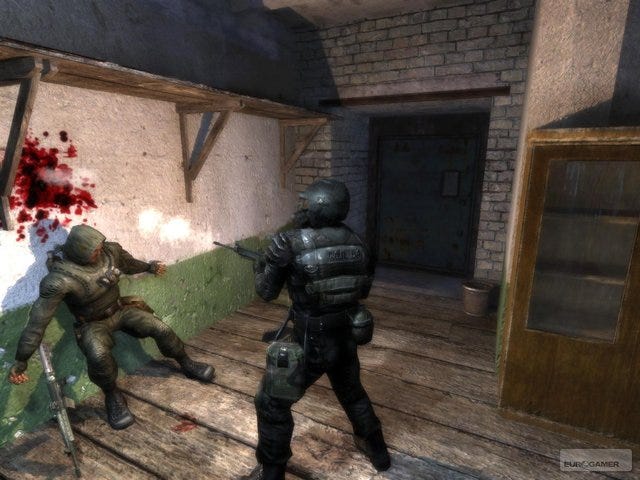
Body armour is scarce, so avoiding the business end of enemy weapons is recommended.
Meanwhile, the average humble PC gamer sits at home, wondering if they'll ever be able to enjoy these groundbreaking experiences without forking over a fortune to upgrade the innards of their rig.
Well, I can put your mind at rest on two scores. Firstly, S.T.A.L.K.E.R does exist - we finally have stand-alone preview code that can be played at length without PR overlords hovering over our shoulder, or developers guiding us to the bits that actually work. Secondly, while those with turbo-nutter PCs will certainly revel in the visual splendour GSC has conjured up, the game works just fine when installed on a less powerful machine. You'll miss out on some of the more snazzy flourishes but if you beefed up your computer to cope with Half-Life 2 or Doom 3, as I suspect most PC players eventually did, then you'll certainly be able to play S.T.A.L.K.E.R. Even on an ATI Radeon 9800 Pro it coped with the high detail setting with no problem.
What you will need is a muscular amount of RAM. The original tech specs for the title suggested 1GB of the stuff, but the preview code arrives with a note suggesting at least twice that amount. That's because the game pre-loads each of the sprawling play areas, so while loading times are sluggish (though this may yet be optimised further) once you're in the game, the frequent loading pauses which plagued Gordon Freeman's second outing are a thing of the past.
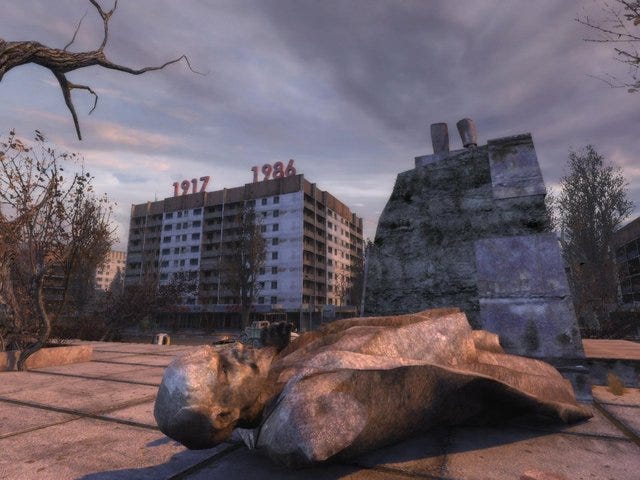
This fallen statue of Richard Stilgoe shows the overwhelming detail that has gone into the game.
And what of the game itself? We've heard plenty about the A-Life system, which governs the behaviour of the thousand-strong population of mutants and mercenaries, and the game's visuals, which are as lush as a bleak, grey radioactive landscape can be, so I'm not going to waste time repeating the obvious. There's a whole bunker full of past coverage on those topics just one click away should you desire it.
No, I'm going to tell you how the damn thing plays. How these lofty elements are coalescing to produce something you can actually interact with, and be an active part of. Is it actually going to be any good? Thankfully, the answer seems to be a resounding "yes". In fact, lets make that a "YES", with capital letters and everything. With only a month and change before release, it's looking really good.
The opening movie, a sizable chunk of which made up the game's last trailer, casts you as a rather generic amnesiac tough guy, stranded in The Zone and looking for answers to your shadowy past. The year is 2012, and a second disaster at Chernobyl has created a 30km wide hellhole of radioactive anomalies, mutated wildlife and lawless scavengers. The Stalkers are freelance explorers who pick their way through the ruins, and bring out artefacts to be sold in the outside world and, with apparently nothing better to do, you set about learning their trade. From there, it's pretty much up to you.
Control is your standard WASD set-up. Interaction is via a context-sensitive prod of the F key, while instant medkits and ammo swaps are assigned to hotkeys for easy access during battle. It's all completely familiar and functional, so you're able to divert your energy towards exploring your new environment rather than constantly checking the keyboard. The only control quirk that caused minor annoyance was a rather counter-intuitive crouch command. You hit Ctrl to squat, but have to press Shift as well if you want to crouch further down. There's no prone position, and you have to keep the keys held down if you want to move while crouching. As you can imagine, this makes moving and aiming while crouched a bit of a fumble, and makes the stealthy approach a less attractive option.
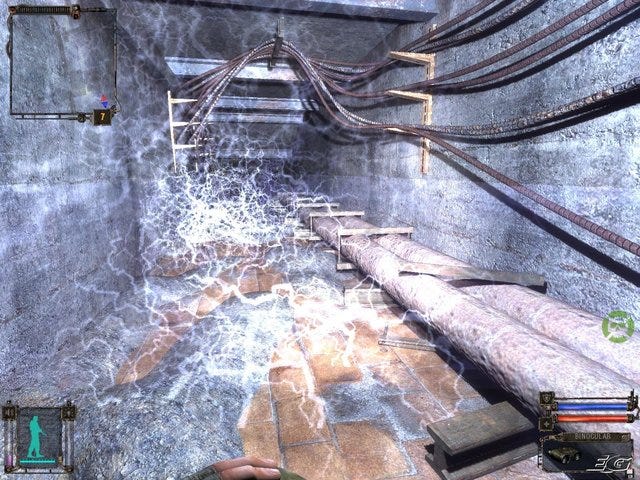
Electrified water is one FPS cliché we were hoping would be left in the past.
"Oblivion with guns" was the tantalising soundbite that squirted from Patrick Garratt's word-teat following his trip to the reactor, and it's easy to see why. Vast, open landscapes await you, with story missions and side quests approachable in any order you fancy. Well, almost. One of the first things you realise is that, as always, the lofty ideal of non-linear gaming doesn't quite match the reality. There's a story to be told, and stories need structure. While you can piddle about, admiring the scenery and gathering items for as long as you like, the game does subtly herd you in certain directions whenever the narrative needs to be advanced. It's never crude or intrusive though and as you get to choose when this herding will take place, it's hard to resent the presence of a little formal structure.
Certain confrontations, such as a sprawling conflict between Stalkers and the Army, or a bandit raid on a Stalker camp, are scripted insomuch as you have to take part in them to save key characters whose information is vital to progress. There are also certain sections that must be traversed to find specific items. While there's freedom to choose when you tackle the missions, the concept of a completely open-ended Choose Your Own Adventure should probably be debunked now to avoid disappointment.
Each area is, however, completely free-roaming - and the hefty RAM requirements really make the difference here. You're able to spy a campfire burning in the distance, hike for kilometres to reach it, discover it's in the middle of a ruined farm complex, clamber inside one of the buildings, scramble onto the roof and look all the way back to where you started out - and the game doesn't even break a sweat. It's a seamless, natural environment and one that begs for exploration, even without the promise of hot, hot gun action. Although the game refers to each map area as a level, you're always free to go back and forth between them. Indeed, sometimes you'll have to, as you make your way back to certain characters to trade items or collect rewards. The only restriction is that passage between levels can only take place at specified entry points - tunnels, checkpoints and the like. You can't just wander over the boundary anywhere you fancy.
The implications of the A-Life artificial intelligence system are apparent right from the start. The various beasts roaming the wasteland - mostly scabby dog things and bloated mutant hogs to start with - behave in eerily realistic ways. They hunt in packs, attack each other and can even be scared off rather than engaged in combat. The same applies to your fellow Stalkers, who have their own routines and jobs to do. Every character even has a unique name and, while it doesn't really add much to the gameplay to know that both friendly and hostile NPCs will cross from one map to another to exploit power vacuums, it does make for an easier-to-swallow alternative to tired old respawn points. What it does mean is that not only does combat benefit from intelligent foes, but you can use the gameworld to your advantage.
For example, the first area you start in - essentially a large training zone - is bisected by a shattered railway bridge. The way through the bridge is guarded by bandits, who will demand 500 roubles each time you wish to pass through. After paying up once, I decided my money could be better spent elsewhere, and decided to just make a run for it on the return journey. Sure enough, they opened fire, but I was able to out-run them. After that, they didn't seem open to bribery. So the next time I needed to cross their turf, I waited until dark. Lurking a short distance away from their barricade, I flashed my torch and fired off a few warning shots. As they came to investigate, I cheekily doubled back around them and sauntered through their den unscathed - even stopping to swipe their stash of vodka on the way.
Later still, having noticed a group of fellow Stalkers nearby on the map, I goaded the bandits into chasing me and led them into a massive firefight. The bandits duly killed by my unknowing accomplices (with minimal help from myself) I was able to swap my feeble pistol for an arsenal of automatic weapons stolen from the corpses. Unscripted moments such as this, which happen because of your direct actions in the simulated world, tickle the pleasure nodes on two levels. It's fun because it involves big guns going bang, and it's exciting because it feels a little bit random and chaotic, an honest-to-goodness event unfettered by the confines of What The Game Wants.
Behave yourself in the Stalker camps, and you'll find information and side missions aplenty.
This sort of gameplay isn't anything new, as Deus Ex fans will noisily point out, but it's still far from the norm. In a genre where corridors and ultraviolence are still the preferred options, S.T.A.L.K.E.R looks like being one of the few games to deliver something a little more thoughtful.
Even so, it's probably wise to quell some of those wilder FPS/RPG crossbreed fantasies. While S.T.A.L.K.E.R certainly borrows elements from the role-playing textbook, it never strays too far from its shooty roots. There's no character progression, no way of improving your stats, for instance. The weight of the items you carry affects your stamina, and if you load up your backpack with guns and ammo, you'll find your stamina bar runs low even when not sprinting. "You are too tired to walk" is your cue to dump some of your baggage, this game's equivalent to "You are over-encumbered". Yet there's no way to increase the amount you can carry, or to speed up your recovery. Weapons degrade with use, but you can't repair them yourself. It's hardly a deal breaker, but those expecting a revolutionary genre hybrid would seem to be barking up the wrong tree.
Interaction with NPCs also seems to be fairly standard stuff, with rigid conversation trees and somewhat basic attitude parameters. If you're nice to someone (which almost always seems to involve responding to a cry for help, or handing a medpack to a wounded Stalker) then they'll show green on your radar, as a friend. If someone is neutral towards you (showing yellow on the map and your crosshair) and you approach with guns drawn, they'll respond in kind. Holster your piece, and they're more open to a bit of chat. You do find you get the same responses to the same questions though, with only mission specific characters offering more in-depth interaction options. I saved one Stalker from a pack of mutant dogs, and earned his undying gratitude, only to be told to "bugger off" when I tried to talk to him minutes later, so it seems that their moods may be as hilariously random as Oblivion's fickle inhabitants.
Taking the last Haribo - still a social faux pas, even in a radioactive wasteland.
All of this doesn't really impact on the game's immediate appeal, especially if you approach it as a shooter rather than an adventure, but it does raise a question mark over the long-term appeal of the numerous optional missions. In a true RPG, you'll grind through as many side quests as possible because each encounter, each skill you use, makes you stronger and better equipped for what lies ahead. If the only reason for undertaking S.T.A.L.K.E.R's often lengthy secondary objectives is to earn more cash, many players may eventually choose to focus on the story missions.
This concern is heightened by the sparse nature of the early maps, which are undeniably large and luscious, but don't really offer much in the way of actual things to find. Again, much like Oblivion, the game takes a good few hours to unfurl in all its glory. Once you get past the early stages, the maps open out to offer a lot more opportunities for improvised exploration and character interaction.
All this RPG banter is, of course, secondary to how the game performs at its primary function - that of first-person shooter. With thirty or so real world firearms on offer, along with weapon jams and different ammo types, the emphasis is on precision and tactics rather than run-and-gun pyrotechnics. The very first mission you're offered - to clear a small farm of bandits - acts as a solid introduction to what's expected. Teamed up with a squad of AI Stalkers (or, rather, tagging along in their wake) any attempt to steam into the action, guns blazing, is likely to result in rapid death. Equipped with just a pistol, skulking and sniping are the order of the day, and it's a lesson that holds true even as you progress to more powerful weapons.
As you can see, realistically portraying the after-effects of radiation poisoning is high on the agenda.
A mission to steal government documents from a dilapidated military base provides another showcase. The sort of prolonged pitched battle that would be the centrepiece of most shooters, here it's merely an optional objective. And getting the documents is only half the task - you still have to deliver them to a middleman on the other side of the map. While you may come to question the ultimate purpose of such missions, it's clear that S.T.A.L.K.E.R is going to offer a lot of action for your money. At the very least, it's looking sure to be an addictive and varied shooter set in a compellingly realised environment.
Start thinking of it as a kinky radioactive threesome between Far Cry and Deus Ex, with a smidgeon of Oblivion's RPG trimmings, and you'll have a pretty good idea of what's coming your way in March. In the meantime, why not point your face at our competition and see if you can win yourself a key to the soon-come multiplayer beta test?