In Brink, Splash Damage and Bethesda may have one of the most ambitious games of 2010: a first-person shooter that blends single- and multi-player on a fundamental level, which is also sufficiently accessible that a complete novice can go toe to toe with a veteran and both still enjoy themselves. Following his Developer Session at the Eurogamer Expo 2009
last month, we cornered studio boss Paul Wedgwood to see how it's getting on.
Eurogamer: With Brink out in spring 2010 on three platforms, are you planning a beta or a demo?
Paul Wedgwood: We certainly would do a closed beta for friends and family. But I couldn't say about a public beta or a demo.
Eurogamer: Brink aims to blend single- and multi-player, but which audience is going to enjoy it most?
Paul Wedgwood: We hope this will be the game that changes people's minds about the multiplayer experience.
Our past game, Wolfenstein: Enemy Territory, had a large but predominantly hardcore PC audience, and just to get to the point where they could play online they had to download the demo, install it, connect to a server, realise they need a patch, get the patch, realise their graphics card isn't up to scratch, go out and get a new graphics card; then they finally get to play online with the right patch and on the right server and their broadband connection is choppy so they get a better broadband connection and they finally connect and everything's fine and suddenly some 13-year-old racist tells them that their wife is 400lbs and, you know, it just basically ruins their experience.
[Splash Damage creative director] Richard Ham has a rigorous set of anti-griefing safeguards and advanced player matchmaking and...
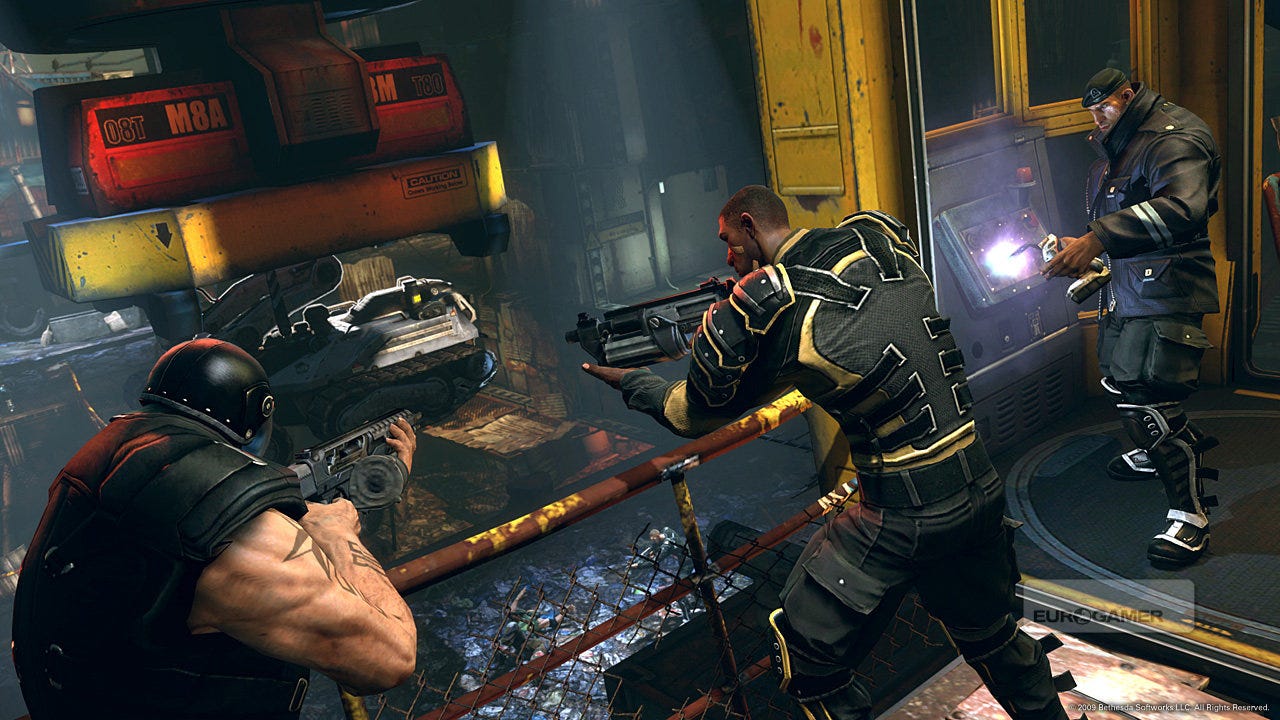
Using the crane achieves your team objective and awards lots of experience, but you'll need your friends to cover you.
Eurogamer: What sort of anti-griefing safeguards?
Paul Wedgwood: We're not going to talk about how it works because people will start thinking about ways to get around it before we even get started, ha! There are a lot of people that buy shooters and only ever play single-player and never even go online - some of them don't even realise there is a multiplayer button and what that's supposed to do or what that experience is supposed to be. It's our goal from the outset to incidentally teach people to be good at multiplayer shooters while they're playing our single-player shooter; to play as part of a coordinated team; to earn rewards for making other people's experience more fun; to outflank the enemy, and things that are going to happen when they play online anyway.
And we have a bunch of other methods from proving their abilities playing Engineer, Medic and so on, not just from grinding XP to make them a more powerful, item-owning character, but actually help their skill improve as an Engineer or Medic. We track that and at a certain point in the game we say to them, "Why don't you just try co-op and see how you go? For this next mission we're going to give you twice the number of experience points if you play co-operatively with somebody else." We're so confident that the players are going to have fun that they'll then want to start playing co-operatively more often.
Eurogamer: How much of a single-player campaign is there for me to explore, what sort of emphasis is there on story? Or is the solo mode more of a training ground for multiplayer?
Paul Wedgwood: No no no: it's massive! Wolfenstein: Enemy Territory was pure multiplayer and Enemy Territory: Quake Wars was a multiplayer game that had offline bots but apart from that was exactly the same game. This is a game that has been built from the outset as a heavily narrative-driven story by full-time writers. We're making use of techniques like performance capturing - so we get really good physical performances from actors along with their facial expressions and voices and their interaction with other actors - to build a game that has a really strong narrative component that isn't just a highly replayable shooter. So that's a big part for us.
Your experience through it, imagining you have no internet connection should, for us to have achieved our goal, be as compelling as any other triple-A shooter.
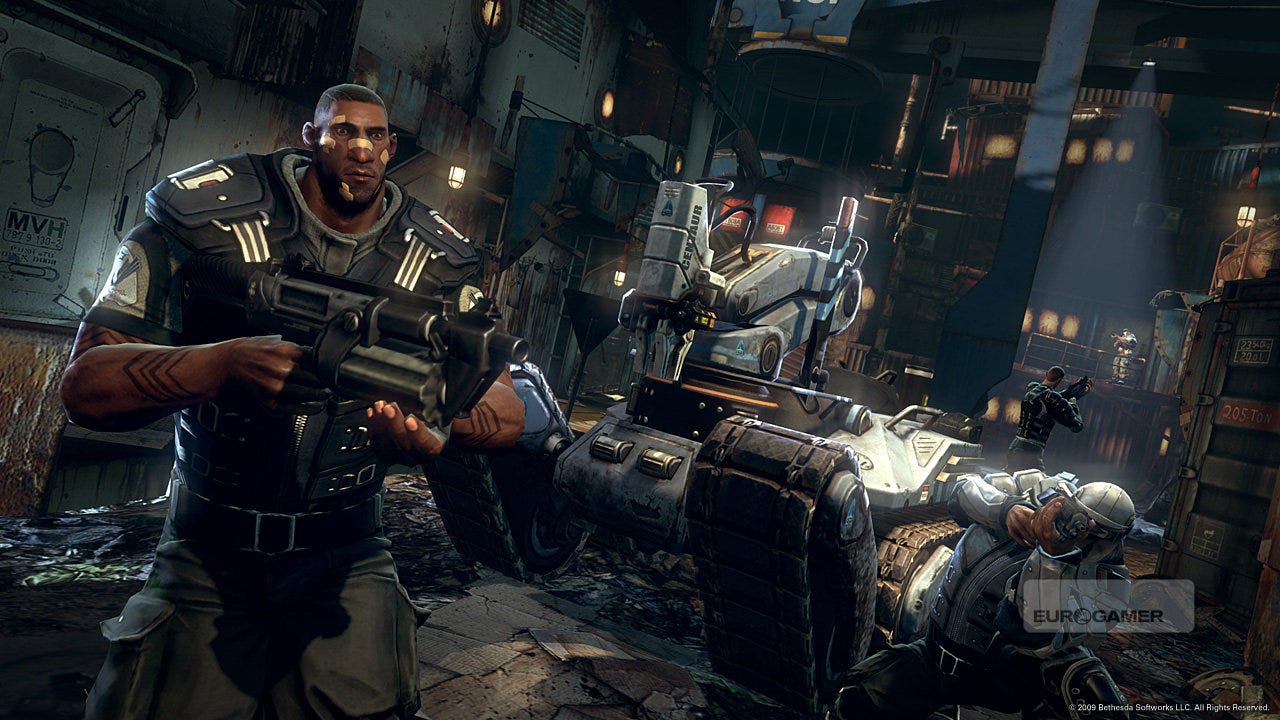
He's absolutely plastered. Sorry.
Eurogamer: To stop veterans being vastly more powerful than newcomers in Brink you've limited active abilities to three. Am I not going to feel hamstrung, assuming I play the game an awful lot, by my character not being more powerful or special than someone who has just bought the game?
Paul Wedgwood: Well in some ways you are [more powerful] because the new player can't specialise and do certain things. For example: the interrogator PDA Taser is one of the items you can buy and it takes up one of three items or tool slots. Tools are things you use on people and items are things you drop in the field for other people. What you do then is you bind those three items. Those items do get more powerful, but they get more powerful in their ability to have fun while you specialise doing something really, really cool.
You can take a route that makes you a really cool meat-shield able to deal massive amounts of damage, but it's not going to outdo somebody who's chosen Skinny, who sneaks up the rafters behind you and stabs you in the back. There are counters. As long as people understand why death or incapacitation occurs and are able to react to it and learn from it then it's the combination of the choice of how to specialise and the skills the player has developed. You can earn more experience points in the game without firing a single shot by playing well than you can simply as a shooter.
Eurogamer: What kind of range of skills are we looking at?
Paul Wedgwood: Certainly dozens; it's a large number. We're pre-alpha so we put things in that we cut. We had a grenade that did a group-revive and it felt over-powered when we playtested so we cut it and may put it back in with some tweaking. We tend to playtest everything without special effects, without all of the art committed, and when we've got something we really enjoy like the heavy explosive charge or interrogation PDA or hacking into doorways or capturing command posts, then we start to focus on the art and special effects for them.
Eurogamer: Brink, as you mentioned, will support dedicated servers. Will those be on both PC and console?
Paul Wedgwood: Certainly for the PC. Our preferred mode of operation is to use dedicated servers, particularly now with more recent versions of Windows they have a somewhat more automated approach to their firewalling, and when a game is full-screen you can't tell that your firewall is or isn't enabled and it's easy for users to get confused by that. Really, peer-to-peer is only something you can do at LAN parties. You really need to have a dedicated server for people who are going to play from a PC and play online.
For consoles, at the moment, we play peer-to-peer and it works.
The game will intelligently navigate obstacles like barriers when you pelt towards them.
Eurogamer: What engine is Brink running on, out of interest?
Paul Wedgwood: We spent around four years co-developing id Tech 4 with id Software, and when id branched off to make id Tech 5 we branched off and started working on Brink. So it's founded on id Tech 4 just like id Tech 5, but does a few things subtly different.
Eurogamer: Will you package your tools for the mod community, given your strong background in that scene?
Paul Wedgwood: Well we have done for all of our games so far; we've always released an advanced SDK. It's a more difficult question to answer now because ZeniMax, who owns Bethesda Softworks, has bought id Software, so it's not just a question of me calling my mate and asking: "Is it alright if I release the source code?"
Eurogamer: Are you saying you would if you could?
Paul Wedgwood: Oh we would absolutely love to - time allowing and everything else - continue supporting the mod community in the way we always have done. Funnily enough, even now, people are still creating levels and mod-making for Wolfenstein: Enemy Territory. Our support forum for Wolfenstein: Enemy Territory is as busy as all our other forums still, today. People can go there and download the SDK and start coding a different game-type. Equally, artists can make low-polygon art and get used to working with skeletons, animating things and the basics without feeling there art doesn't compete with the high-end CG community. And level designers can jump in and start making their house or school as well.
He's like a chunky Iceman.
Eurogamer: What about post-release support for Brink? I realise you can't go into specifics this far off, but is that part of the plan already?
Paul Wedgwood: It is a difficult question to answer because we are so early in development. But our track record is of continuing to support titles. We did a further five updates just for Quake Wars and then quite often we then hand over to the community to continue doing updates and patches and things - we give them the code so they can do that stuff. And we've done that with all of out past titles.
Eurogamer: And what worries you most about Brink as a game at the moment?
Paul Wedgwood: I would say that the biggest challenge is that transition from being a pure PC studio to a multiplatform one. To me as a game director there are some things that are just alien, like PlayStation 3 technology and job systems, that I find it really difficult to get my head around. Luckily it's not my job to understand job systems: we just hire really talented people to solve it instead. We have Dean Calver who was lead programmer on Heavenly Sword as lead programmer on Brink. The art director that we hired, Olivier Leonardi, was the art director behind Prince of Persia [Two Thrones] and Rainbow Six Vegas. We got Tim Appleby back in 2007. He'd just finished Mass Effect; he was the guy who created Shepard and the aliens and stuff. He's our lead character artist.
We've done that pretty much across the company. Even our level designer Neil Alphonso was the lead level designer on Killzone 2. We've really tried to bring in people who all have shipped multiple multiplatform Triple-A games, just because I'm such a noob at that stuff. Hire people who are better than me, which isn't hard.
Paul Wedgwood is CEO of Splash Damage. Brink is due out in spring 2010.
