Silent Hill Origins Preview

The root of all evil.

Do you remember the first time a piece of fiction - a film, a book, a game - made you genuinely, horribly afraid? Everyone is afraid of something, and for each fear there's a fiction which touches precisely on that most primal of instincts, twanging unsettlingly on the strings that make even us hardy grown-ups wonder, just for a moment, if we really are alone in the dark.

In my childhood, for example, there were some brushes with frightening movies. An all-too-young viewing of Arachnophobia managed, ironically, to turn a childhood fascination with creepy-crawlies into a screaming terror of hairy beasties with altogether too many legs which has lasted into my twenties, while The Omen left me with broadly the same response to priests, bishops, organised religion and posh children.

But by the age of about 16, I was pretty much past that; unflappable in the face of the cheap scares and shocks which movies and games of the time could muster. That self-confidence and certainty is probably, in retrospect, a major part of why Silent Hill was such a shot to the gut. Beautiful, disturbing, melancholy, eerie, inexplicable and overwhelmingly terrifying, Silent Hill opened a dreamlike world of nightmares. I slept with the bedside light on for several days, although I could never have told you exactly why.

That was the first time Silent Hill scared me. The most recent incident was very different - about as different as you can imagine, really. It took place on a train to Portsmouth on one of those astonishingly wet July mornings we've been having of late. I was on my way to see the next instalment in the series, Silent Hill Origins, at developer Climax' studio near the harbour - and the fear? Simple. I was afraid that the game I was about to see would be really, really bad.

You're Not Here
1

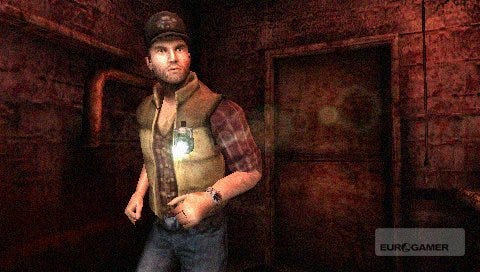
Truck-driving Travis is the reluctant protagonist of Origins. Despite his attire, we suspect deeply that there's more to him than a Yorkie-chomping stereotype.

Now, on one level, it's the job of the journalist to be a cynic - but I'll confess to approaching Origins with something less than the full proportion of professional detachment. This is the first Silent Hill to be developed outside Konami's Japanese studios, eight time-zones and half a world away from the hive mind at Team Silent. On top of that, the game has had a rather interesting development history - a history patchy enough to give any Silent Hill fan a furrowed brow.

Originally envisaged as a remake of the first Silent Hill game for the PSP, and designed to tie in with the Christophe Gans helmed movie, Origins later became an entirely new game set seven years before the events of Silent Hill. Early glimpses, however, suggested that the game would be more heavily action focused than its predecessors. A Resident Evil 4 style over-shoulder camera was revealed in screenshots, and it was strongly hinted that the core gameplay would be much more physical and combat-centric than Silent Hill fans are accustomed to.

It sounded, in other words, like the very basis of what makes people love Silent Hill had been overlooked. Silent Hill isn't about fighting monsters. It's about the oppressive atmosphere, the sense of being near-helpless in the face of vast, incomprehensible forces, the beautifully composed characters sketched across understated, perfectly formed stories.

Development shifted around. Rumours of mismanaged schedules flew as the original team was disbanded, and the project crossed the Atlantic and landed in Portsmouth. The Resident Evil 4 influenced camera angle is gone; Silent Hill Origins has, fittingly, returned to Silent Hill's origins. But with talk of such a troubled path through development running around my head, I was steeled for disappointment.
2

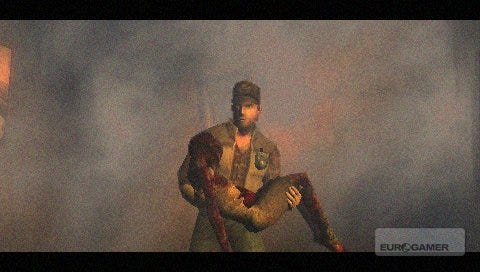
The prologue level sees you rescuing a hideously burned but still breathing young girl from some kind of sacrificial ritual.

In retrospect, I should have had a little more faith - in the capacity of talented developers to learn bloody quickly, if nothing else. The team in Portsmouth working on Silent Hill Origins has already seen one team of fellow developers try to turn the franchise into an action game, and watched them being broken mercilessly upon the harsh rocks of fan response. It would be disingenuous to suggest that the outcry at Origins' early public airings directly led to the abandonment of the US team's efforts; it would be equally disingenuous, we suspect, to suggest that it had no bearing whatsoever on the decision.

As a result, the team in Portsmouth oozes respect for the Silent Hill franchise from every pore. Team Silent, strongly rumoured to be beavering away in Japan on Silent Hill 5, were carefully consulted about keeping the story canonical - "somewhere, deep in the heart of Konami's headquarters in Japan, there's a book entirely bound in human skin which contains the entire storyline of Silent Hill," jokes game director Mark Simmons. ("I thought it was split into 30 pieces and tattooed on the bodies of 30 different men," responds producer William Oertel.)

Perhaps more importantly, the team have also consulted deeply with the most important reference of all - the previous games in the franchise. In doing so, they have dragged the game right back to the basics of how Silent Hill works, and why we love it. Rather than innovation for the sake of innovation (or innovation for the sake of hanging off Capcom's coat-tails), the build of Silent Hill Origins we got to play showed off more subtle, welcome innovation - much of it focused on making Silent Hill work on a handheld, rather than on trying to fix unbroken game mechanics.

"It doesn't matter who I am..."

Yes, that's right - we got to play the game. In fact, we played through roughly the first half hour of Origins, a sequence which introduces the central character, long-distance truck driver Travis O'Grady, and then introduces much of the mystery of Silent Hill itself. In a lengthy and largely interactive intro sequence, Travis is forced to brake hard on a road near Silent Hill when a girl seems to run out in front of his truck. Climbing down from the cab, he sees her run off into the distance (while players are treated to an incredibly creepy shot of her watching him through his rear-view mirror), and runs after her.

You quickly come upon a burning house, and upon navigating it, find the incredibly badly burnt body of a young girl laid out in a ritualistic circle in an upper room - badly burnt, but seemingly still alive. Taking her in your arms, you run out of the house... And promptly pass out, only to wake up on a bench in Silent Hill, surrounded by a thick, creeping fog.

From here on in, we played through the first part of the Hospital area, which is one of the core parts of the game. Progression takes its lead strongly from other Silent Hill titles, with each major building having a map that you fill in with penned annotations as you move through, and a wide variety of somewhat surreal locked-door puzzles to complete in order to progress. In the hospital, for example, we found ourselves collecting the ages of nurses from graffiti on the walls in order to unlock a medical chest, retrieving from it a plastic heart which could be replaced in an anatomical model...

3

Mirrors provide a view of the Otherworld - and a way to cross over the boundary between realities.

You get the idea. It's solid, enjoyable Silent Hill fare, the sort of puzzles which focus largely on doors and improbably hidden keys. However, Origins has a unique twist up its sleeve, which is revealed early on when you walk into a room with a mirrored wall, and realise that something isn't quite right about the reflection in the mirror...

Silent Hill has always featured the concept of the "Otherworld", a hideous, twisted world of rust, decay and ruin; however, previously access to this alternate world has generally been through plot developments. Origins, however, allows Travis to move between worlds at will whenever he encounters a mirror; by touching the mirror, he moves to the other world. This is essential for solving many puzzles, as the layout of buildings remains broadly the same, but doors may be locked in one reality and unlocked in the other, passages blocked in one but accessible in the other.

In terms of combat, some echoes of the game's one-time obsession with action remain. Travis can pick up a very wide range of items to use as weapons - nowhere near the scale of a game like Dead Rising, but according to Simmons, there are about 50 items in the game which can be used as weapons. These range from guns, knives and swords through to bottles of acid or portable televisions, which can be smashed into enemies for single-shot, high damage attacks.

Where previous Silent Hill games relied on unresponsive, somewhat clumsy combat to emphasise your vulnerability and build tension, Origins has taken a somewhat different tack. Travis is a burly truck driver, and can handle himself to some extent - so combat is a little more responsive and brutal than in other games.

4

Yes, it has zombie nurses. Stiletto clad zombie nurses. We know someone who thinks they're incredibly hot. Go figure.

However, this is still no RE4. Monsters who get close to you can grab you and engage in an often horrifying grapple move - a chance, Oertel tells us, to get the player really up close with the hideously disturbing monsters in the game and really freak them out. Even getting a great weapon won't make you invincible; like SH4, the game features a health gauge for weapons. Use them too long, and they'll break, which adds a real note of tension to fights in the game. To top it off, the old SH strategy of legging it past monsters won't always work; some of them move faster than you do, now. Travis may be a tougher cookie than previous SH protagonists, but this is a million miles from the shooting gallery game many feared; the old Silent Hill tension is never far away.

Where much of the development team's efforts have been concentrated is on making Silent Hill work on the PSP. At first, a horror game on a handheld seems like a strange decision - however, Oertel says that the design was inspired by the acknowledgement of how involving and immersive reading a horror paperback can be. "When you're sitting there, in bed, in your room, playing this game - it's an intensely personal experience, much more immersive in some ways than being in your living room with a TV across the room from you," he explains.

"...I'm here for you. See?"

As such, the team doesn't feel that the PSP is a limiting platform - but it's certainly one that brings unique challenges. Previously, Silent Hill games relayed a lot of information to the player through rumble or audio feedback. Neither of those channels can be relied upon on the PSP, so now the game uses subtle visual cues in their place. The heart-beat vibrations which indicated low health are replaced by a red pulsing glow at the screen edges, while the radio noise which scared the crap out of a generation of videogamers by telling us when enemies are nearby has been supplemented with a cool, flickery, aged-film effect on screen.

Moreover, while the team would love for everyone to experience the game curled up in their bed in the dark, with the sound up full, they know that not everyone plays handheld games like that. Silent Hill has traditionally been a very dark game, which wouldn't work terribly well for those playing outdoors or on brightly lit public transport. For those people, the team has created a gamma slider entirely independent of the PSP's own brightness controls, which should mean that everyone can set the screen to a level which they can see easily.

In pure technical terms, Silent Hill Origins is something of a marvel. It looks better than its predecessors on the PlayStation 2, with detailed player and monster models, gorgeously realised environments and lovely atmospheric effects on the thick, realistic fog which pervades the town. Of particular note is the player's torch, which casts fully realistic shadows off every object in the world - an amazing achievement given the PSP's graphics power. This is especially eerie when fighting enemies, as their huge shadows are projected onto the walls behind them while you bludgeon them into submission.

5

The Otherworld - unpleasant, we'll grant you, but still preferable to most kitchens and bathrooms in student flats.

In audio terms, too, Origins looks set to live up to the high standards set by its predecessors. One of the only members of Team Silent to be fully involved in Origins' development is legendary composer Akira Yamaoka, whose compositions have given the previous games (and indeed the movie) much of their atmosphere. He wrote the full soundtrack for Origins, and it is backed up with some superb sound direction which emphasises uneasy, discordant noise in different parts of the game we visited, fully leveraging the possibilities of using sound to make the player very, very uncomfortable with the environment.

Memories of Alessa

All of which is, I'm absolutely delighted to report, vastly more positive than I could ever have dared to expect. On all of those fronts, the dedication of the team to respecting the Silent Hill formula is paying off in spades, and the game we got to play in Portsmouth is unquestionably a fine Silent Hill game in almost every regard. Indeed, on the basis of gameplay and atmosphere alone, Origins seems far more comfortable with its place in the franchise than the retrofitted spin-off Silent Hill 4 was - a great achievement given that it has been entirely crafted by an external team.

There remains, however, one vast, looming question - one which cannot be answered by half an hour of playtime. Silent Hill lives or dies, to a large extent, on the basis of its story and characters. While Origins is confirmed to fit in a "watertight" way with the Silent Hill canon, checked and double checked past Team Silent's own Necronomicon of storyline, that's no actual guarantee of a compelling ride through the game's ten hours.

6

The lengths the undead will go to to try and find a nice orthopaedic bed...

However, the noises coming out of the team in Portsmouth on this front are nothing if not encouraging. Set seven years before the events of the first Silent Hill (fans of the series may go "ohhhh!" at this point, if you wish), the game explores what happened to the crucial character of Alessa before the first game - and the protagonist, Travis, also seems to be a complex character, whose own private demons are likely to be behind his entanglement in the whole mess.

More importantly than simple plot details, however, Oertel, Simmons and the rest of the design team seem to keenly understand how Silent Hill works. Simmons, with whom the storytelling responsibility lies, reels off Team Silent's favoured influences - David Lynch, Jacob's Ladder, Stephen King, and the list goes on - and opines that while the British team may bring a slightly different flavour to the game, the British sense for horror and storytelling is surprisingly close to Japanese sensibilities in many ways.

His goal, he says, was to combine Silent Hill 1's cult story with Silent Hill 2's emotional, personal journey - a match which sounds like music to our ears. Strange, discordant music, filled with uncomfortable trills and difficult sounds; the sort of music Akira Yamaoka uses to bring a sad, melancholy little town in the American mid-west to life in a haunting, tragic way. Some doubts may linger, but by and large we're trapped in the dream all over again. Something is calling us back to Silent Hill - and we can't wait for our next visit.

Comments (39)

Comments for this article are now closed, but please feel free to continue chatting on the forum!

  • Loading...hold tight!