Sid Meier's Civilization Revolution Review

Reinventing the wheel.

Version tested:

Hopefully yesterday's surprise announcement of Civilization IV: Colonization has quietened strategy gamers' hysteria that this cartoonish, slimline version of Sid Meier's favourite (or at least most lucrative) son might be the long-running series' only future. You don't get much more niche than an out-of-the-blue sequel to a 1994 turn-based PC game about trading rum between America and Europe, after all.

Well, hey. Already I'm probably confusing people who don't know much about Civ. In fact, over two previews, I've talked about how Civ Rev feels, and about how this console rethink differs from more than a decade of PC Civilizations, but what I haven't done is say how it's played. So, for total newcomers, let's take it from the top.

Civilization is all about tribalism. It begins with the most barbaric aspect of that (quite literally, hairy blokes with wooden clubs hitting other hairy blokes with wooden clubs) and ends with its other extreme - asserting your tribe's dominance over others through technology, culture, commerce or military might. In other words, you pick a nation and progress it from cave-dwellers all the way to factories and tanks.

To do this, you explore the world, you research new scientific advances, you found and improve cities, you shake hands with foreign dignitaries - or you wave your clubs/swords/lances/rifles/machineguns/nukes at anyone who stands in your way. It's all turn-based, your puppet-like armies marching across the land square-by-square, and a raft of numbers gradually raising and lowering - ideally the former. There's honestly no reason for it to be otherwise. You need that time and headspace to choose what you want each of your cities to be building, to decide whether invading Norwich is a smart move or not, and to prepare yourself in the event that an army of Zulu cannons starts rolling your way. You'll win because you think better, not because you react faster.
1

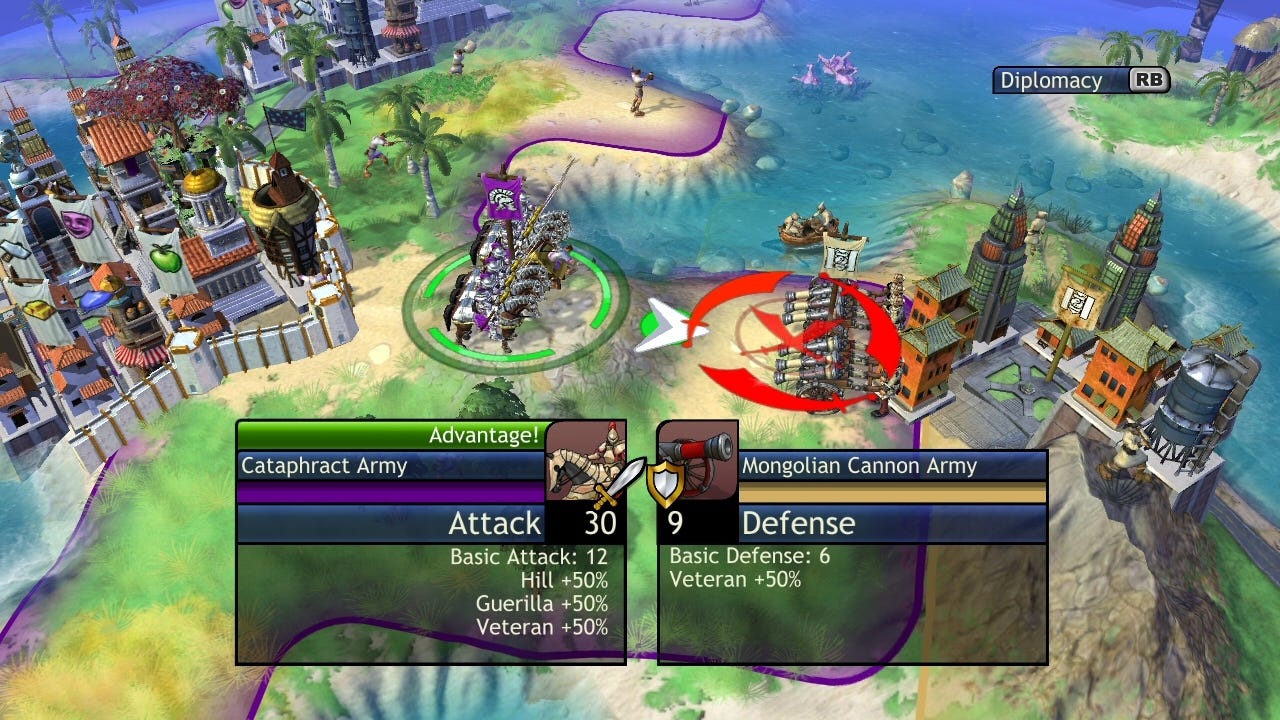
Combat maths is a little off - invisible dice-rolls play a part, despite the Top Trumps presentation of units' stats.

Me, I tend to be a pacifist in these things. Given the choice, I'd rather head to a quiet corner of the planet, get my head down and build an empire off my own back - not by greedily seizing land and coin from others. Civ Rev thus takes some getting used to. It's simply not possible to play it like that. This is inescapably a competitive game - one in which you're nose-to-nose with your rivals at all times. If you're doing well, your rival nations - each as determined to rule this tile-based world as you are - will constantly threaten you with annihilation if you don't relinquish your treasures.

The demands start small, but grow to unreasonable with alarming speed. No, Ghandi, you can't have 500 gold. No, Queen Elizabeth, I'm not going to give you the secrets of steam power. No matter how placid I try to act - will 200g be enough to satisfy the bloke in the nappy? Would Currency keep Queenie quiet? - it'll come down to capitulation or war soon enough. I've played a couple of dozen games of Civ Rev now, but there hasn't been a single one in which I haven't ended up having a barney with a hysterical neighbour or three. In most, I've usually ended up actively wiping out other Civs just to keep them from my own door.
2

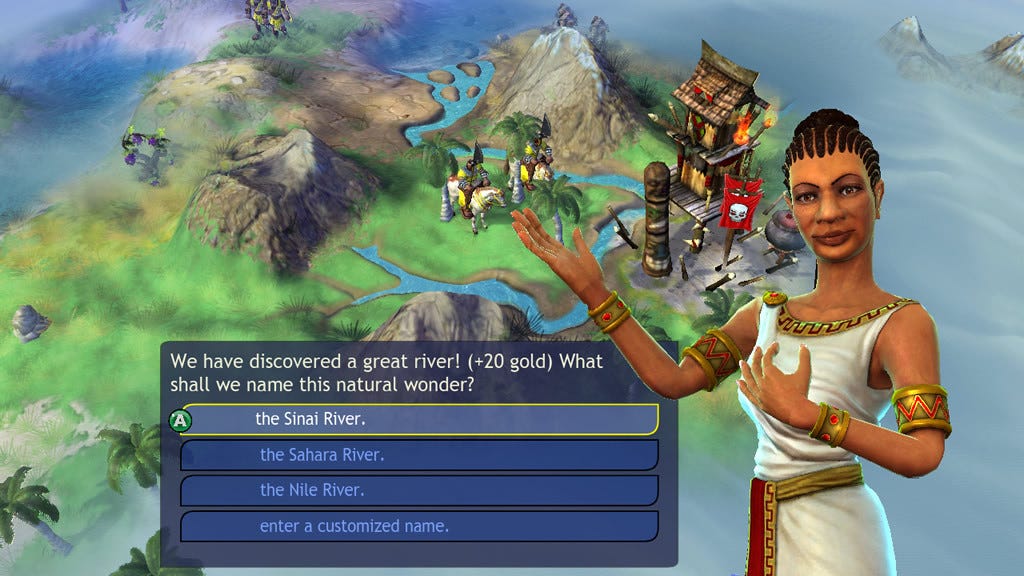
A lot of work's gone into the character models, but generally you're so focused on your situation that you just push them off-screen immediately.

Because that's the thing. You can't play Civ Rev like Civ. The underlying systems are the same, if hugely (and at times brutally) simplified, but where its PC siblings could, to a certain extent, be played at your own pace, this sticks army ants in your bed. If you try to sleep, you'll be eaten alive. It keeps moving at all times, and if you don't move with it you won't get anywhere. That said, the lowest couple of difficulty settings are almost hilariously forgiving, but you'll very quickly want to graduate to a more challenging one. Even if you're specifically aiming for an economic, cultural or technological victory, be prepared to shed some blood along the way.

While I miss the option for subtlety, this pushiness makes perfect sense, and is really the only way to ensure a match comes to a satisfying conclusion within a couple of hours. It's also a smart move for a game that may struggle to entice a brand new crowd. Offending existing Civ fans (and it will - the angrier, snobbier ones at least) by throwing too many nuance-babies out with the bathwater is one thing. Being perceived as too stuffy, too slow, too turn-based strategy by the mainstream console crowd - now that would be disastrous.

That's why it's so fast, that's why there's so much emphasis on combat, that's why trade and diplomacy are all but absent. This isn't 'dumbed-down', as is the knee-jerk protestation of elitists, but there's no escaping that it's been made for a completely different audience to the usual Civ crowd. My concern is that its audience doesn't in fact exist, that it's an unnatural middle-ground between veteran Civ players and folk who run screaming from the very concept.

It's not stupid. There's plenty to think about, and you're viscerally rewarded for doing so. Often, I started feeling sorry for my rivals as, faced with a tank army smashing through their hopeless horsemen, they begged and begged me to let them live, pathetically offering up the last scraps of gold they had. If anything, there's far more focus on having a master plan from the very start than in the bigger Civs. The world is small and your rivals few but ever-present. If you don't have some idea of how you're intending to deal with them, you won't get anywhere. You'll learn the interface, you'll memorise the rock-paper-scissors of which units are best against which units, you'll twig that you need to manually shift cities' economies to focus on growth, production, science or cash as the situation requires.

And you'll learn this only by having an attentive mind over the course of several games. It's not stupid. For a lot of people, it may not be stupid enough, even.

3

The early game is spent picking on aggressive but puny barbarian villages - a good source of unit experience and bonus cash.

Which is a little at odds with Civ Rev's biggest failing. As I suspected in the last preview, the game's too small. It's not 'too small compared to Civ IV'; it's just too small. While becoming really good at the game will take some time, the array of possible options and outcomes are almost all revealed after just two or three 1-3 hour sessions. You'll have researched every technology, built every unit, achieved every type of victory and conceived of every strategy. It does what it does do very well, with cheer, with accessibility and really very prettily, which is why discovering that, upon feeling you've gotten your head around it, there isn't much left to experiment with is so disappointing. It's the pop song that ends after 90 seconds - being an eight-minute epic would surely rob the joy from it, but dancing your heart out to just one more chorus would have made all the difference.

Which does, however, makes it ideally suited to multiplayer. Truly, this is a Civ you can play post-pub or pre-dinner, absolutely confident that the whole thing will wrap up before booze-oblivion or gnawing hunger calls an abrupt end to things. While alliances are possible, really you're playing it like a boardgame - you want to win, and so do the people you're playing with. You'll be in each other's faces all the time, and so Civ Rev's slimness simply won't matter - you'll want to make immediate response to their threats/lies/vulnerabilities, not to lose the sense of clear and present danger because you're lost in a sub-sub-sub-menu about city hygiene or something.

4

Each different Civ has different bonus abilities, like super-catapults or, uh, half-price roads.

And so I reach the big number at the bottom, and it's one I don't enjoy putting there. This is easily one of the best strategy games on the current console generation, and much of that is specifically because it is a strategy game for console, not simply a PC strategy game on a console. I'd love for a great many people to play it, including those who've immediately decided they won't because it's about history and numbers. If I stuck a 9 on the bottom, perhaps some of them would.

Unfortunately, I'd be lying, as the many punches Civ Rev pulls means its exhilaration is so often followed by slight dissatisfaction. An 8 may not be enough to convince cynical minds to suck it and see, which is a terrible shame. This slick new Civilization may be more reduction than Revolution, but it's easily one of the most distinctive games on 360 and PS3. I can't see myself playing much more of the single-player, but I genuinely cannot wait to war over landmass with a few like-minded chums.

8 / 10

Read the Eurogamer.net scoring policy

Comments (120)

Comments for this article are now closed, but please feel free to continue chatting on the forum!

  • Loading...hold tight!