Rolando Review
Starring roll.
Version tested: iPhone
Rolando may have a lot in common with LocoRoco - simple, colourful graphics free from outlines and textures, smiling, charismatic blobs and tilt-based controls - but it's a forgivably cynical way to catch the attention of App Store browsers; a split-second sales-pitch in a market where pixels and prose are at a premium. As a strategy it's not without risk, either: LocoRoco is a fond memory, and tarnishing it would imperil the goodwill ngmoco has built up with its cheap and cheerful catalogue of early releases. Ultimately it's shrewd, if slightly disappointing, because Rolando is its own game, among the best the iPhone has to offer, and would still have been had the developer, HandCircus, come up with its own signature visuals.
The first and most obvious distinction between Rolando and LocoRoco is that rolandos only react to players tilting the screen once they have been selected, either individually with a tap or as a group with a drag-box. Otherwise they stand still, immune to your input. Once under your control, they can be made to jump by an upward flick of the thumb, or deselected with a quick tap on an empty part of the screen, and this brings them to a near-instant standstill. Immediately Rolando overcomes one of LocoRoco's biggest issues - regularly losing control of disparate blobs and suffering the consequences - and shows similar restraint in its economical use of the iPhone touch-screen.
The goal is still to transport as many of the creatures under your control to the end as possible, but levels are short, and split up further still by state-saving checkpoint balloons, while rolando-killing enemies are set on specific repeating movement paths, and don't roam off-course looking for a frustrating fight, like LocoRoco's Mojas. The tilt controls are also precisely calibrated: rolandos take a split second to speed up, and there's an appreciable deadzone to soften the initial lurch. Staying in control and out of trouble is in your hands, but supported by HandCircus, and it's hard not to conclude that Rolando's developers weren't just conscious of the tilt-and-touch control system's potential imprecision, but obsessed with it.
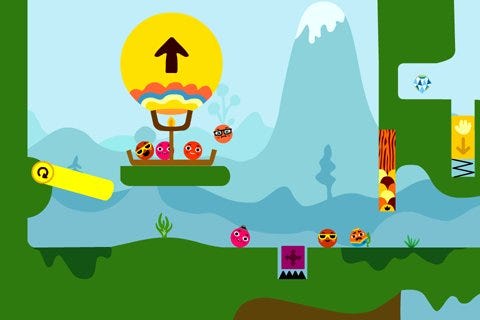
Finger-operated mechanisms can be used to redirect light beams in concert with rolandos manoeuvring bombs to solve larger puzzles.
Whether because of that or in spite of it, they have created a manageably paced and well-considered puzzle game rather than a network of rail-riding rollercoasters, aerial displays and unlockables. The first thing you do upon starting most levels is not barrel to the right, but place two fingers on the screen to drag the camera around to take in your surroundings, before deciding how to proceed through the generally non-linear layout. A measured approach is often more important than reflexes and guile.
For instance, you may have to use a spiky commando - a particular kind of rolando that can cling to any surface - to climb to an elevated switch, or retrieve a block to fill in a hazardous spike pit, before moving other rolandos through to safety. These may include rolando royalty, like the energetic prince, who races away on his own until he hits a wall and turns back, and needs to be buffered by rolando civilians to negotiate moving platforms and roll past dangling enemies.
There's also the sleeping, double-size king, who takes at least two rolandos to push over minor inclines and divots, and another one to halt him. The number of rolandos involved - or rather, that you need to involve - for individual tasks varies, but any left behind hold their ground and can be brought in to assist, or transported to the goal separately, by tapping their icon in the corner of the screen to re-centre the camera, and then selecting them and moving out. The number available rarely reaches half-a-dozen.
Yet levels quickly become more elaborate in other ways. There are bombs, which you dispense from a chute by tapping a red button above it, and these are used to blow away cracked-rock obstructions, but often only after you've positioned a rolando to bounce them out of the dispenser in the desired direction, or, more perilously, by pushing them directly and then getting out of the way. There are doors controlled by pressure switches, and pulleys, and numerous gizmos that you operate with your finger - bridges that you draw out of thin air from fixed points, catapults, conveyor belts, springboards, platforms, fans, and cross-shapes and flaps to rotate and draw back to let rolandos past.
Most, if not all of these elements have been seen before, but it's the manner of their composition that singles Rolando out. The combination of multiple rolandos, which only come to life once selected, and familiar platform puzzle architecture are superbly complemented by sympathetic, self-conscious construction. HandCircus also strips things back now and then to change the pace. Bonus levels give you 360-degree rotational control to drop a tumbling king solo through mazes, reminiscent of Cameltry, while other levels set the prince free and rely on your input to shift blockades in time with his movement.

Rolandos often have to be released from cages to join in and play their role, but it pays to think about the order you release them.
Sadly though, having built up a strong foundation of slow and meticulous going, later levels become too condensed and fiddly, and jumping can be thrown off when the game reads an upward flick as an attempt to control a nearby platform or spring, while platform sequences necessitate too much repetition; manoeuvring rolandos through networks of tunnels one by one to avoid hazards. There also isn't that much incentive to revisit the game on completion, with rather drab time-attack and gem-collection sub-objectives. Having paid so much attention to how LocoRoco looks, HandCircus might also have spent time considering the reward system and spin-off mini-games that made the second PSP release stand out.
For the most part, though, Rolando demonstrates a powerful command of the iPhone's strengths and weaknesses. Apple was always confident that iPhone games would reach a level of quality comparable to the best of DS and PSP, despite the absence of an established first-party studio to set the pace, and this is the strongest evidence yet that Steve Jobs and friends were right. Rolando is derivative, but no less essential for this, and the attention to technical detail is often exemplary.
8 / 10
Rolando is available now from the iTunes App Store for GBP 5.99.
You may also like...
-
Mass Effect 3 Demo: The First 20 Minutes
-
Face-Off: Final Fantasy 13-2
-
Retrospective: Star Wars Episode I Racer
-
Why Devs Owe You Nothing
-
Digital Foundry: PS3 Skyrim Lag Fixed?
-
Game of the Week: Catherine
-
Who Killed Rare?
-
Gotham City Impostors Review
-
App of the Day: Ascension: Chronicle of the Godslayer
-
Face-Off: The Darkness 2
-
Kingdoms of Amalur: Reckoning Review
-
Epic's Sweeney on graphics tech: "the limit really is in sight"
-
The Darkness 2 Review
-
EA evaluating FIFA Street features for FIFA 13
-
Grand Slam Tennis 2 Review
-
Ultimate Marvel vs. Capcom 3 Vita Review
-
One Piece: Unlimited Cruise SP Review
-
App of the Day: Sir Benfro's Brilliant Balloon
-
Catherine Review
-
King Arthur 2 Review
-
Sony admits "dropping the ball" with Demon's Souls
-
Skyrim patch 1.4 now live for Xbox 360
-
Metal Gear Solid: The "Lost" HD Remasters
-
Mass Effect 3 FemShep trailer debuts
-
Skyrim patch 1.4 performance tip: make a new manual save


Comments (35) Latest comment 3 years ago
Comments threads automatically close after 30 days, but please feel free to continue chatting on the forum!
Comment below viewing threshold Show
BTW great review
BTW2 the iPhone has turned out to be a pretty powerful beast, working on it right now and I like the hardware (although Objective C is a strange beast when you come from C++).
Comment below viewing threshold Show
Nevertheless, a lovely game with production values to rival shelf store titles. The App Store really is getting crowded with some super games!
Comment below viewing threshold Show
Bloody hell, most of the challenge for players of LocoRoco is getting to the end with all your guys intact. Being able to select the ones you wish to move kinda makes it a bit easy doesn't it?
I would have marked it down for blatently not having the imagination to come up its own design asthetic.
Comment below viewing threshold Show
Well, yes, but seeing as this game isn't LocoRoco, it has a whole different set of mechanics to create and manage challenge, risk and reward. I frequently fail to get everyone home; it's a much more hostile environment than the PSP game.
Comment below viewing threshold Show
"although Objective C is a strange beast when you come from C++"
Not so much when you realise you can include C++ inside Objective C
Comment below viewing threshold Show
P.s. Bloody hope so, am making stuff for it right now
Edit: Oops!
- (void)dealloc {
[super dealloc];
}
Comment below viewing threshold Show
Or is that only when its teh M$ and not teh Appl£?
What score do you reckon theyd have give it if it were MS who released it on LIVE? I say 5 or 6 at best.
Comment below viewing threshold Show
Because you can. You still need an Obj-C entry point and whatnot but your friendly neighbourhood Obj-C compiler should be able to compile C++ in with the rest of the code. When I've ported games from Windows to MacOS in the past that's how I did it. You can use the Obj-C and Cocoa side of things to integrate with the OS but then the main game code can be C++.
EDIT: I should point out that it's technically Objective-C++ but I've never had any problems with it.
MORE EDIT: Just done a quick search in the MacOS Developer Guide and found this...
[link url=http://books.googl e.co.uk/books?id=XJ-BVuQfitAC&pg=PA107&dq=integrate+c%2B%2B+ with+objective+c
]http://bo oks.google.co.uk/books?id=XJ-BV...[/link]
Also, you might want to download OGRE for MacOS because all the example code does exactly what I was describing above.
Comment below viewing threshold Show
Better than locoroco which i almost find too japanese for its own good.
looking forward to an EDGE review, that game is now my current fav
Comment below viewing threshold Show
Thta's what I mean, see, sounds way better already.
Comment below viewing threshold Show
yeah i know i stealth read a copy in my newsagents the otherday
i actually meant the game EDGE, available on the app store, check it out , well worth it and got a lovely retro feel
Comment below viewing threshold Show
As for Rolando's battery life, I finished it in two days off two charges on a newish iPhone 3G, but I'd been doing other stuff as well. I've seen games that drain it much sooner.
Comment below viewing threshold Show
Monopoly (currently £3) is a steal for anyone who enjoys the game and wondered how well it was done. Resumable single player with 4 player via the iPhone and with bots who bid at auctions and even counter bid. 3D tables with animated pieces and very stable (no crashes so far). Even has resumable wifi games.