Resistance: Fall of Man
Tripped up by his own lack of ambition, no doubt.

Down the years, Insomniac's games have always had the same effect on me. Initially they've always felt quite underwhelming. Generic, even. But the numerous Ratchet & Clank games all had that crucial ability to get their claws into you via great level design and an array of completely ludicrous weapons. Far from being by-the-numbers platform romps, they had absolutely wonderful combat where your strategy was defined by your choice of weaponry; which ones you chose to upgrade and how you chose to use them. Over the course of the series, I'd go as far as saying they were among the most consistently entertaining games of the past five years.
With this in mind, I almost expected to Resistance to be similarly slow-burning and not to be the easiest game to appreciate from the outset.
Well, I was half right.
Indeed, Resistance isn't the easiest game to get into. By all accounts it really does adhere to every lazy description you might have read about it. It really does - sigh - feel like Call of Duty with aliens. Stupid spiny reptilian creatures with sharp teeth, flinty eyes and red pipes sticking out of their coolant garb. 'Stupid' in that they shuffle obligingly from side to side, fire in a scattershot fashion and display anything but 'next generation' intelligence, whatever the hell that's supposed to translate into.
Meet my friend, whatshisname
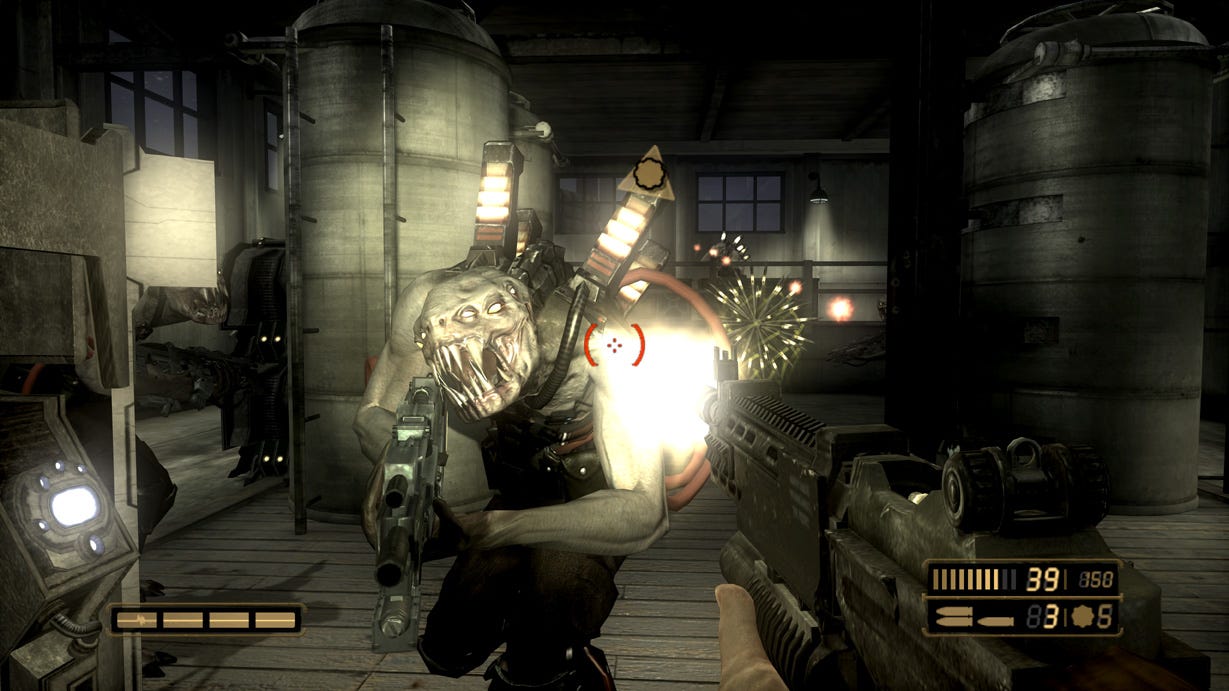
And just like any of the gazillion 'cinematic' WW2 games produced over the years, the game populates the scene with dozens of anonymous squad-mates that charge into battle, only to get mown down and airbrushed from the scenery in a matter of seconds. It's supposed to add that essential chaotic intensity of battle, but you won't care when the 400th hapless squaddie gets raked with Chimeran fire. You've seen it all before. You know how this plays out.
For the first hour or so, it's hard to tell whether Resistance does anything different whatsoever. For all the world, it's yet another linear, set-piece driven first-person shooter, with corridors to funnel you down very prescribed routes, populated with manageable clusters of identical enemies who display depressingly little flair in their combat tactics beyond 'duck, shoot, peek out, shoot, lob grenade, repeat' until death. No flanking, no teamwork, no alarms, no surprises.
The main surprise that hits you early on is how unforgiving the first level is. With no health packs lying around, and good old fashioned health that - gasp - doesn't recharge, you're tasked with guiding Nathan Hale to safety with only a sharp aim and careful avoidance of enemy fire. No cheating recharging health or overly forgiving checkpointing here, sir. The first few levels remind you what shooters used to be like before publishers got fed up with us whining about games being too tough and implemented all of the above. And then, of course, having toughened you up with some brutal reality, Insomniac caves and shoehorns a means of giving you regenerating health anyway.
Wanted: recharging enthusiasm
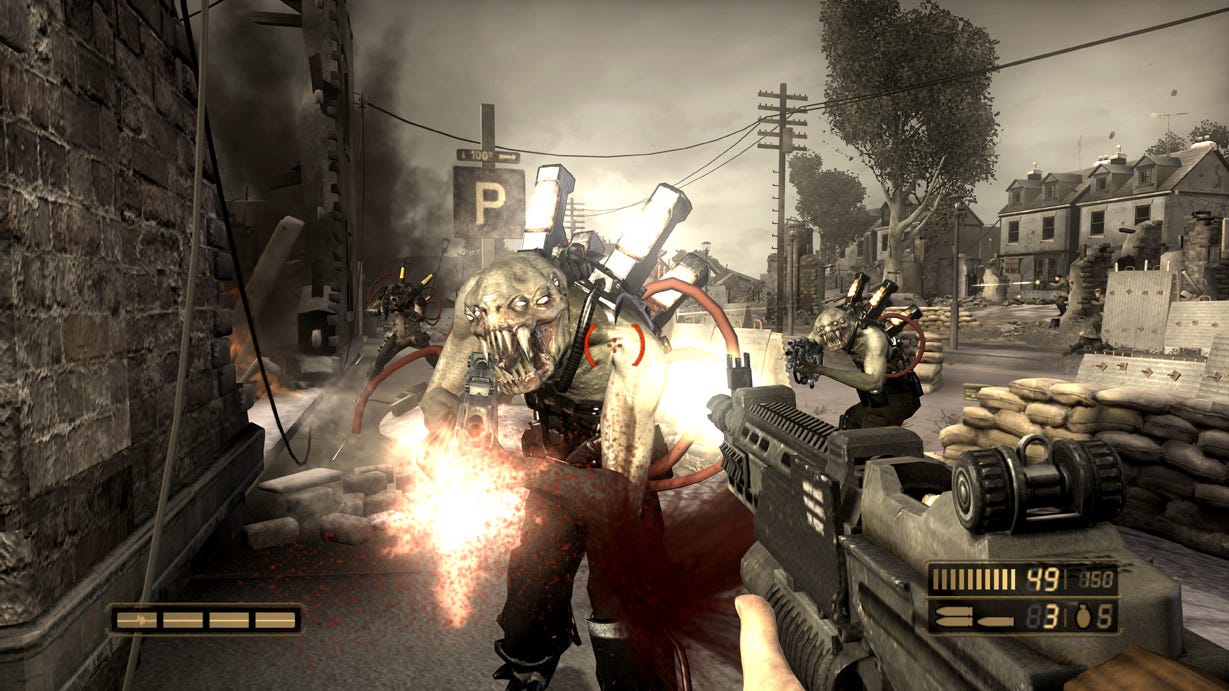
At a stroke, Resistance reverts to FPS type, where little actual combat skill is required to blitz through the game in about 10 or 12 hours on normal. Like every shooter from Halo onwards, it simply reduces the task at hand to observing when you're about to lose a unit of health and making sure you duck back into cover whenever it's looking a bit dicey. In between, you're given the freedom to wander into the open, fire a few well-placed pot-shots and dive back to get your health back. It solves the frustration of having to be genuinely good at the game, but means the game - like most shooters these days - lacks tension almost throughout.
And even when things are hanging on a slender thread and you're skipping between cover points with one unit of health left, you can generally rely on discarded health packs all over the battlefield. All that's required of you is to diligently backtrack, gather them up and resume the battle fully replenished. Like so many regulation, unambitious shooters, at no stage will the enemy consider chasing you down as you frantically retreat. They just sit waiting at their spawn point, ducking and firing, ducking and firing. If we hadn't seen this sort of braindead enemy AI behaviour about eight thousand times before, we might be more pumped about it. Does it matter that this is on a PS3? Well, yes. It's a machine that's inordinately more powerful, therefore ought to be capable of throwing a few surprises at us. Should we let the game off because it's a first generation PS3 title? A little, but not much. As we said before, Insomniac is capable of making games with excellent combat and imaginative weaponry in them. That's the very least we'd expect from Ted Price and his team for a flagship first party release. A lot of what we're complaining about, in terms of the core gameplay, would have been an issue three years ago.
Just a little more environmental imagination would have made a lot of difference too, but we're talking about a game where the most you can expect is that your cover points will get blown apart. No matter how rickety a building looks, or how temporary a particular shelter might look, you could fire a shell from a tank and not even make a dent. Likewise, when all hell is breaking loose and you're standing in a building that's barely upright, how ridiculous to see that you're entirely safe from an onslaught of rocket fire if you just duck down behind a rickety brick wall. "Ground breaking" would actually be quite nice in this case. It might force us, and our enemies, to be a little more dynamic in the way we play. Instead, what we're faced with is the same old show, playing to the same old rules. For some that might be enough, and in most senses Resistance is no worse an offender than any other number of games of this ilk, but wherever you look it conforms to the standard unreality that we're all used to.
The Price of being first
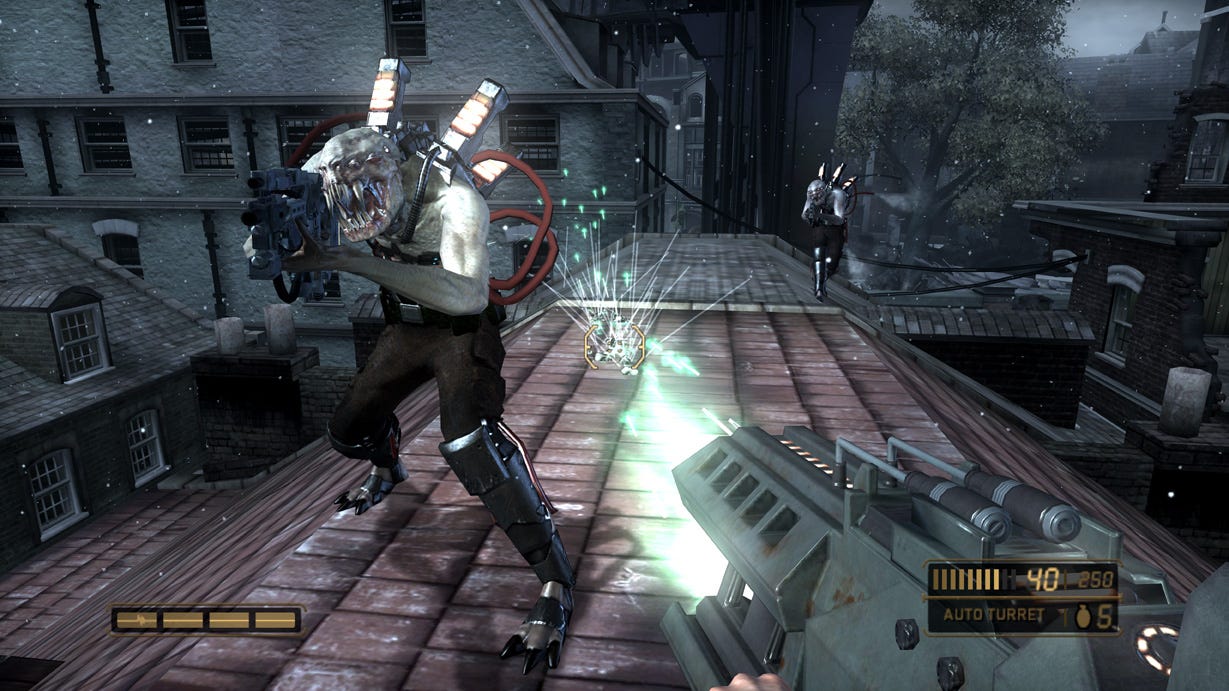
So, the only sliver of hope was that Insomniac could inject some sense of novelty and creativity in how it uses its weapons. Certainly, Ted Price's presentations of the game prior to its launch elsewhere in the world last year focused heavily on things like the hedgehog grenade that spits out individual spines. By pausing the game and panning around the environment, he showed just how cool the effect was, with each spine shooting out at a precise angle and velocity and capable of inflicting their victims with a certain amount of damage depending on where they hit.
Such technical demonstrations looked cool, no question, but the practical difference between this grenade and any other grenade used in an FPS is almost zero. It goes off. You must get out of the way somehow. If you don't, it will dish out a lot of damage. In real-life gameplay terms nothing whatsoever changes.
Other weapons, like the Bullseye, do add something to the gameplay, but it's marketing spin gone mad to suggest that it adds more than an increment of an increment. Being able to 'tag' someone and duck around a corner and giggle as your bullets get drawn to your hapless victim is an undeniably cool moment, but it's a novelty that wears off pretty quickly (besides, you soon realise that it's just as effective to pick them off as you normally would, which is kind of where such innovations fade into the background).