Resident Evil Archives: Resident Evil Zero Review

Flogging a dead house?

Version tested: Wii

Just like the recently released Resident Evil Archives: Resident Evil, this reissue of Resident Evil Zero is a direct port of the GameCube version. Apart from offering support for various Wii control configurations, it's unaltered in any way, and comes presented in its original 4:3 form and all its gameplay quirks. Take it or leave it.

Even when it first emerged in late 2002, Resident Evil Zero was something of an anachronism for the survival-horror genre. Although unquestionably one of the best-looking games in the series (alongside the excellent remake of the original Resident Evil, released earlier that year), even loyal fans of the series were fully aware that the game's design was stuck in the previous generation - hardly surprising once you realise it was originally designed for the Nintendo 64 a few years prior.

Saddled with a woefully unhelpful fixed camera perspective, tank-like controls, and all the usual limited inventory nonsense that came with the territory, Zero was typical example of Capcom's tough love on its loyal fanbase. It had been easier to forgive the remake of Resi 1 for its creaky design, perhaps because of the nostalgia factor and the need to retain the core gameplay, zombie warts and all.

With Zero, though, things were different. This was the first all-new Resident Evil since 2000's Code Veronica, and five iterations on it was harder to forgive the same old issues. The treacle-slow door-opening and stair-climbing animations. The insistence on making you carry around ribbon so you could manually save via typewriter. The ridiculous combat system that had you firing haplessly at enemies you couldn't even see half the time. Actually being able to drop items felt like progress.
1

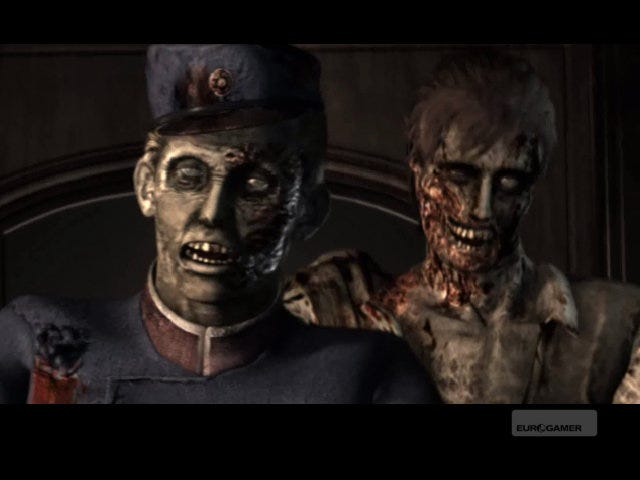
Where's your ticket?

Playing it through again all these years later, most of these daft quirks hit you like zombie morning breath. Even as a fully schooled-up veteran, you'll howl in righteous indignation at your baffling inability to carry more than six items at once, however small and insignificant they may be. You'll want to rip the Wii remote in half when an unexpected death necessitates reloading a save that happened 20 minutes ago.

The blind exasperation the early Resident Evil games provoke from their bloody-minded design is enough to bring on an existential crisis. What would a psychiatrist make of all this blind loyalty to a game series that is basically an exercise in self flagellation? Do you have to be just a tiny bit broken in the head to enjoy a Resident Evil game? Answers on a postcard. Or perhaps series of different-coloured emblems, strategically located around the house, which open the seal on a door to a postcard.
2

He's behind you.

Whatever initial hatred you might be spewing forth at the TV screen though, before long the hammy B-movie plot and cheap scares get their hooks into you. The next thing you know, hours have passed and you're sat, saucer-eyed, splitting undead skulls and doing the tango with yet another giant mutant menace. Take a bite of peach indeed.

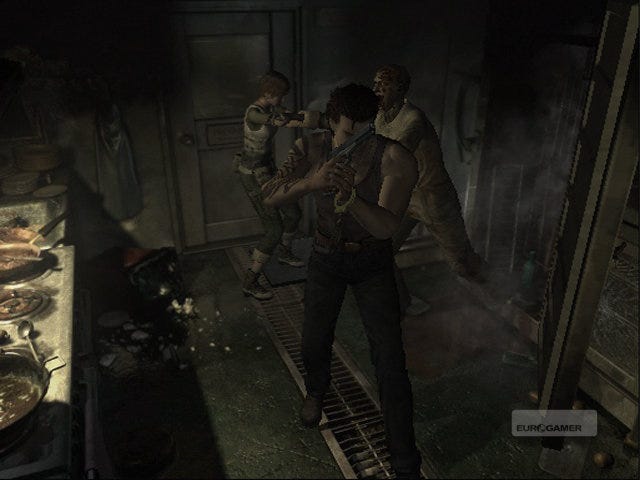
For all its stuck-in-the-past design, Resident Evil Zero does boast some noteworthy innovations - chiefly the 'partner zapping' system, whereby the game allows you to swap between the two main characters on the fly. STARS Bravo Team medic Rebecca Chambers and escaped convict Billy Coen each have their own characteristics: Billy can take more damage and handle heavy objects, while Rebecca can mix herbs and chemicals and crawl into narrow spaces.

Once they stop bitching at each other, getting through the various locations necessitates a degree of enforced co-operation, and a modicum of lateral thought to make the best use of the objects available to you. This unique co-op puzzling system gives Resident Evil Zero a degree of its own charm, somehow managing to make the endless search for glinting items less futile than it might have otherwise been.

Rather like Resident Evil 5, the system also extends to jointly manipulating the environment, passing objects between one another and giving a leg up where necessary. Sometimes the teamwork involves being in two separate parts of the environment at once; one might end up doing most of the puzzle legwork, while the other gets their hands dirty fighting solo. Zapping between partners is a single button press, and on the whole it's an experiment that works well in the confines of the genre.

The co-op combat, mind you, doesn't fare quite as well, and can, at times, be a real bugbear. Not only is the partner AI prone to getting itself into trouble, but it also illogically tends to use up its most powerful weapon when it doesn't need to - not exactly helpful in a game that's as much about prudent inventory management as reslaughtering the undead. Most of the time, in these situations you're better off ordering them to stay out of harm's way in another room and do all the killing yourself, or else you'll end up in a boss fight with nowt but pistol ammo.

Fortunately, the implications of keeping your partner elsewhere are minimal. In most respects, the game plays out just like any other old Resident Evil - albeit now with an extra layer of nannying. The targeting lock-on certainly helps offset the problems associated with off-screen enemies, but it only goes so far towards solving the broader issues.

Like most of the hugely unforgiving early Resident Evil games, this process of learning through bitter experience becomes perversely enjoyable, and helps ratchet up the often unbearable tension that comes from the threat of danger. Never quite knowing what drooling menace is lurking around the corner is one of the key ingredients that keeps us coming back, and in that regard, Zero doesn't disappoint.

3

Billy and Rebecca pause to reflect on the gravity of their error.

As usual, some of the highlights of Zero are its epic boss battles. Released back in the day when Capcom wasn't inclined to offer concessions to a less patient player, these terrifying, beautifully rendered, screen-filling behemoths generally require every ounce of focus and concentration to dispatch - not to mention pre-planning. For those who've recently embraced Demon's Souls, this return to a less forgiving, more challenging set of enemies has a peculiarly satisfying appeal that feels unexpectedly relevant right now.

Perhaps one of the more surprising aspects of Resident Evil Zero is how well the visuals have held up after all these years. By using a combination of highly detailed static backdrops, scripted animation and shadowing, the effect is still glorious. Capcom always did have an eye for atmospheric detail, and this along with the Resident Evil remake represent the pinnacle of that bygone style. But as tension-inducing as the static camera technique was, the practical limitations are simply unforgivable in a game that involves so much shooting. Going back to this old system now merely underlines why games aren't made this way anymore.

In many ways, Resident Evil Zero provides a timely reminder of the things we miss about old style survival-horror. The heavy emphasis on puzzles, slower pace and the harrowing boss encounters make it feel more like a true horror adventure, and once you get to grips with its foibles it becomes strangely satisfying and rewarding. For those who still hanker after that style, and maybe missed out on Zero the first time around, this mid-priced release is a high-class offering that's well worth investigating.

7 / 10

Read the Eurogamer.net scoring policy

Comments (53)

Comments for this article are now closed, but please feel free to continue chatting on the forum!

  • Loading...hold tight!