Prey Review

Giger counter.

Version tested: Xbox 360

Summer's a rotten time for new game releases - we know this, but it's a good thing. It gives us a chance to, you know, go outdoors, see friends and family we've been "too busy" to see, not to mention indulge in an entire month's worth of football and the associated liver failure that goes with it.

But that's gone now, and unless you're indulging in a disgustingly long summer holiday (in which case, congratulations, enjoy it while it lasts) or have a stack of unfinished games to go back to, you're probably wondering whether Prey's good enough to rush out and buy. It's indicative of how quiet it is that so many people seems to be pinning their hopes on it being the next 360 killer app, but, yet again, it's one of those first-person shooters that threatens to do wow us with bold new ideas before treading the same old familiar path that's been etched into the FPS fabric since the late '90s.

To start with, it's promising enough. You assume the role of Tommy, a mid 20s Cherokee Indian who's never really been into all that spiritual mumbo-jumbo that his grandpa spouts. He prefers living a typical 'white man' life as a garage mechanic, and we join him in the toilet of his local diner. Before you ask, no he hasn't murdered anyone, but he soon finds himself making use of his handy wrench once some low down clientèle start disrespecting his barmaid girlfriend, Jen.

Come get some

Just as the fight's getting interesting, all hell breaks loose and Tommy finds himself abducted aboard an alien craft high above Earth's orbit, with his frightened friends and family screaming for help from their Giger-esque prison pods. Our reluctant hero quickly breaks free and finds himself roaming the confines of a biomechanical spaceship on a desperate mission to find his loved ones and to seek vengeance for their 'harvest'. Time to kick ass and chew bubblegum. Oops, wrong game.
1

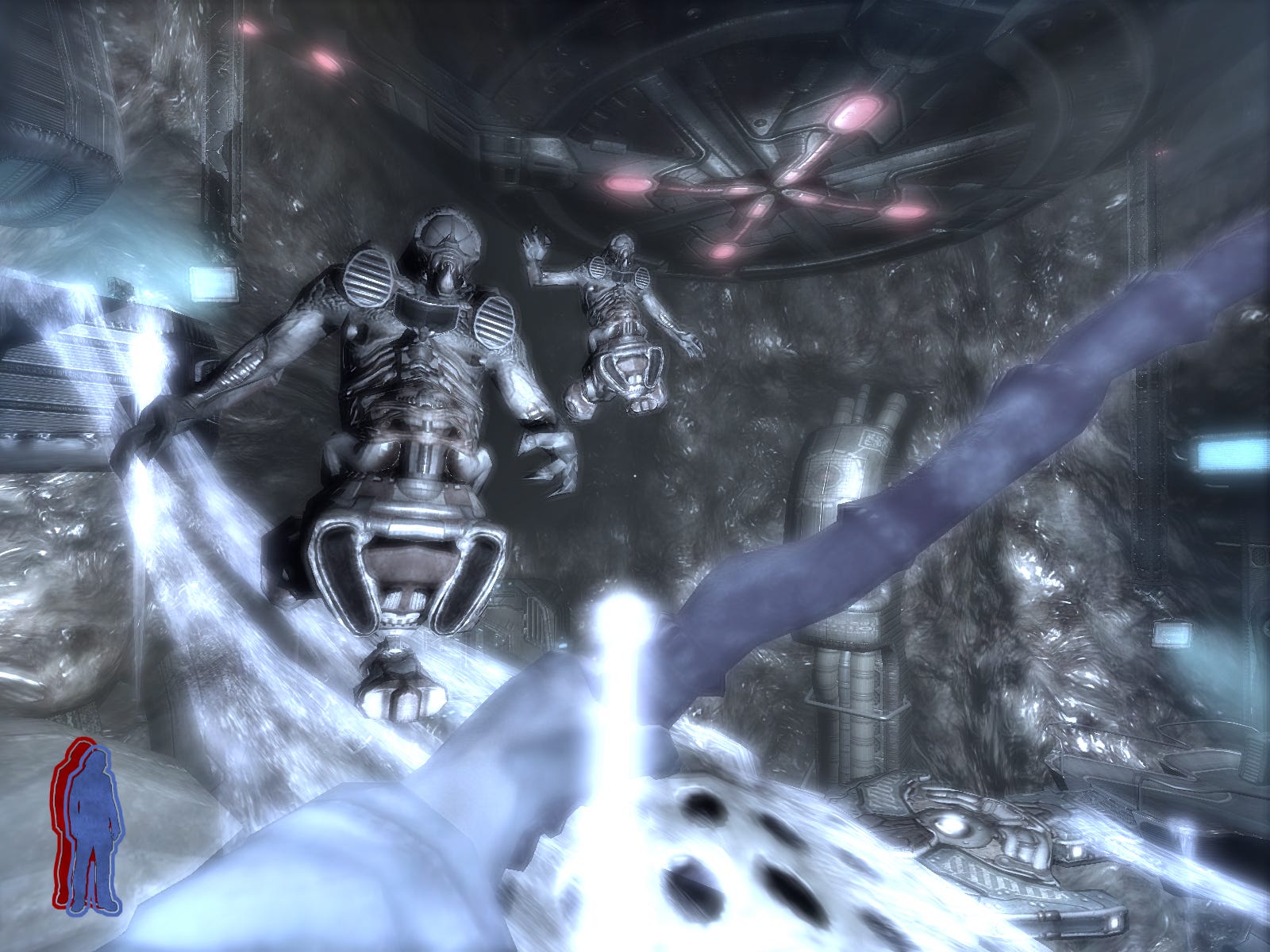
Before long, Tommy's forced to accept the birthright of his long-dormant Cherokee spiritual powers in order to stand a chance of getting even with his deranged abductor. (Big) Chief of these is your ability to leave your body and go on a Spirit Walk - rather like the out-of-body ability present in the under-rated Psi-Ops, hitting Y at any time turns the screen a washed out blue and gives you a chance to wander straight through force fields and sneakily turn them off, not to mention disarm security systems, unlock doors and so on. Occasionally you also get to traverse otherwise impossible gaps via handily placed bridges that are only visible (and unusable) when you Spirit Walk, and you'll become aware of little sun symbols etched in floors and walls to remind you to use it. On the downside, you're limited to firing bows and can't open doors, so it's not all good.

Another rather useful ability is your Death Walk, which kicks in automatically as soon as your mortal body is 'killed'. Rather than be presented with a Game Over screen, you enter the Death World, and have 15 or so seconds in which to shoot red or blue Death Wraiths and steal the energy trapped within them. If you succeed, you're spirited back to the point where you were killed and given the chance to carry on - negating the need to rely on checkpoints or have to replay previously cleared sections. While it's definitely a bit of a cheating fudge to be able to do this (rather than rely on skill, you can just chip your way through via repeated Death Walks) it's preferable to quick-saving every time you turn a corner, or replaying long sections as with many FPSs.

For the majority of the time, though, you'll charge around in human form, blasting a fairly grisly but familiar selection of mutant enemies that appear to have been borrowed from any number of sci-fi shooters down the years. If Duke Nukem, Doom and Unreal all had a hot tub party in 1998, the chances are the monsters that populate Prey's space ship would have looked uncannily familiar to this particular cast list. The truth might not be all that far away from our glib assessment.

Deja Vu
2

But it's not just the inhabitants that feel familiar. The biomechanical constructs that you explore have more than a whiff of games gone by, albeit replete with the kind of gelatinous ooze, moody lighting and steamy ambience that affords next generation FPS engines in 2006. It's a suitably Alien environment and one that looks crisp and striking on an HDTV, but given the number of Giger-inspired games over the years it's not one that feels particularly strange, foreboding or unwelcoming. Heck, we don't feel at home in a sci-fi flavoured FPS if we're not clanking over metallic walkways while slick, spongy entrails snake their way through the gloom. Originality? Nil points.

To be entirely fair to Human Head and 3D Realms, the box marked 'new ideas' was largely reserved for how the levels themselves were constructed - and it's here that Prey does things a little differently from the FPS herd. Come see.

For example, Prey contrives to complicate otherwise standard level design via its occasional use of blue gravity switches that flip levels through 90 or 180 degrees if you shoot them - suddenly giving Tommy the ability to negotiate otherwise impassable obstacles and reach previously off-limits areas that, in turn, might grant you access to switches that allow you to make progress elsewhere.

Spacious

This 'levels-as-puzzles' design philosophy becomes more prevalent as you progress, with entire areas of the game constructed around manipulating the environment or navigating it in unusual ways. For example, the ability to walk up certain designated chevron-marked surfaces evoked memories of the long-forgotten platform title Dr Muto (where you could transform into a spider and walk up specific surfaces to access otherwise unreachable areas), where the level design is, literally, turned on its head, forcing you to think about your destination in a completely different way. Much like the gravity switches, this concept gives each level a much more 3D feel, with enemies appearing in disorientatingly unexpected places (such as what appears to be the ceiling, but is actually the floor, etc.) and challenging you in ways we're not used to in first-person shooters.

And yet it's precisely here that being 'different' doesn't necessarily equate to 'better'. For the majority of the time, when Prey switches to 'contrived puzzle mode' it treads a fine line between being thought-provoking and just plain annoying at how prescribed such segments are. In what stacks up to being a pretty short 8-10 hour game, it's surprising how many times you end up snagged by one of the environmental puzzles. Surprising, because none of them are that hard in reality yet still have the capacity to become really annoying when you've spent ages trawling round and round searching for something that's been staring you in the face all along.

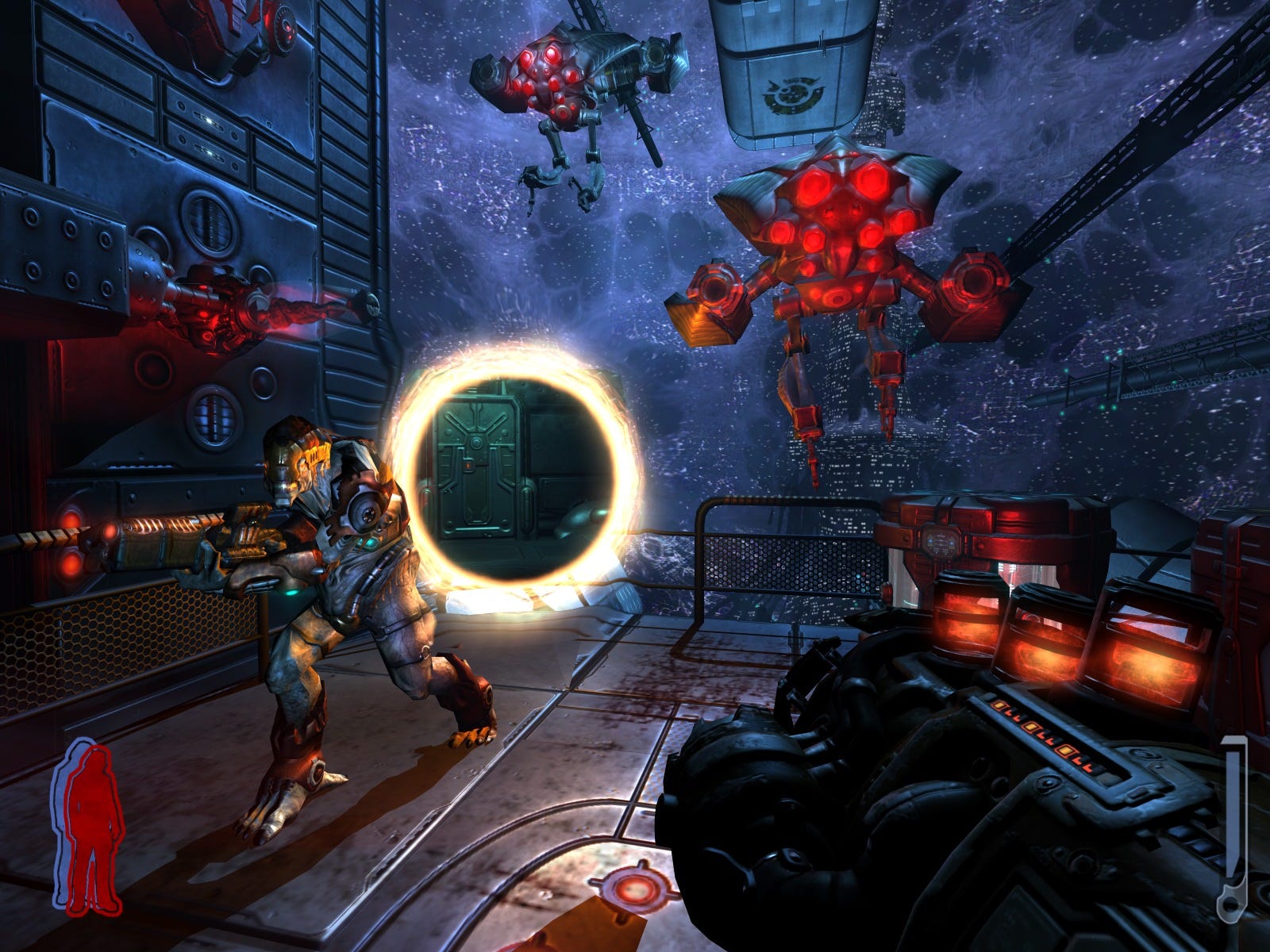
Meanwhile, the much-vaunted Portal technology is little more than a cunning marketing buzzword that sounds more profound and interesting than it really is. In truth, they mainly serve the purpose of being doors to a different part of a level, and as a result make very little difference to the gameplay in any meaningful sense. Sure, they look very cool - being able to peer into another location before you're there is a neat trick, and the ability to duck in and out of portals seamlessly between two locations with no loading pauses is a lovely sight to behold - but once you've done it a few times it's fundamentally just another way of getting around. The enemies you face also use their own portals, but only in the sense that they're ostensibly used as a cunning way of justifying why they are able to spawn right before your eyes. If enemies could chase you between portals, or you could use theirs, that would make more sense and be a cunning use of the tech. As things stand, it's just a means of making the game look cooler than it would otherwise.

Predictable

3

But all of this might be forgivable if the core combat was so intense that your memories of the game were littered with wide-eyed moments of awe. The truth is slightly more mundane than that, sadly, thanks to an arsenal of too-powerful weaponry and huge, predictable, lumbering foes who make it a perfunctory exercise to blast them to mincemeat within seconds of their appearance (including the various anticlimactic boss encounters). With the most casual use of circle-strafe and the abundance of available cover you'll easily avoid most enemy attacks and also get a surprisingly large window of opportunity to strike back. It's simple enough to keep backing away from chasing enemies, and it's no problem to avoid incoming rocket fire. And any game that rarely challenges you to take on more than two enemies at a time is just asking to be kicked.

Meanwhile, although just seven weapons make it into the game they're all a bit too powerful for their own good (apart from the entirely redundant wrench) and ammo is always plentiful. With skill, even the first proper projectile weapon (the relatively underpowered Hunter Rifle) seems capable of taking down most of the enemies you face, and without fail, by the time you do face anyone of any power, you'll be supremely well stocked with a brutally powerful arsenal to take care of them very quickly. Failing that, you can easily fall back on the cheatery of repeated regenerative Death Walks. Without exception, even average players will breeze through Prey with barely a pause for breath - in fact, you can expect to polish it off inside a day if you're determined.

In technical terms, Prey rarely rises above 'satisfactory', and looks every inch the medium range PC port that it is. The interior environments of the sprawling spaceship certainly appear detailed and impressive at first glance, but quickly get samey and - rather like Doom 3 - aren't especially interactive. There's almost nothing in the way of destructible scenery, physics barely even figures in the entire game and the majority of it takes place in small, enclosed, darkened environments that make it feel just like any other corridor-based shooter you care to mention. Fair enough, the occasional flying sortie around the more cavernous parts of the ship adds a fleeting sliver of welcome variety, but it's frankly not enough to make you want to tell all your friends that you've seen the future of the genre.

Prey tell

4

And apart from the amusing licensed jukebox inclusions at the very beginning of the game, the soundtrack is entirely forgettable watery string-based sci-fi fodder that noodles just outside your consciousness whenever the action amps up. Depressingly, the voice acting is shockingly run-of-the-mill amateur dramatics fare which adds little to any attempt to build the atmosphere. We wish we could be kinder to a game we've been really looking forward to for ages, but the closer you examine Prey, the more disappointing it gets.

At the end of Prey you'll probably just feel a little blank. Its tendency to lapse into generic blandness might be acceptable on boring days in July with no other games to focus on, but it'd have to a fairly rainy one at that. Even with our feel-good glasses on it feels like we're damning Prey with faint praise to write a sentence that ends with "reasonably entertaining few hours of gunplay that never really stretches you". More likely, you'll mutter to your mates in the beer garden that you're glad that you got through all those slightly irritating, rarely satisfying puzzling sections without having to resort to a guide, and feign surprise as the subject gets changed in an instant. Back home, you'll wonder why anyone made a fuss about the storyline in the first place, wonder what 3D Realms really think about it, and sit the summer months out, waiting patiently for the next developer to do something truly surprising in the FPS genre.

Perhaps inevitably - although maybe not intentionally - Prey struggles to break free of its late '90s genesis, and essentially what we're left with is a game whose good intentions simply don't translate into wide-eyed entertainment. With uninspiring and basic deathmatch multiplayer options failing to rescue the package, it looks like it's going to be another long hot summer for FPS devotees.

7 / 10

Read the Eurogamer.net scoring policy

Comments (94)

Comments for this article are now closed, but please feel free to continue chatting on the forum!

  • Loading...hold tight!