Geometry Wars: Galaxies
The handheld half of Kuju's shape-shooter.

I write with my left hand. Not that I ever write, really, apart from scrawling names on padded envelopes containing Christmas presents that I was too busy or drunk to send. It's one of the poetically enjoyable things about The Future; writing is only necessary when I let things slip into The Past. Anyway, writing with my left hand singled me out for abuse from craggy old Mrs. Alexander when I was 10, so I hardly miss it, or being called "Smudgie", but it wasn't until I picked up the DS version of Geometry Wars: Galaxies that the shame and humiliation of my genetic predisposition toward being a wrongbrain redoubled its attack on my aspirations. Basically, I cannot play this game with the stylus because my remaining right hand is not programmed to operate a spaceship's directional movement.
In theory, and according to people on the Internet even in practice, Kuju's stylus-and-directional-pad solution to moving a spaceship around the screen and firing in another direction works brilliantly. There's a learning curve for people brought up on shoot-'em-ups that use a pair of analog sticks, but that's to be expected - buying a DS version of a two-stick shooter and complaining that it's different would be like hauling your skis from the snow to a lake and then complaining that you can't throw snowballs or dress up like a tea cosy and that it's wet. You're wet.
So, your ship appears in the top screen's gamespace, and, while using the d-pad (righties) or face buttons (lefties) to manoeuvre it, your writing hand prods or scrubs the stylus around a ship-shaped centrepiece on the touch-screen to send bullets in the direction of your choosing. Tap left of the ship and it fires left. Etc. The lack of tactile feedback about stylus position from the touch-screen surface can lead to minor mishaps - as it was all the way back with Super Mario 64 DS, you may remember - but as with much in life this can be overcome by behaving more assertively.
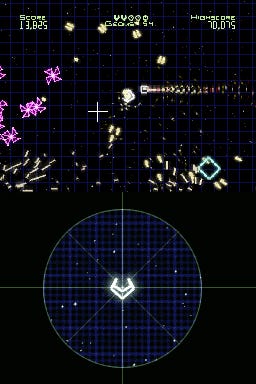
What can't be overcome - and I've tried so hard - is the left-hander problem of reprogramming your brain to point accurately and comfortably with the right hand. Think about all the games you've played, lefties; your left thumb has done the movement, hasn't it? You will presently discover that your right thumb is a poor substitute. But it will have to do, because trying to use the stylus with the right hand is even less effective. In other words, I am fundamentally flawed. Woe is me. Except, good news! Because you can just control the game using the d-pad for movement and the face buttons for firing. Phew. This renders most of the text so far redundant, but given that probably you're reading this at work I suppose it's a sensation into which you've learned to slip comfortably and so will continue.
However you choose to play Geometry Wars: Galaxies, it will be time that you reflect on fondly. Built upon the same premise as the Xbox Live Arcade game that won it most attention (and indeed the unlockable arcade extra bundled with PGR2), Galaxies involves shooting little geometric shapes as they zoom around your little C-shaped spacecraft using the afore-thoroughly-mentioned control scheme. If things get hectic, you can deploy a smartbomb by pressing one of the shoulder buttons, which blows everything up within a certain radius. You only get a few of those, and a few lives, but the longer you survive and the more damage you do, the more replacements you're awarded. On 360 there was a beautiful, undulating background that helped put on an amazing display for onlookers; the DS game understandably lacks that, but it's graphically consistent with its maker and fairly handsome in its own way.
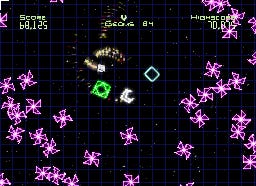
However, where Galaxies deviates most from Geometry Wars: Retro Evolved - which is actually included here too, although we'll come to that in a bit - is that it is no longer one big last-as-long-as-you-can game designed to be played over and over again until your high score is higher than your friend's. Instead, a single-player Galaxies mode offers 60 varyingly distinct miniature scenarios where conditions are altered. For a start, you're forever collecting "geoms" - little enemy drops that add up to a heightened multiplier (up to 150x) and act as currency for unlocking new star systems on the Galaxies mode map, and for other things, the shape of the play area may be different, there may be a swirling permanent vortex in the centre that affects everything's gravity, only certain types of enemy may spawn, or the game may deploy some of the new enemies it has invented. Each level has its own identity.
This is all jolly good. Geometry Wars was lovely anyway for a lot of reasons, but one of the most powerful ones was the quality of its enemies - little shapes whose particular movement and attack patterns, though simple, quickly transformed each encounter into an anthropomorphic tale where the poor, stupid little diamonds were sent out to be slaughtered by the snarling squares-with-Xs-in that spit swirling mini-enemy venom even in death. For me anyway. You may just have admired the enormous variety their collaborative deployments produced and how much you had to learn to keep staying alive. So, having more types of enemies: good.