As Uncle Ben once said, with great power comes great responsibility. However, according to videogames, with great power comes 10 minutes of action and then some sort of flashback or plot device that takes the great power away again, followed by 10 hours of getting it back. Prototype is that sort of game.
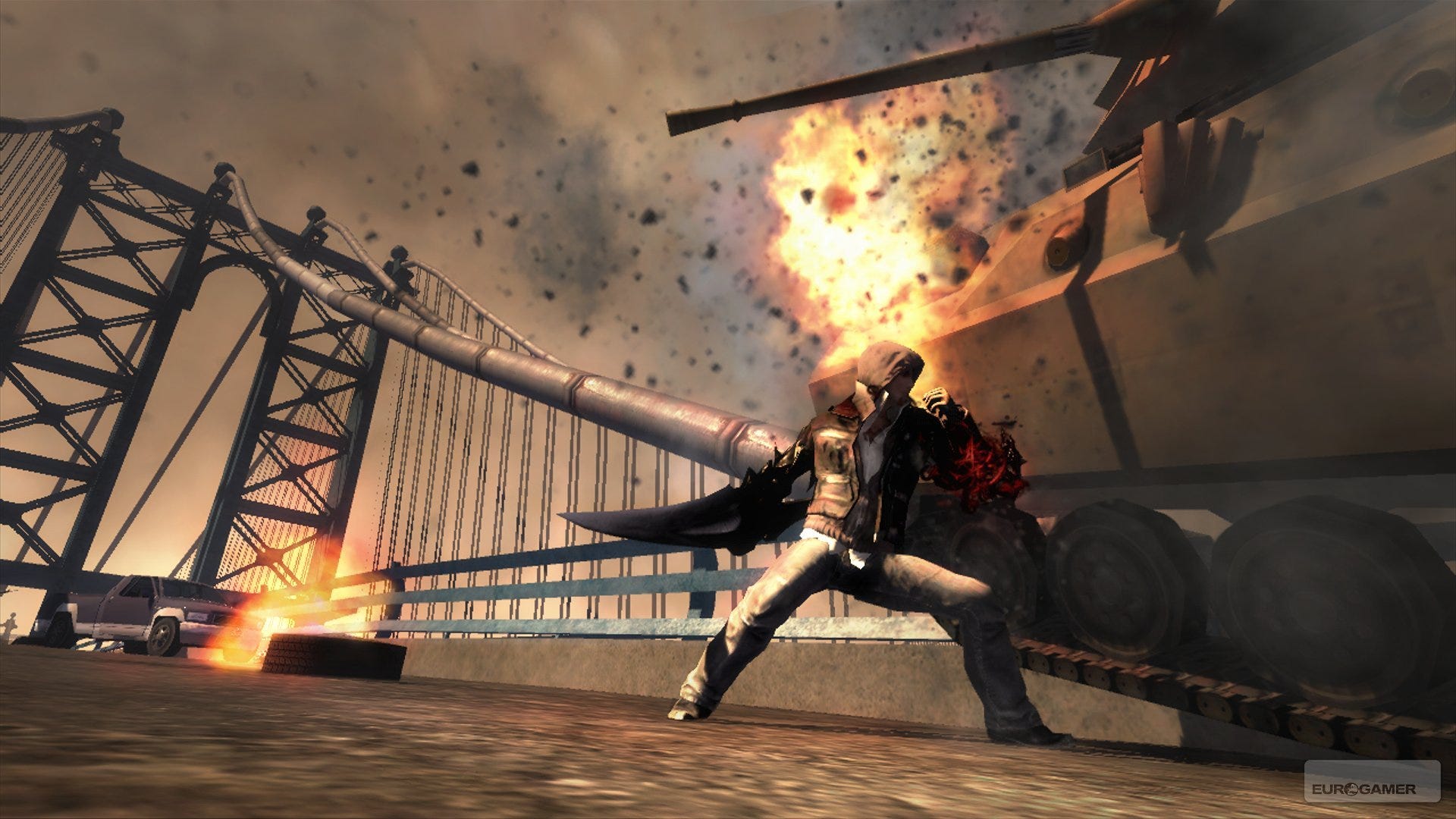
But hey, those 10 minutes are mental. Hopping into the trainers, jeans and hoodie/leathers ensemble of a grumpy-looking Alex Mercer, you set about ripping through Manhattan, running up sheer skyscrapers to launch into tank-destroying elbow slams, throwing yellow cabs into helicopters, and ultimately taking out an entire city block by crouching into a sort of organic explosion, which pierces just about everything in the vicinity with black, otherworldly tendrils of death.
And hey again, even without your powers, you're still powerful, and by the time you reach the same stage of Mercer's evolution a couple of game-weeks later, you will not only feel like you've earned it, but you will have a greater understanding of every little thing, forged through exciting, brutal experiences that always emphasise your ridiculous, superheroic abilities.
Admittedly though, you still won't behave very responsibly, and fans of serious hero fiction will find Prototype a bit of a turn-off. You're infected with some sort of virus, which allows you to grow spikes and other things out of your arm, withstand enormous damage, and do superhuman things, and the story of why, told through snatches of video obtained by absorbing key characters (basically, weakening and eating them) and in moody cut-scenes, is basic and yet difficult to follow.
But the greater shame is it never accounts for the fact that your primary source of health is eating civilians, who you also run over in tanks, and murder by running through them with your shield out or armour on. It's not really collateral damage: you're on a self-serving quest to find out where you came from, and nobody's getting in the way, even if they're terrified and clearly not infected.
The screenshots disguise the sloppy texture work and rubbish draw distance, but Prototype does at least keep the frame-rate up and pack a lot of people in.
Still, ignore that and there are a lot of infected monsters and fascistic soldiers to vanquish in enterprising style. Although an openworld game with Ang Lee's Incredible Hulk-style superjumps and the requisite hover and air dash moves to increase your range, Prototype's primarily a brawler, offering an increasingly ferocious range of offensive mutations to morph between. There's also an experience-points currency used to unlock a tsunami of overlapping powers covering combat, infiltration and manoeuvrability, which splashes across the upgrade menus as though someone's popped Marvel Comics in a blender with some trenchcoats and Marmite and forgot to put the top on.
Targeting enemies with the left trigger, every button on the pad has to sing for its supper to allow for regular and heavy attacks, area-effect attacks, uppercuts, grabs, slams, throws, flying kicks, stealth kills, consuming enemies, and ultimately the aptly named slow-motion Devastators, which you can access at the peak of your powers or with your last sliver of health. And that's before you consider more menial things like dashes, sprinting, switching to a disguise for evasion (the last body you consumed, cunningly), and using the radial menu to switch buffs and weapon-sets.
Developer Radical is also happy to let you play with the military hardware sent after you, if you can overcome a storm of lead and missiles to obtain it. By consuming certain enemies (usually highlighted in a story mission), you gain the ability to hijack APCs, tanks, and eventually helicopters, which have a Grand Theft Auto-style thrill to them after so many hours running, jumping and hovering to get around.
Mission design isn't very open-ended, usually boiling down to doing something violently or stealthily, but with such a vast array of attacking options you often have the luxury of trying something different. There are certain missions that follow strict prescriptions - fly here, chase this guy, consume these fellas, etc. - but many throw you into combat against a combination of foes, plucked from the menagerie of infected enemies and the bottomless garrisons of the oppressive army, and use positional and locational variation to force you to experiment. If you find yourself bouncing off, it probably means it's time to explore those upgrade menus again.
The niggling thing about this, however, is that the reason you can't slip into comfortable rhythms isn't that the game is outthinking you; it's because it's out-spamming you, and the recovery systems at your disposal are puny next to your offensive powers. As soon as the military is onto you, you're in a blizzard of bullets, supported by a monsoon of rockets from helicopters, tanks and rooftop rocket launchers, while the tougher infected enemies have a habit of pouncing and going into unblockable frenzies once you've had a few pops.
So you're going to take damage, and while there are upgrades for health regeneration speed, maximum health and aerial recovery to unlock, they are all ineffective against the relentless onslaught of your adversaries, who are increasingly difficult to evade. In theory you can alleviate some of the difficulty by targeting soldiers who are calling in strike teams (chopper and tank units that hound you across the city), but getting to them in time is almost impossible because it involves navigating into the maelstrom. Snacking on human health-boxes is rarely as simple as all that either - they may be everywhere, but pausing to eat one generally earns you a rocket in the face.
Of course, with an open-ended upgrade system, difficulty spikes are inevitable, and it often pays to calm down and scrounge your own new resources to fight back. But certain key upgrades are withheld - bound to particular narrative events - while the boss fights scattered throughout the game are wars of attrition. One towards the end, in Times Square, is just appalling - nearly half an hour of slog against a Who's Who of what not to program: flying blobs that stun, respawning tentacles, unpredictable wave attacks, and inconsistent damage conditions among them.
You can at least gain the vital experience points you need to bulk up by taking on side missions, but these are also rather forgettable, reflecting a rather dull Manhattan in general. Radical includes Crackdown-style orbs, but the poor draw distance means you stumble onto them rather than really discovering them, and while people with "Web of Intrigue" icons can be consumed for another little snatch of video, the snatches of video aren't really very interesting. Mercer's linked to the virus, which is linked to a town in Idaho and a dodgy military unit. We get it.
Prototype isn't really a game of exploration though. It's also less visually striking and varied than last month's inFamous, and less stylish than Crackdown. But, again, neither is really a criticism. Prototype is a game of riotous, gore-splattering ultraviolence. That's all it wants to be, and in many respects it does a solid, and often spectacular job. The victims may be plot, atmosphere and the difficulty curve, but then great power always comes at a cost.
7 / 10
