Mass Effect Review

Pause for effect.

Version tested: PC

Given that Kristan wrote a three-page review of the Xbox 360 version back in November, and the PC version is basically identical, I'm left with a whole review to dwell on the important questions about Mass Effect.

For instance, why did BioWare model its adorably rubbish Mako ground-attack truck on early-eighties toy Big Trak: the Fully Programmable Electronic Vehicle? Almost everything about Mass Effect can be explained with a little thought (Why is the combat a bit shonky? They haven't had a crack at an action game since MDK2. Why is it so talky? Well, it's a BioWare game, innit. Why do you have to buy stuff from the bloke in the basement of your ship rather than just court-martialling the little dipstick? Because BioWare cannot resist the tropes of the RPG genre). But the Big Trak homage is completely inexplicable. Perhaps Big Trak is worshipped as a totemic creature in Edmonton? Perhaps Greg and Ray were always denied one as kids and decided Mass Effect would be their late Christmas? Perhaps they were aiming for a Halo Warthog clone and just missed?

Thankfully the origins of Mako are only a peripheral issue when considering this epic space-action RPG.

The easiest way to grasp Mass Effect is to imagine Knights of the Old Republic. Strip out the Star Wars licence and replace it with some serious-but-well-crafted original fiction, then remove all the pause-time strategy-style comba. Replace it with competent but unspectacular third-person shooter tactical action, complete with cover system and team-mate ordering. The RPG skills influence the game, in terms of special powers and improved shooting abilities. So, like Deus Ex, the amount your sniper-sight wobbles is based upon your character's ability and the quality of your weapon. And, like Deus Ex, its worth is less in the individual action sequences, and more in the synergy between the RPG development, the action and the frame of a developing story. The results are splendid. Kristan gave it a strong eight, and that's what I'd give it too, so if you're one of those sort of people you can go and get back to comparing PS3 and Xbox 360 screenshots for errant pixels.
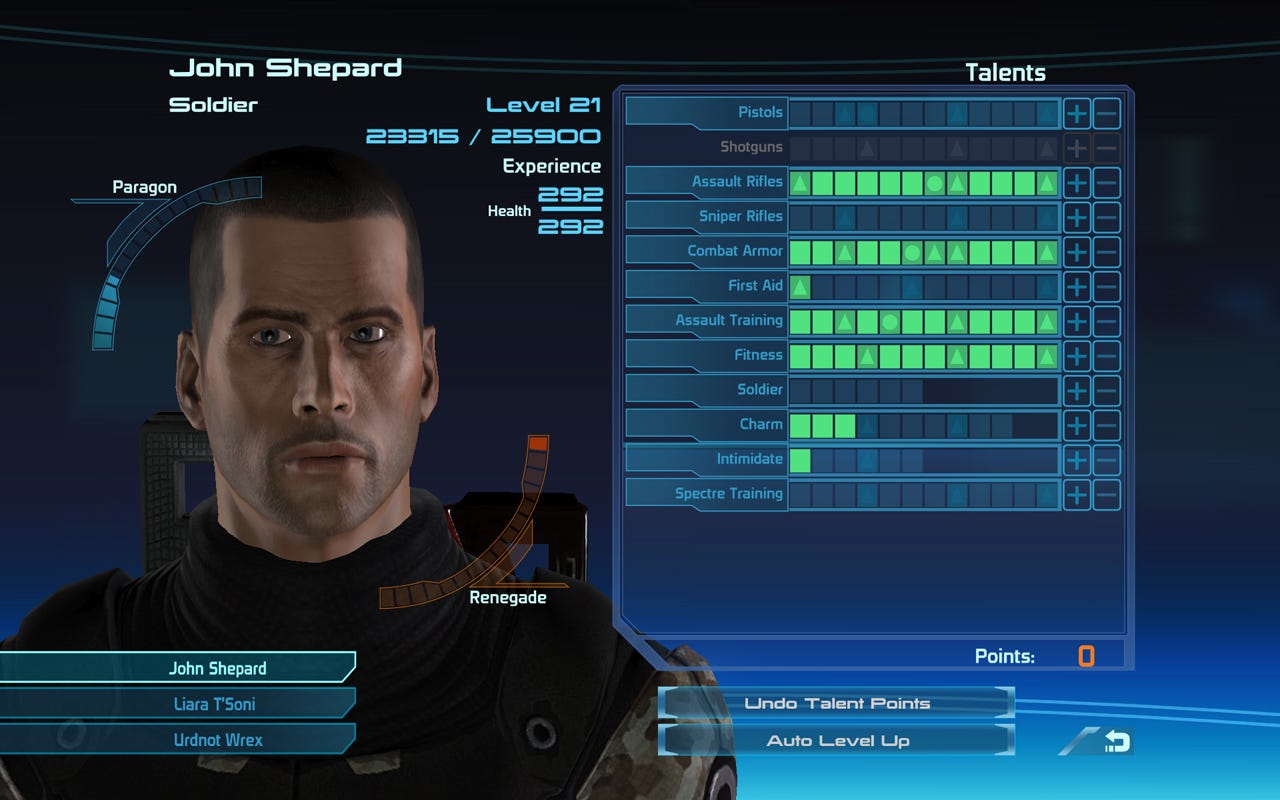
1

I do like those Assault Rifles, but I hate Sniper Rifles. They smell bad.

The PC version is, as promised, definitely a PC version; a conversion more than a port. Admittedly, that's mainly because of how low the standard for "conversion" has sunk, but there's nothing particularly grating, like the appearance of Xbox controllers in the tutorial sequence. The biggest change is a mechanical one - the mouse gives a lot more flexibility both in calling up the variety of powers your Biotic and Tech characters can perform (Biotic = Mage, Tech = er, another sort of Mage, basically), as well as the simplification of aiming (Mass Effect, with the deliberately-imperfect aiming, sidesteps the PC's flaw of superhuman, impossible accuracy). Hotkeys can summon up your characters' abilities. Also, you're able to swap seamlessly between all of your weapons. Oh - and you can order your team-mates to go forward and take up their own positions. These things are all are integrated so well that I was surprised when I discovered they weren't in the original 360 version.

In terms of stuff which doesn't actually affect the game that much, there's the graphical upgrade - the game remains gorgeous, in short - and a new hacking mini-game. Instead of the Simon-says of the original, it's a sequence of rotating disks you have to skip through. Think concentric Frogger. It's a mini-game and it manages to reach the heights of a mini-game. It does the job. The job being a mini-game. Yes. A mini-game.

But the problems come around the edge of the system, where things become a little clunkier. While the shooting is improved, despite the Mako handling being apparently tweaked, it's still bloody rubbish. Maybe a Big Trak would have been more controllable. Similarly, the inventory management. You're only able to carry 150 items, after which you have to reduce them to Omni-Gel (which sounds a little unsavoury but is a generalised currency which powers a load of nano-tech abilities, like the hacking bypass). Problem being, you have to do them one by one. Having to stop after a few fights to clear a bit more space in a select-then-confirm way is just a tad tedious when the PC could do a drag-and-drop or multi-select mechanism easily enough.

And since the What Is New is out the way, this review can take a sharp turn to the left.

Despite everything I said earlier about KOTOR and Deus Ex and Gears of War (except I only thought that and didn't write it, as an Easter Egg for Eurogamer's telepathic readers), the game I found myself most wanting to compare Mass Effect to was none other than Shogun: Total War.

No, bear with me.

One of the core pieces of genius in Creative Assembly's design was the integration of the tactical battles and macro-scale strategic nation management. Rather than being lead by your nose through a pre-set campaign story, the battles ended up being more meaningful, more dramatic due to your knowing what they mean on the larger scale. So defending this ford isn't important because a cut-scene told you so; it's important because you know that it's the last point you can stop defenders before they reach your capital. It's using another genre (the turn-based strategy game) to elevate another (the real-time strategy game) without ever truly integrating the pair. They run in parallel with one another, with information passing between the two to enhance the experience of both.

2

Dating aliens proves tricky. Don't hold their hand but do bring flowers.

And, basically, that's what Mass Effect does. While the strategy level (the RPG exploring/talking stuff) is clearly more linear than Total War, its point is to provide meaning and elevate the action sections. Kristan got quite a few Mass Effect fans' backs up by reviewing it primarily as a shooter... but after going through the game, I can see his point. That is, there's masses of stuff which isn't actually the action part - but, in terms of the actual progress of the game, it's the action which is paramount and everything else supports and enhances (or, occasionally undermines) that. Those hours of running around space-stations and chatting are to make the actual fight against the enemies dramatic. That you're defending civilisation is a hell of a lot more meaningful when you've seen the civilisation you're defending - compare and contrast to Halo 3, where there's none of that emotional punch. At its best, Mass Effect isn't about popularising the RPG - it's about re-imagining the shooter. It almost doesn't matter that its mechanics aren't quite as pure and polished as its direct competitors - everything around it makes it matter all the more.

It helps that BioWare proves itself deeply talented as a videogame storyteller. The writing is exemplary, mostly highly naturalistic with no desire to caper for your amusement. Making a science fiction epic takes a degree of balls, and BioWare has balls. Doubly so when it's created a universe from a whole cloth, with multiple species with their own traits, fairly sophisticated politics and a cast of memorable - but not cartoonish - freaks and heroes. The story managed a couple of real emotional gut-punches, which I clearly won't spoil. Hell, even the sex-scenes aren't completely embarrassing in context. In fact, the only bit I'd actually actively critique would be a couple of jingoistic excesses towards the close. But that's another piece, y'know? [We'll see. - Ed]

All this is supported by the graphics engine, which manages to absolutely steal the facial-acting-in-an-RPG crown from Vampire: Bloodlines. In the masses of conversation, characters just act convincingly. I found myself repeatedly enchanted by my lead character's every expression - how alternately charismatic, wise and sly she seemed. I could easily imagine her on a film poster... and when I remembered I created her from scratch at the start the actual achievement of the BioWare art people becomes all the more impressive.

There are some problems with the graphics - frame-rate is hardly stable, for example. But the bigger problem seems that by concentrating so much on memorable individuals, you lose the ability to convey a crowd. Even the biggest space stations are virtually empty of human (or alien) life. While this was just about acceptable in KOTOR, as a next generation game, especially post Assassin's Creed, it starts hurting its atmosphere - and when that's a primary thing the game runs on, that's a problem.

It's also problematic when BioWare chooses not to question those aforementioned tropes of the RPG. It tries to justify why a guy in your spaceship basement sells you weapons, but it's just a little grating, and you wonder why it didn't try a different approach. In some areas Mass Effect captures being a starship captain brilliantly - the writing in characters, for example, with obvious respect, or at least subservience. However, to chat to your various staff members you have to trudge around the ship like it's KOTOR. You're the captain! If I want to talk to someone, they can come to me and like it.

And if that strikes you as nit-picking, I suspect RPG-heads are going to throwing swords of griping +4 when I note that the sub-quest system seems particularly ill-fitting here. It's always been an issue in an RPG when you throw a serious threat into the plot, and then the player is free to wander off before casually get around to saving the world. Even if there's no time limit, if you don't feel the need to go and try and stop the baddy immediately, your game has fundamentally failed to immerse. To that end, Mass Effect succeeds, as I went through the main plot in less than twenty hours, with only a minimum of side-tracking, but there's a lot of content I didn't look at. If you're offering a galaxy to explore, you should try and create a plot which at least leaves room to explore. Mass Effect serves two masters, and it never quite works.

3

I like destroying Geth with the power of love that fires from my crotch. And in the game.

That's a problem that faces most RPGs, but it's particularly notable in Mass Effect for two reasons. Firstly, because the FPS element shines a spotlight on them, because those conventions tend to be so driven. Secondly, because in so many areas Mass Effect absolutely succeeds, and discovering BioWare hasn't questioned its core assumptions is a little disappointing.

But you also suspect BioWare's on the right track, and until it pulls it off - and the initial noises about the sequel seem promising - Mass Effect offers us a singular universe of excitement and drama to lose ourselves in. It's an incredibly ballsy game, not afraid to take on any of its competitors, in any field. Story-lead games? Shooters? Even genuine, non-game populist sci-fi? Mass Effect has a try at them all, and leaves more wounds in them than they leave in it, before blasting off into a space all of its own.

8 / 10

Read the Eurogamer.net scoring policy

Comments (128)

Comments for this article are now closed, but please feel free to continue chatting on the forum!

  • Loading...hold tight!