MadWorld
Worn out faces.

Jack has just torn the head clean off a man dressed as a minotaur, when yet another steroid-pumped goon wanders into shot. Perfect timing! In one graceful movement I slam the beast's still-warm horned skull down onto the unfortunate man's shoulders. It connects with such force that, as I step back to admire my handiwork, it remains lodged in place. If Xzibit were here perhaps he'd quip: "Yo Dawg! We heard you like head so we put a new head in your head." Instead, as MadWorld's two commentators come from the Wrestlemania tradition of television commentary, we're treated to the cruder line: "You've got one minute left: which is precisely the amount of time your wife spent f***ing you on your honeymoon."
Next, I grab a signpost and spear the brute's second-hand face with it. As he stumbles about, understandably disorientated from his improbable wounds, I rev the chainsaw attachment on Jack's right arm and, encouraged by the FINISHER! icon flashing on screen, slice him vertically in two with a deft flick of the Wiimote. His torso flaps open like a peeled banana as a crimson puddle bubbles about my feet. Jack's ratings soar.
Gamers who have been clamouring for adult content for Nintendo's Wii are to be sorely disappointed. MadWorld is as juvenile a videogame as Barbie's Horse Adventures. Of course, juvenile doesn't necessarily mean that it's in any way suitable for children. Quite the opposite, in fact. After all, Barbie never got to dip her pony into a flaming oil drum before ramming it onto a spiked wall. Eyes first. Repeatedly.
As manna for Daily Mail Outrage, MadWorld is the choicest morsel yet delivered by gaming in 2009. Of course, the idiosyncratic black and white visuals, interrupted only by the odd splash of yellow comic book onomatopoeia and spattering of bright red blood, bespeak the game's graphical pedigree. This is what Clover Studios did next, the latest addition to Atsushi Inaba's stylised family of games that includes Viewtiful Joe, Okami and Godhand.
But on the other side of MadWorld's family tree sit Manhunt and Smash TV. This is snuff videogaming, the latest in a short but controversial line of games about a character killing other characters in gruesome ways for the viewing pleasure of an in-game television audience. This is a supremely violent videogame but it's the kind of violence in which you catapult a zombie into the light side of the moon, or in which a sumo wrestler leaps up to grab a helicopter from the sky before trying to impale you on its blades: more Powerpuff Girls than sick filth.
Jack, MadWorld's gravel-voiced antihero, is the latest star of Death Watch, a television show filmed entirely by the CCTV cameras of Jefferson Island. This totalitarian future city has been cordoned off and turned into a bloody television set, its residents fighting each other to death for viewing figure glory. Jack ostensibly works for a TV producer, Agent XIII, chasing a grim career trajectory by touring the various areas of the city, facing off against the other show's stars (the game's bosses) and climbing the rankings. But writer Yasumi Matsuno (best known for his games Final Fantasy Tactics and Vagrant Story) builds upon this vanilla premise in interesting ways and it's not long before the story becomes a compelling proposition.
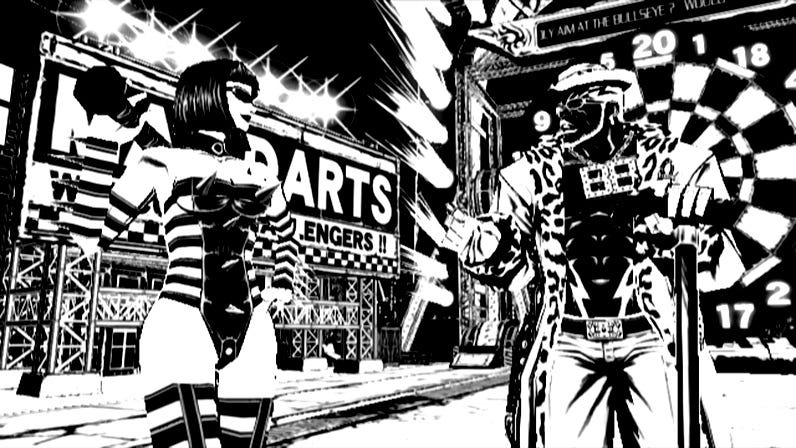
Even if it doesn't grab you, the story provides a solid and traditional structure for the game, each district in the city offering up three stages, each with its own rival TV character to defeat. In every level you have to pass a specified score threshold before the boss is drawn out, a target which can be met through a variety of different point-collecting. Firstly, there are the grunts that roam each area. You can take them down with a few punches to the head or, if you prefer, by slicing at them with your chainsaw arm. However, to score the high points you'll need to get more creative, linking together attacks before you finally snuff them out.
This is achieved by making use of the various items and safety hazards littered about each level. For example, you might pull a tyre over an enemy's torso, trapping his arms, before slicing at him with twin blades to chop those arms off. Then you can grab what's left of his body and throw him into a trash cart, the force of which causes the lid to slam down on his waist, chopping him in half. Each step in the sequence acts as a multiplier, and the more steps of violence you can introduce, the higher the points you'll net for the kill.
The complex controls, which make use of every button on the Wiimote and nunchuk, are in practice intuitive. The A button is used to throw punches and grab enemies while special attacks are triggered by moving the controllers in motions that mimic the on-screen violence. As such you'll be swinging the Wiimote around your head to throw enemies into jet engines, or pulling the Wiimote and nunchuk apart from one another to break a grunt's neck. There's a lot going on but the action is never anything but instinctive.